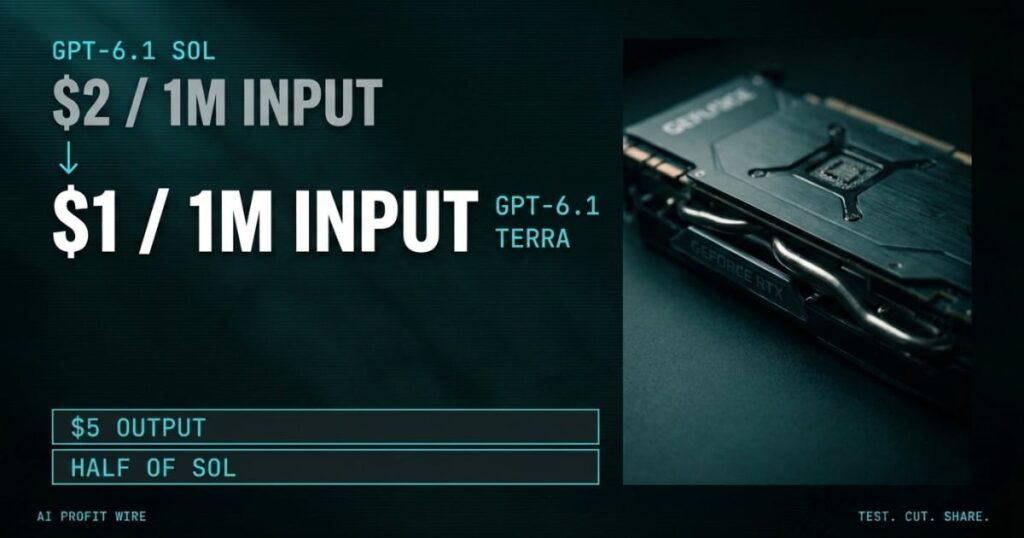
Provides a cheaper API option for automating repetitive computer tasks and interpreting technical documents.
GPT-6.1 Terra is a solid midrange release rather than a landmark, and the price is the story. Standard API pricing is $1 per million input tokens, $0.05 per million cached input tokens and $5 per million output tokens, checked October 29, 2026 on OpenAI’s announcement page, half of GPT-6.1 Sol and 10x budget model GPT-6 Luna on both input and output, which is the rate that makes running desktop automation all day affordable. This audit traces to OpenAI’s own announcement, pricing and staff commentary plus Simon Willison’s October 26 write-up, a page that carries a WorkOS Airlock site sponsorship banner, noted here for transparency because the commentary itself is his own.
What Is GPT-6.1 Terra and What Does It Do?
GPT-6.1 Terra is OpenAI’s new midrange model, built to combine detailed visual reasoning with precise computer use alongside clearer, more natural writing. OpenAI positions it as a significant step up from GPT-5.6 Terra for the communication and computer-based tasks that fill a workday, from drafting proposals and interpreting technical drawings to filling out forms.
The release matters for small business owners because computer use is the task you run at volume. A model that reads documents, fills forms and drives a desktop for half the flagship price changes what an automation budget can cover. GPT-6.1 Terra is a midrange workhorse, and the price cut is the story.
Is GPT-6.1 Terra Actually Faster Than GPT-6.1 Sol?
On speed, the early evidence says yes where it counts. OpenAI’s Ted Sanders, commenting on Hacker News, describes Terra as probably better than Astra and Sol at technical communication, similar on vision and computer use but much faster, and a bit worse on most other things.
Willison’s own test run puts real numbers on the speed claim: a max-reasoning-level image generation task cost 11.3161 cents and took 4 minutes and 11 seconds. His comparison grid shows where Terra sits next to GPT-6 Astra, GPT-6.1 Sol and GPT-6 Luna on the same prompt.
The honest read is narrower than a launch headline. Sanders frames Terra as a midrange option for API developers who want something cheaper than Sol but more capable than Luna on vision, computer use and communication. Terra wins on speed and price, and gives up ground on general depth.
Is GPT-6.1 Terra Cheaper Than GPT-6.1 Sol?
Yes, by half. Terra costs $1 per million input tokens and $5 per million output tokens, checked October 29, 2026 on OpenAI’s announcement page, against GPT-6.1 Sol at $2 and $10, checked October 29, 2026 on OpenAI’s API pricing page (standard tier, short context). Cached input tokens cost $0.05 per million on the same page, so a pipeline that resends the same instructions pays far less for that repeated text.
OpenAI’s announcement, checked October 29, 2026, says Terra’s standard API prices are 50% lower than those of GPT-5.6 Terra and GPT-6.1 Sol. If you run either of those models through the API today, the same volume of work costs half at list price on Terra. OpenAI’s own example is reading incoming invoices and entering their details into accounting software.
We keep the full model price list in our AI API pricing guide.
Against the budget tier, Terra costs 10x GPT-6 Luna, which lists at $0.10 per million input tokens and $0.50 per million output tokens on the same pricing page. Willison’s comparison puts Terra in the same position Sonnet holds in Anthropic’s collection: not the cheapest, not the most expensive, and harder to place. The half-price claim holds on both rates, and volume decides whether it matters.
What Does GPT-6.1 Terra Change for ChatGPT Subscribers?
Subscribers see Terra as a stretch on limits rather than a bombshell, in Sanders’ own framing: if you’re hitting usage limits, it may help you go a bit further, and if you want clearer communication or faster computer use, it can be a nice option to select.
OpenAI’s announcement page, checked October 29, 2026, names the plans: GPT-6.1 Terra is available to Plus, Pro, Enterprise and Edu users in ChatGPT Work and Codex. Developers reach it through the OpenAI API as gpt-6.1-terra. Subscribers may get a little more runway, and the API is where the real saving sits.
The clipboard sits on the passenger seat with a 500-gallon pool chemical balance written on it, and the technician drives the route assuming the dosage math is standard. Two hours later the pump runs dry because an uncalibrated feeder valve dumped double the chlorine into a residential filter without triggering 1 alert. The chemical bill spikes, the customer calls about bleached tiles, and the margin for the route is gone on a single backyard job.
Automated computer tasks through unmonitored API endpoints behave the same way. A midrange model drops input to $1 per million tokens, and an unwatched script across thousands of desktop forms multiplies the waste before anyone opens the billing page.
Set volume limits on automated workflows before the first run, not after the first bill.
Who Is GPT-6.1 Terra Actually For?
API developers running high-volume pipelines for visual reasoning, form filling and document interpretation are the core audience. Computer use benefits from a less expensive model because you put it to work on automated, repetitive tasks, which is exactly the trade Willison flags in his post.
For subscribers, Sanders frames it as a selective upgrade: Terra earns a slot when you want clearer communication or faster computer use, not as a default replacement. Volume automation teams get the most, and everyone else gets a wait-and-see.
Should You Switch to GPT-6.1 Terra?
Switch where the workload is repetitive and visual, and stay put where judgment decides the outcome. Price 1 month of real token volume against Terra’s $1 and $5 rates before migrating anything production, because the half-price structure only pays off at volume.
OpenAI also reports fewer wrong answers. On its own internal benchmark of error-inducing prompts, at low reasoning effort, the error rate fell from 53.6% with GPT-5.6 Terra to 16.7% with GPT-6.1 Terra. Those are OpenAI’s figures, and we haven’t tested them ourselves. For you, 16.7% still means about 1 wrong answer in 6 on those hard prompts at that setting, so keep a person checking anything Terra writes to a customer or enters in your books.
The midrange trade is explicit in the source: a bit worse on most other things than Astra and Sol. Route the mechanical steps to Terra and keep the flagship for the steps that need it, which is how we suggest splitting work in our AI agent stack for small teams. Migrate the repetitive visual workflows first, and keep judgment tasks on the frontier tier.
GPT-6.1 Terra Questions Small Teams Ask
Is GPT-6.1 Terra better than GPT-6.1 Sol?
Not across the board. OpenAI’s Ted Sanders calls it probably better than Astra and Sol at technical communication, similar on vision and computer use but much faster, and a bit worse on most other things.
How much does GPT-6.1 Terra cost compared to GPT-6 Luna?
Terra costs 10x Luna on both rates: $1 and $5 per million input and output tokens against Luna’s $0.10 and $0.50, checked October 29, 2026 on OpenAI’s API pricing page (standard tier, short context). The premium buys vision and computer use capability that Luna does not match, per Sanders’ comparison.
What did the pelican test actually measure?
Willison ran the same illustration prompt across every reasoning level in OpenAI’s lineup and logged price and time. The max-level run cost 11.3161 cents and took 4 minutes and 11 seconds, which is where the speed claims in this piece come from.
Source: simonwillison.net (page carries a WorkOS Airlock site sponsorship banner; the post is the author’s own commentary)
