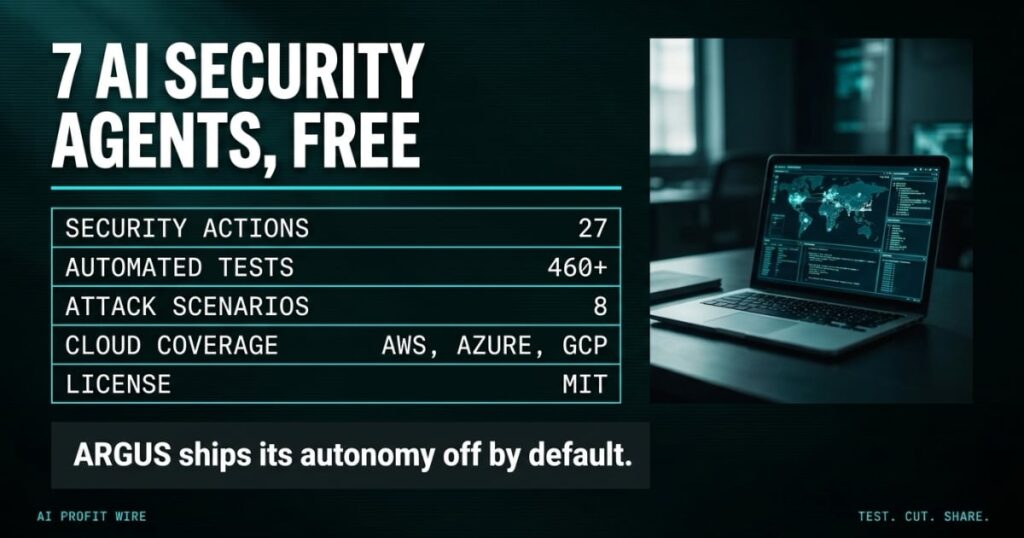
Provides enterprise-grade security automation and threat detection capabilities without licensing costs for resource-constrained teams.
What Is ARGUS And What Does It Do?
ARGUS is an open-source cybersecurity platform released on GitHub under the MIT License, and it bundles AI-powered threat detection, autonomous security agents, penetration testing, incident response, and infrastructure monitoring into one system. The project is built with Python and FastAPI, runs on PostgreSQL and Redis, and ships deployment configurations for Docker, Kubernetes, AWS, and Azure, according to the Medium write-up and the ARGUS repository.
The platform runs 7 specialized AI agents that investigate suspicious activity, examine security findings, and hunt for threats, and an AI red-team agent runs autonomous penetration testing while infrastructure changes rather than waiting for an annual assessment. Connections cover AWS, Azure, Google Cloud, Kubernetes, GitHub, Okta, and Microsoft Entra.
ARGUS packages enterprise-style security automation into a free MIT-licensed platform.
Does ARGUS Actually Automate Threat Response?
Yes, inside limits the administrators control. The platform includes 27 security actions that respond to incidents across Cloudflare, CrowdStrike, and SentinelOne, and it can block malicious activity and initiate endpoint isolation.
Every action passes through a separate policy system with approval requirements, dry runs, limits, and rollback, and autonomous response is disabled by default, so containment waits on a human decision until an administrator enables it. Dry runs show what an action would change before it executes, and rollback reverses one after the fact.
Endpoint isolation is the action to notice, because it cuts a compromised machine off the network in the minutes before a human can log in and triage. The 27 actions run across Cloudflare, CrowdStrike, and SentinelOne, which covers the three services most small stacks already pay for.
ARGUS automates containment, and it keeps the execution gate in human hands by default.
Is ARGUS Good Enough To Replace Paid Security Tools?
Most commercial security products specialize in one area, vulnerability scanning or incident response, and each carries its own license. ARGUS unifies monitoring, penetration testing, and threat hunting in one interface, and it works with established tools including OWASP ZAP, MITRE CALDERA, Nuclei, Trivy, Prowler, and Semgrep, so scanner investments already on the books keep working.
The enterprise feature list covers role-based access controls, audit logging, and multi-tenant support, and the repository carries more than 460 automated tests. For a resource-constrained team, that combination replaces a meaningful slice of what paid platforms bill monthly, with no license fee at all.
Role-based access controls and audit logging decide who can trigger the 27 actions and record what was triggered, which is the paper trail an incident review asks for first. Multi-tenant support matters for the shops that run security for more than one environment.
ARGUS will not replace a full enterprise security operation, but it replaces several single-purpose subscriptions for teams that can run it.
The pager on the nightstand goes off at 2:14 AM, and the dashboard already holds 27 possible containment actions against a compromised credential. An agent that acts first can isolate the server before the on-call engineer finds the light switch, and the same agent with a bad rule can lock the whole team out of production.
Approval gates, dry runs, limits, and rollback are the difference between those 2 outcomes, and ARGUS ships all 4 in its policy system. The free price does not change the math: autonomy without controls is a second breach waiting for a schedule.
What Breaks When You Run ARGUS In Production?
Self-hosting is the job. The team that deploys ARGUS owns the PostgreSQL and Redis infrastructure, keeps the policy system tuned, and reviews the dry runs, because a free platform bills you in administration hours instead of license fees.
The AI-specific defenses need their own owner. ARGUS monitors AI service usage across an organization, enforces policies around OpenAI and Anthropic API traffic, and plants deceptive credentials, fake MCP servers, and prompt injections to expose unauthorized AI tools, and an attack simulator runs 8 scenarios that test whether the platform catches AI-driven attacks.
ARGUS breaks when nobody owns it, so assign an owner before the first deployment.
Is ARGUS Production Ready?
For a team with cloud operations experience, yes, and the 460-plus automated tests plus Docker and Kubernetes configs make the on-ramp realistic. For a team without one person who owns security tooling, the platform will sit unmonitored, and an unmonitored security platform is worse than none because it manufactures false confidence.
Start with detection and leave the response actions off for the first week, then enable them one at a time with dry runs on. That pace matches how the policy system is built, and it keeps the first autonomous mistake from being an outage.
Releases like this one land weekly, and ARGUS is the strongest open-source security signal we have logged this month; the other open source AI releases we have tracked are worth a scan before you shortlist anything.
Deploy it if you can name the person who will own it, and skip it if you cannot.
Source: Medium (@ai_news)
