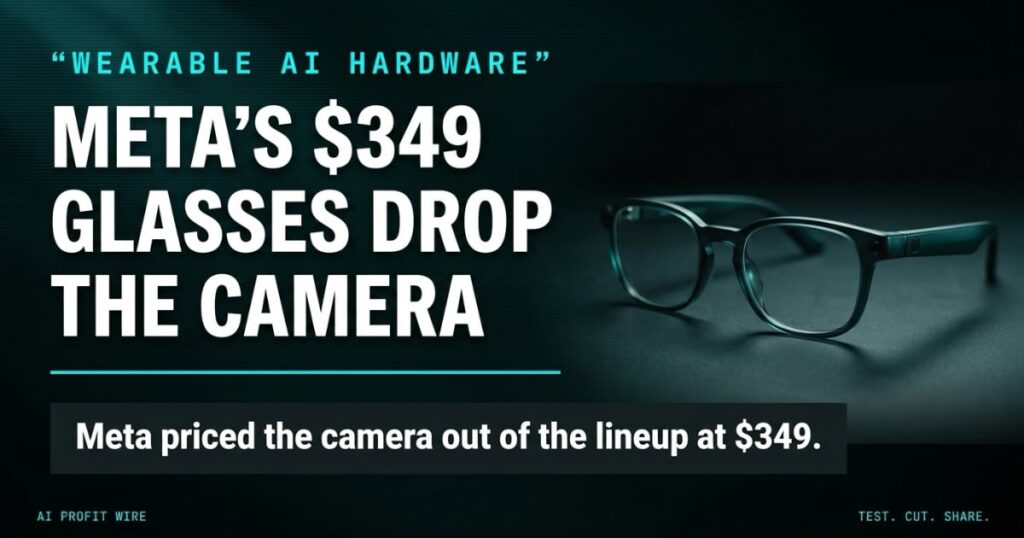
Provides hands-free productivity and communication for mobile professionals, though at an increased equipment cost.
What Is Ray-Ban Meta Audio And What Do The Glasses Do?
Meta has launched the Ray-Ban Meta Audio glasses at $349 and up, an audio-only branch of its smart glasses family with open-ear speakers, Meta AI built in, and calendar syncing, according to Bloomberg. The wearer plays music, takes calls, dictates texts and audio messages, sets reminders, and gets recommendations like nearby coffee shops in an unfamiliar neighborhood.
The frames were announced last month, and everything runs through the speakers and the voice assistant rather than a display. Meta’s own Ray-Ban Meta page documents the wider family these frames sit in.
Open-ear speakers leave both ears open to the room, which is the practical difference from earbuds on a job site. Audio messaging and reminders cover the errands that used to mean pulling out a phone mid-task.
Ray-Ban Meta Audio delivers hands-free AI assistance through open-ear speakers at $349.
Does Ray-Ban Meta Audio Justify The $349 Price?
The launch coverage says it depends on what you value. Bloomberg’s review calls the glasses an odd proposition, because they cost more than some of Meta’s entry-level models while doing many of the same things.
What survives the strip-down is the core assistant stack: music, calls, dictation, calendar sync, reminders, and recommendations. What is gone is the camera, and photo capture, video recording, and the ability to have AI analyze surroundings go with it.
The entry models in the same family carry the assistant features at lower prices, and Bloomberg’s comparison makes the gap plain: the cheaper hardware does many of the same things. That is the core of the odd-proposition framing, and it is the number that should anchor any buying decision.
The $349 price buys the assistant, not the capture, and the entry models prove the assistant costs less.
Is There A Cheaper Alternative To Ray-Ban Meta Audio?
Yes, and it comes from the same company. Meta’s own AI glasses store lists the category from $224, and those entry frames carry the camera this model drops, while the wider market runs from basic Bluetooth earbuds to full video-recording frames.
The audio-only design is the differentiator, and it is a real one for buyers who want voice assistant access without a recording device on their face. Everyone else is paying above entry pricing for a narrower product.
Earbuds cost less and pocket easier, but they come out when conversations start. Frames stay on the face and the assistant is a head tilt away, which is the trade the higher price is asking about.
The cheaper alternative exists inside the same product family, and it does more.
The equipment quote sits on the clipboard at 7:55 AM, and line 3 reads $349 for a device that does less than the pair already in the team’s ears.
A field crew needs calls and hands-free dictation, and both live in the feature list at the lower price. The camera the vendor removed is the feature the crew never asked for, which makes the higher price a bill for what the spec sheet lost, not what the job needs.
Who Is Ray-Ban Meta Audio Actually For?
Bloomberg’s sharpest line is the fit: the glasses suit a buyer who is “a little paranoid” about cameras and uninterested in the latest tech, because the missing camera is a privacy feature for the wearer and for everyone nearby. Mobile professionals who want calendar syncing and audio messaging with open-ear awareness are the obvious second group.
Prescription lens support keeps the frames practical for daily wear, and the Clubmaster style keeps them looking like ordinary glasses, which is part of the point. Setup and daily use are documented in Meta’s AI glasses help center.
The design targets buyers who want a discreet audio accessory rather than a wearable recording device, and the camera-free build is what gets them there. Everyone around the wearer gets the same privacy benefit, which is worth naming in any office rollout conversation.
Buy it for discretion and privacy, not for capability per dollar.
Should You Buy Ray-Ban Meta Audio At $349?
Test the daily use case before the team expense, because $349 is real money against hardware that drops the feature most buyers associate with smart glasses. Confirm the built-in AI assistant and calendar sync would survive a week against a pair of wireless earbuds costing a fraction of the price.
If voice-first convenience is the job, buy one pair and pilot it the way you would pilot any tool. If calls and meetings are the real work, see what our Krisp intelligence report says about AI noise cancellation on the devices your team already owns before you spend on new hardware.
Run the pilot like a trial with a return date: one pair, one week, calendar sync and calls as the test jobs. If the crew reaches for the glasses without prompting at the end of the week, the price has an argument; if they reach for the earbuds, it doesn’t.
Pilot one pair against earbuds before you put $349 on the equipment line.
Source: Bloomberg Tech
