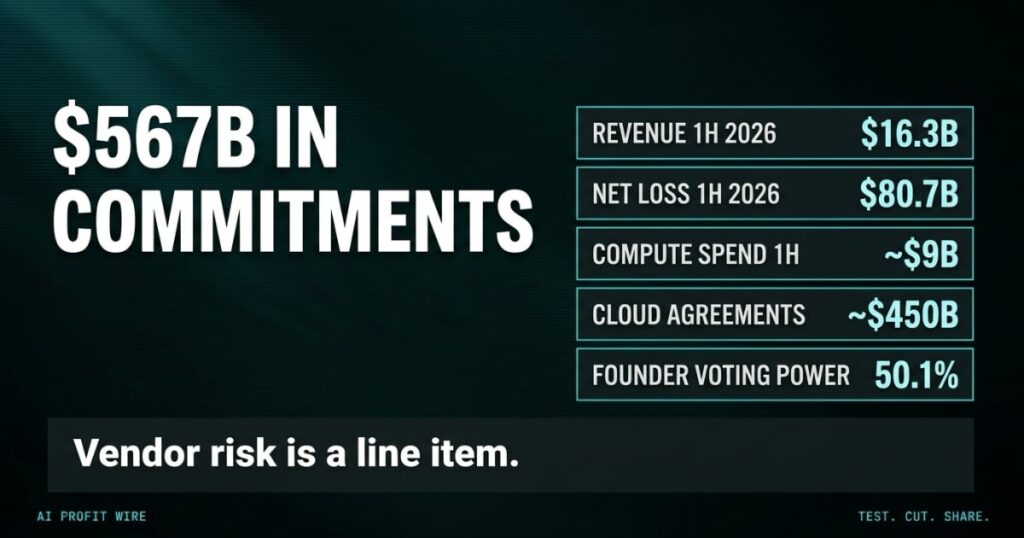
Highlights potential vendor risk and the importance of maintaining multi-model flexibility in your tech stack.
Anthropic filed its S-1 on Monday and expects to go public as soon as next month. The filing’s structure decides who carries the compute bill, and customers carry it in the end.
What Does the Anthropic IPO Filing Actually Say?
Anthropic filed for an IPO on Monday with an expected raise most observers bracket at $1.5 trillion to $2 trillion, which would make it the largest public offering in history and clear SpaceX’s $85.7 billion June IPO by an order of magnitude. The filing pairs that ambition with founder control: the founders keep collective control of 50.1 percent of voting power on corporate governance matters.
Anthropic states the structure on its own site: it is a public benefit corporation whose board is elected by stockholders and its Long-Term Benefit Trust, an independent body of 5 trustees with authority to elect and remove directors. CEO Dario Amodei and President Daniela Amodei both sit on the 7-person board.
Anthropic filed to go public without handing public shareholders the final word.
What Are Anthropic’s Actual Revenue Numbers?
The draft prospectus reported $16.3 billion in first-half 2026 revenue, up from $1.1 billion in the same period a year earlier, against an $80.7 billion net loss, per The Wall Street Journal’s review of the filing. About $72 billion of that loss sits in accounting charges on convertible notes and other instruments, which is the number that makes the growth and the loss readable together.
Consumption runs the business: $13.1 billion of the $16.29 billion in first-half revenue came from customers consuming its models, and about one-fifth of total revenue came from two customers. The company spent nearly $9 billion on compute and cloud infrastructure in the half, up from $2.3 billion a year earlier, and it is locked into long-term infrastructure contracts totaling up to $567 billion.
The growth is real, and so is the $567 billion bill attached to it.
How Is Anthropic’s Governance Different From a Typical Public Company?
A standard listing hands the vote to whoever owns the most stock. Anthropic’s structure gives its founders a 50.1 percent voting block, and a separate stock class elects a majority of the board through the Long-Term Benefit Trust, so public shareholders hold limited influence over major decisions no matter what they own.
Kashyap Kompella, CEO and founder of RPA2AI Research, told AI Business the structure raises accountability questions, because public shareholders will hold limited influence even as the company raises their money. Michael Bennett, associate vice chancellor for data science and AI strategy at the University of Illinois Chicago, called Anthropic a safety-first company and said it may accept moves that diminish revenue if safety demands them.
The governance is built so the mission outranks the market.
The vendor invoice lands on the 3rd with a usage line you did not model, and the renewal call opens with the phrase “infrastructure costs.” An $80.7 billion half-year loss has to get recovered somewhere, and per-model pricing is the lever a public company reaches for first. Your API budget sits downstream of a capital structure you do not vote on.
Kompella warned that pressure to recover infrastructure costs could change pricing or usage limits, and that compute constraints could hit service reliability and delay releases. The founders hold 50.1 percent of the vote, so the strategy is theirs to set, and the invoice is yours to pay.
A vendor’s IPO is a pricing event for its customers.
What Does the Anthropic IPO Mean If You Already Use Claude?
Claude claims the fastest enterprise adoption of any technology per Anthropic’s own filing, and the revenue behind it multiplied from $1.1 billion to $16.3 billion in a year. A public listing adds shareholders with quarterly expectations to a vendor spending nearly $9 billion per half on compute, so pricing and usage limits become live variables for every customer.
The vendor has also restricted its Mythos model, which it says can launch dangerous cyberattacks as well as defend against them, to select enterprises and institutions, so product availability is already a lever Anthropic pulls. Kompella’s advice to enterprises cuts through the market excitement: focus on what your operations need and match the vendor to your actual agentic workflows instead of the headlines.
Your Claude dependency is now a public-market story.
What Should You Do About the Anthropic IPO Now?
Audit your Claude exposure this week: list every workflow that breaks if pricing changes or usage limits tighten, then price that same workload on a second provider. Before your next renewal, check what Claude costs per million tokens right now and requote the workload elsewhere so you know what leaving costs.
Bennett told enterprises to stay pragmatic about the offering, and Kompella recommended building AI-infused IT systems that allow for flexibility instead of betting on a single provider. Two independent analysts landed on the same play: optionality.
Do not build core business processes on technology supplied by a single evolving vendor.
Source: AI Business
