Most AI news is opinion. Someone reads an announcement, posts a hot take, and waits for likes. That works for engagement. It does not work for decisions that affect your business.
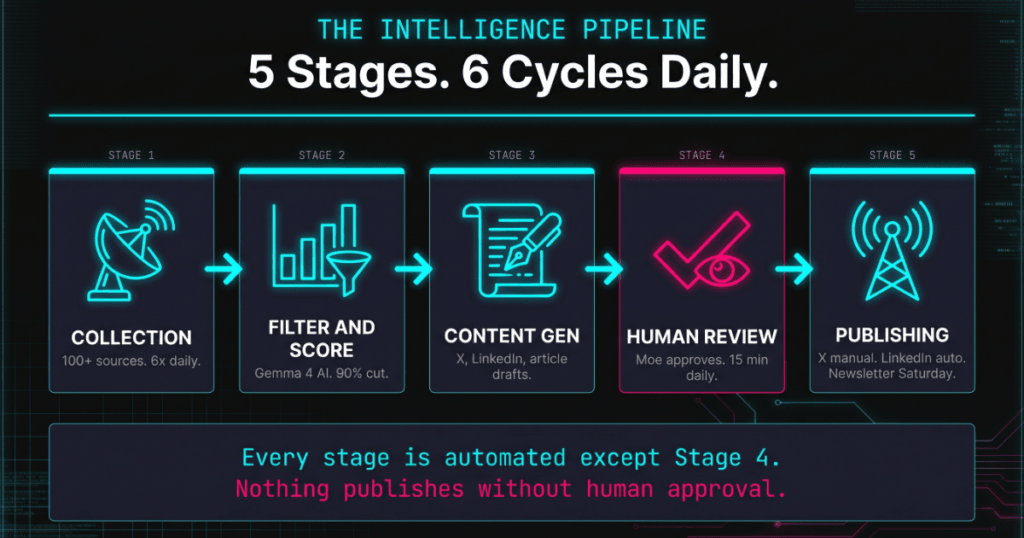
Every signal published on The AI Profit Wire runs through a 5-stage automated pipeline. It filters noise, scores quality against 5 measurable data points, and produces only what actually matters for small business owners. Here is exactly how it works.
Stage 1: Collection
Six times every day, an automated workflow pulls the latest content from 100+ sources. The schedule runs at fixed intervals, 24 hours a day.
The sources span three tiers: the official research blogs of OpenAI, Anthropic, Google DeepMind, Meta AI, and Microsoft Research; open-source hubs including Hacker News, GitHub Trending, ArXiv, Papers With Code, and Reddit’s AI communities; and high-signal publications including TechCrunch AI, VentureBeat AI, MIT Technology Review, and The Rundown AI.
Each cycle captures thousands of raw items before any filtering begins.
Stage 2: Analysis
Raw items go through two sequential passes before anything advances.
The first pass cuts for relevance and runs on Gemma 4 via the Gemini API. Items that are not related to AI, business operations, or small business impact are dropped immediately. Duplicate articles from the same cycle and items already covered in the last seven days are removed.
The second pass is the Hype Check. Every surviving item is scored across the 5 Proxy Signals by GLM 5.2, with Gemma 4 31B held as the fallback if the primary model is unavailable. Items that do not meet the score threshold for their signal type are cut. Roughly 90% of incoming signals do not make it through this stage.
Stage 3: Content Generation
Every item that clears the filter gets three pieces of publication-ready content written in Moe’s brand voice: an X post, a LinkedIn post, and a structured article for the website. The writing is handled by GLM 5.2, with Kimi k2.6 as the first fallback and Gemma 4 31B as the second, using a prompt that enforces voice rules, source authority standards, and the two-track scoring display system.
This is the only stage where writing happens. Everything before it is data processing.
Stage 4: Human Review
This is the only stage that requires Moe. Every draft lands in a review queue and a Telegram notification is sent with the full signal card for immediate review from any device.
For each item, there are three choices: approve as-is, edit and approve, or reject. Nothing publishes without an explicit decision.
Total daily time commitment: 10-15 minutes.
Stage 5: Publishing
After approval, a WordPress draft is created automatically. Moe reviews and posts the X draft manually. LinkedIn publishes automatically once the X post is confirmed live. Every Saturday morning, the week’s top signals are manually compiled into the newsletter and sent through Beehiiv.
That is the entire system.
The 5 Proxy Signals
The Hype Check is the proprietary scoring system that powers every analysis. Each signal evaluates a different dimension of an AI tool or development.
Community Adoption: Are real people using this? GitHub stars, Reddit activity, review counts, Discord size.
Pricing Model: Is the pricing accessible and honest? Hidden upgrade triggers, billing traps, plan restrictions.
Benchmark Data: Does it actually perform better than alternatives? Independent tests, LMSYS scores, real-world results.
Expert Sentiment: What do researchers, analysts, and respected builders say?
Release Maturity: Production-ready product or research demo?
Each dimension scores 1-10. The overall Hype Score is the average of all applicable dimensions.
1-3: Noise. Not worth your attention. 4-6: Interesting but not yet actionable. Watch it. 7-8: Strong signal. Worth acting on. 9-10: Major development. Move fast.
The pipeline uses these thresholds as an automated gate. Moe’s editorial review is the final decision. Signals below 7.0 may still publish if they are timely or directly relevant.
Why I Show You This
Most analysts will not show you their methodology because they do not have one. They have opinions.
The AI Profit Wire has a system. Showing you exactly how it works is the brand’s strongest trust signal. If you understand how the signals are processed, you can decide for yourself whether to trust the output. That is how data-backed intelligence is supposed to work.
Test. Cut. Share.