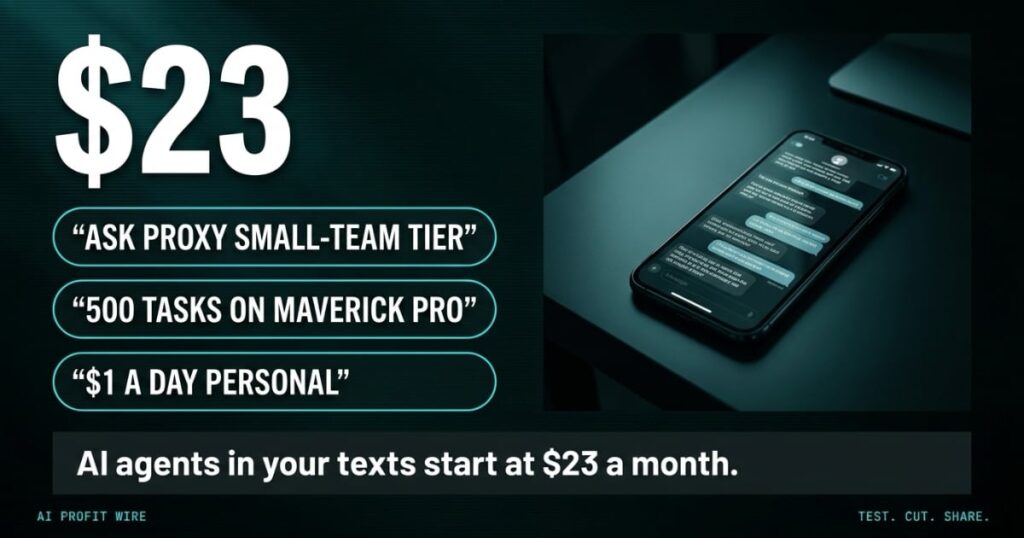
These text-based AI agents handle scheduling, research, and follow-ups without requiring new software installations.
What Are Text-Based AI Agents And What Do They Do?
Text-based AI agents are assistants you reach by texting a phone number or an existing chat thread instead of downloading another app, and a growing list of them now complete real tasks on your behalf. You text what you need, and the agent remembers context, connects to the apps you already use, and finishes the job, whether that is scheduling an appointment, organizing a calendar, sending an email, making a reservation, or canceling a subscription, according to TechCrunch.
The category now runs past a dozen products with different entry points. Ask Proxy works over SMS, Caddy lives in iMessage for iPhone and RCS for Android, Comma reaches you through Signal, Telegram, and WeChat, and Folk arrives on iMessage, WhatsApp, and Telegram.
Funding has followed the behavior. Instinct raised $1 billion at a $10 billion valuation in September 2026 after an earlier $350 million round, Town raised a $55 million Series A in June, and Fambot landed $3.5 million in pre-seed funding.
Text-based AI agents run inside the messaging threads you already use, and venture money treats the shift as a category change.
Do Text-Based AI Agents Actually Complete Real Tasks?
They do, and the difference from a standard chatbot is that the action lands in the real world. Maverick can fix typos, cancel subscriptions, schedule meetings from voice notes, and settle a group chat on a date, and it asks for your permission before it acts. Folk runs on its own private cloud computer, which lets it run code and finish multi-step tasks rather than chat replies.
Instinct pushes autonomy further with dedicated email addresses for each assistant, so the agent can sign up for services, contact businesses, and follow up on requests without filling your personal inbox, and it has begun rolling out support for placing calls. Wajo gives its agent Fo its own email address, phone number, and payment card, which keeps your credentials out of the transaction.
The same autonomy is what raised privacy and security concerns, because an agent with an email address and app connections can act first and clean up later. Poke, the assistant Apple approved as the first AI agent on the Apple Messages for Business platform, was acquired along with its parent by the AI coding startup Cognition in a deal valued in the low nine figures, which tells you where the market expects this to go.
The agents complete real tasks, and the tradeoff is real access to your accounts and conversations.
Is There A Cheaper Alternative To Ask Proxy?
Ask Proxy prices the personal version at $1 per day and starts business plans at $15 per employee per month for large companies, or $23 per employee per month for teams with fewer than 49 employees. That is the expensive end of a spread that runs from free to about $30 a month.
The alternatives cost less and specialize more. Folk offers a Pro subscription at $8.33 per month for unlimited background tasks, Ohai starts at $9.99 per month, Tomo starts at $19.99 per month, and Martin starts at $21 per month. Maverick’s Pro version runs about $30.25 USD per month for 500 tasks and 20 connected apps, while Comma, Pally, Fambot during beta, and Ollie’s entry plan cost nothing. Ollie’s paid tiers start at $25 per month for 150 messages and reach $100 per month for 1,000 messages.
Entry pricing spans $0 to about $30 a month, so pay for the tasks you delegate and nothing else.
The route tablet on the passenger seat buzzes at 6:40 AM, and the customer at stop 1 wants tomorrow’s visit moved. A $23-per-employee agent reads that thread, opens the calendar, and moves the booking before the van finishes the block.
When it reads a reschedule that was a question instead of a request, the fix costs an apology call and a dead hour on the schedule. That dead hour is the one the agent was bought to save.
Who Are Text-Based AI Agents Actually For?
Busy individuals and small teams are the core market, and the products split by job. Ask Proxy and Martin target general personal assistance, Fambot and Ollie target family logistics, Miso targets travel planning, and Folk targets work tasks that need code execution, while Stanley serves content creators and Szn reports more than 7,500 businesses served across 16 countries.
Security posture varies more than pricing does. Ollie stands out as one of the first mainstream family-focused assistants to earn SOC 2 compliance, the audit standard for how a service protects customer data, and Underdog runs its model on your own Mac or Windows machine so personal data never leaves hardware you own.
Pick by job and by data exposure, because the category now has a product for every risk tolerance.
Is Ask Proxy Worth It For A Small Business?
Test it on low-risk scheduling before it touches anything customer-facing, because $23 per employee per month buys real autonomy over calendar, email, and messages. Give one employee a pilot month, log what the agent did, and judge it on hours saved against mistakes made.
Keep the agent away from payroll, contracts, and client credentials at first, and prefer tools that ask permission before acting, the way Maverick does. If the real job is answering customers on your website, a purpose-built chat tool is the safer first buy, and our Tidio intelligence report covers what AI support chat handles well for a small team.
Pilot one agent on one workflow for one month, and expand on evidence.
Source: TechCrunch AI
