HubSpot Alternatives for Small Business (2026): What You Pay Once You Outgrow Starter Intelligence Report

In This Report
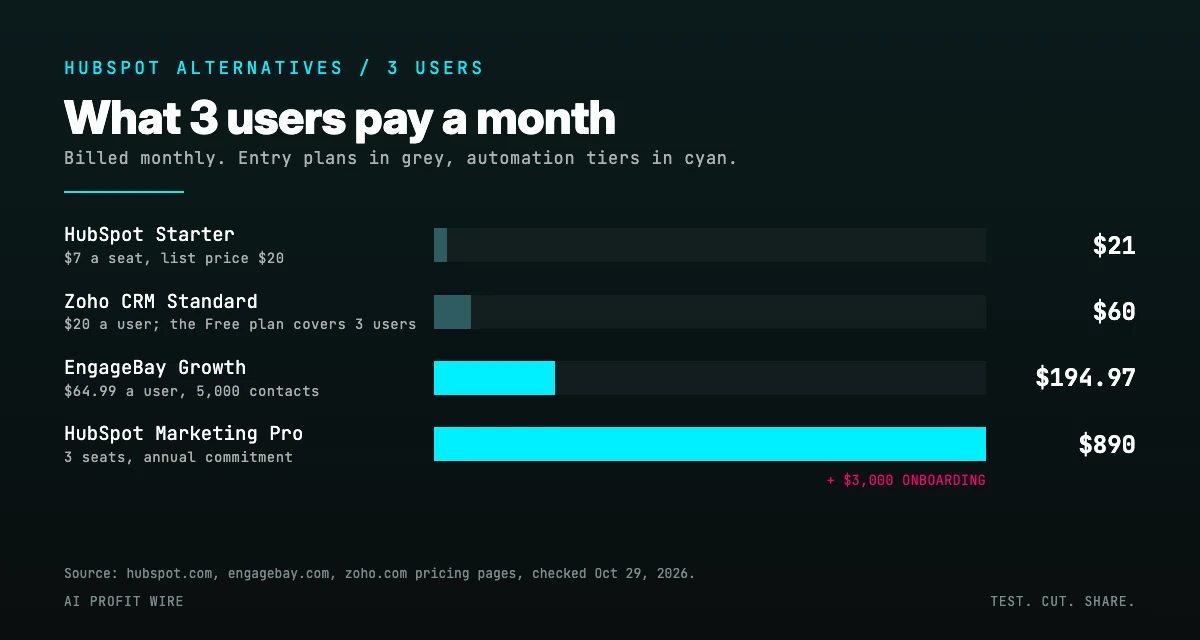
HubSpot’s Starter seat shows $7 a month on monthly or annual billing, a new-customer promo with the $20 list price struck through, and the next step up, Marketing Hub Professional, starts at $800 a month plus a required $3,000 onboarding fee. A founder on r/SaaS who was modelling 18 months of software costs wrote that add-on fees “stack up fast” once you need extra seats, extra pipelines or more marketing contacts. An owner on r/smallbusiness said the CRM, email, booking and social tools had turned into five or six different subscriptions. This guide prices HubSpot against EngageBay and Zoho CRM for a 3-person team. Prices were checked on vendor pages in October 2026.
| Tool | Free plan | Entry plan, 3 users | Next tier, 3 users | Where the bill jumps |
|---|---|---|---|---|
| HubSpot | 2 users, 1,000 contacts | Starter: $21 a month on monthly or annual billing ($60 at the $20 list price) | Marketing Hub Professional: $800 a month, 3 seats and 2,000 marketing contacts included | $3,000 onboarding on Professional, extra contacts from $50 a month per 1,000 |
| EngageBay | Up to 15 users, 250 contacts | Basic: $44.97 a month ($14.99 per user), 500 contacts | Growth: $194.97 a month ($64.99 per user), 5,000 contacts | Automation starts at Growth; the pricing page opens on 2-year billing |
| Zoho CRM | Up to 3 users | Standard: $42 a month on annual billing ($14 per user), $60 billed monthly | Professional: $69 a month on annual billing ($23 per user), $105 billed monthly | Every hire past 3 adds a full paid seat |
Is HubSpot worth it for a small business?
Yes while you fit inside the free tools or Starter, because both are cheap for 2 or 3 people. The cost question starts the day you need what Professional sells, such as marketing workflows, and that’s the day to price the alternatives.
HubSpot’s free tools cover 2 users and 1,000 contacts with no time limit and no credit card. Starter shows $7 a seat a month on monthly or annual billing, under a banner that says “Save up to 65% on Starter” for new customers only, so the $20 list price is the one to plan around once the promo ends.
HubSpot is a fair deal for 2 people on the free tools, and you should price your year 2 bill before Starter’s promo decides it for you.
What does HubSpot actually cost once you add seats and contacts?
For a 3-person team on Marketing Hub Professional, the first year comes to $12,600 on annual billing: $800 a month ($9,600 a year) plus the one-time $3,000 onboarding fee. That’s the jump from about $21 a month on Starter.
On HubSpot’s Marketing Hub pricing page, Professional starts at $800 a month on annual billing, or $890 a month on an annual commitment billed monthly, and includes 3 Core Seats and 2,000 marketing contacts. Extra Core Seats start at $45 a month each, and HubSpot sells extra marketing contacts in blocks of 1,000 from $50 a month.
Sales teams see the same shape: Sales Hub Professional starts at $90 a seat a month on annual billing ($100 billed monthly) with a required $1,500 onboarding fee, so 3 sellers start at $270 a month plus that fee.
One cost you can control: you pay for marketing contacts, the people you email, while HubSpot stores non-marketing contacts for free up to 15 million. Mark old leads you no longer email as non-marketing before your contact tier renews.
The HubSpot for Startups discount the r/SaaS founder was weighing is real and narrow. Funded startups get 90% off year one, then 50% and 25%, and others get 30% then 15%, but HubSpot says it applies to “net-new Professional or Enterprise level products only” and needs an annual commitment, and the same page says standard pricing returns after “typically two years”.
Plan on the full year 2 price, and treat any first-year discount as a bonus you don’t build the budget around.
What’s the best free HubSpot alternative?
For a sales pipeline with up to 3 users, Zoho CRM’s free edition. For a bigger team with a short contact list, EngageBay’s free plan, which allows up to 15 users and 250 contacts.
The 3 free plans cap different things. Zoho lists its free edition as free forever for 3 users, HubSpot caps free at 2 users and 1,000 contacts, and EngageBay caps contacts at 250 and leaves out automation and workflows on its free plan.
Pick the free plan by your tightest limit: people point you to Zoho or EngageBay, and contacts point you to HubSpot.
EngageBay vs HubSpot: which costs less for a small team?
EngageBay, by a wide margin, once you need automation: Growth costs $194.97 a month for 3 users on monthly billing with 5,000 contacts, against $890 a month for HubSpot Marketing Professional billed monthly, before its $3,000 onboarding.
EngageBay’s pricing page lists Basic at $14.99 per user a month, Growth at $64.99 and Pro at $119.99, and it opens on 2-year billing at 15% off, so check which tab you’re reading. Marketing automation and workflows start at Growth, so Basic at $44.97 for 3 users won’t replace HubSpot’s automation.
EngageBay scores 5.5/10, under our 7.0 threshold. Our report found a real free CRM and a full public price list, against automation that starts at the per-user Growth tier, refunds that run out after 2 months, and no status page.
EngageBay beats HubSpot Professional on price, and its 5.5/10 says to compare it against Zoho at your team size before you pay.
Full Hype Check: EngageBay.
Zoho CRM vs HubSpot: which fits a 3-person sales team?
Zoho CRM, for a team whose main job is a sales pipeline: Zoho CRM scores 7.2/10, it’s free for 3 users, and Standard costs $14 per user a month on annual billing or $20 billed monthly.
Zoho’s pricing page lists 4 paid editions per user per month: Standard $14 annual or $20 monthly, Professional $23 or $35, Enterprise $40 or $50, and Ultimate $52 or $65. Our Zoho report found that Standard’s storage caps at 5,000 records, so a team at that size should price Professional, at $105 a month for 3 users on monthly billing.
Zoho CRM is the CRM by itself. Our report’s verdict is no for anyone who wants marketing automation bundled into the same login, which is the job HubSpot Marketing Hub and EngageBay Growth sell.
Zoho CRM is the lowest-cost recommended pick for a 3-person sales pipeline, and HubSpot earns its price when one login for marketing and sales matters more to you than the bill.
Full Hype Check: Zoho CRM.
Do you need an all-in-one, or a CRM plus separate tools?
An all-in-one pays off when it replaces at least 2 tools you already pay for. If it replaces 1, a CRM plus the tool you already use costs less and breaks less.
The r/smallbusiness owner listed CRM, email marketing, appointment booking, social scheduling, automation and client management as separate bills. Write down what each one costs a month, then price the all-in-one tier that covers the same jobs, using the per-user price times your real headcount.
- 1. Count seats: per-user tools (EngageBay, Zoho) charge for every login, so 3 users on EngageBay Growth cost 3 times the $64.99 on the card.
- 2. Count contacts: HubSpot prices marketing contacts in blocks of 1,000, and EngageBay caps Growth at 5,000.
- 3. Find the automation tier: on EngageBay that’s Growth, and on HubSpot Marketing Hub it’s Professional.
- 4. Price year 2: promos and startup discounts end, and onboarding fees don’t come back.
Our AI marketing stack guide ranks the all-in-one platforms we score, if you’d rather replace the whole stack.
Add up your current subscriptions before you shop, because the all-in-one only wins when that total is bigger than its tier at your headcount.
I run 4 businesses, and in each one the customer list is the asset I’d be slowest to move once it’s built. That’s why I read the year 2 price before the year 1 promo.
A CRM gets harder to leave every month you use it, so the time to compare is before the first import, while switching still costs you an afternoon.
What’s the simplest CRM for a small service business that tracks quotes and follow-ups?
A free plan from Zoho CRM or HubSpot, set up with 1 pipeline where “Quote sent” is its own stage and every quote gets a follow-up task with a date.
Someone rebuilding a house painting business’s website on r/smallbusiness wanted “a barebones CRM or system to capture contact info” and nothing more. Another poster there, who is building a quote follow-up app, asked service businesses whether they track the quotes they send in spreadsheets, phone reminders or an app.
For 1 to 3 people, Zoho’s free edition covers 3 users and HubSpot’s free tools cover 2 users with 1,000 contacts.
Start free with 1 pipeline and a follow-up date on every quote, and pay only when a second person or a real email list needs more.
Full Hype Checks: Zoho CRM and EngageBay.
If you want the weekly verified breakdowns behind guides like this, subscribe to The AI Profit Wire, and you can track every tool we score in the Intelligence library.
Facts and prices last checked October 2026. Vendors change plans often, so confirm on the vendor’s page before you buy. Test. Cut. Share.
