Improves customer service automation and sales follow-ups by reducing repeated context loading.
How Do You Give An AI Agent Memory
You build the memory outside the model, because the model holds none. An LLM reads the prompt, returns a response, and keeps nothing, so a second request starts from zero unless your architecture persists state somewhere the agent can reach.
The n8n team describes the split every production system needs: short-term memory tracks recent messages, tool outputs, and task state close to the agent, while long-term memory survives across sessions and holds user preferences, past outcomes, and company knowledge the agent did not generate itself.
Agent memory is a storage and retrieval problem, not a model problem.
Does Agent Memory Actually Work At Scale
The honest answer comes from the hardest benchmark available. BEAM, an ICLR 2026 benchmark, grades 10 memory abilities over conversations of up to 10 million tokens, longer than LoCoMo’s about 26,000-token conversations or LongMemEval’s common 115,000-token variant.
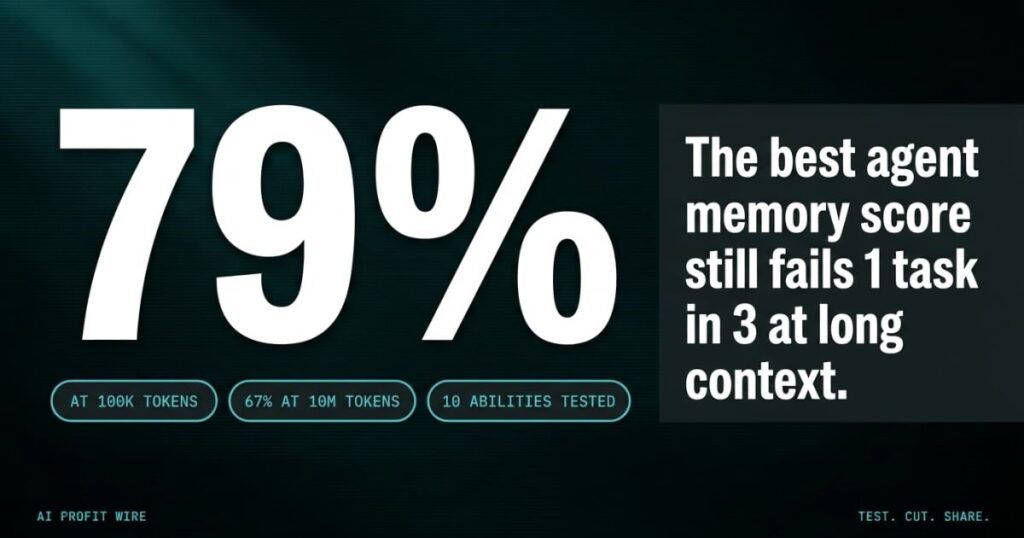
The reported state of the art is 79% at 100K tokens and 67% at 10M, set by Cognee, up from a previous best of 73.4% and 64.1%. Those numbers mean the best available system still fails about a third of memory tasks at production scale.
Most systems track neither what the memory stored nor how it behaves when several agents share the same data, and the agent memory failures other teams have logged read the same from the buyer side: the store works, and the retrieval drifts.
A third of memory tasks still fail at long context, even at the state of the art.
Is Cognee Good Enough To Replace A Custom Memory Stack
For most teams, yes, and the reason is what the benchmark data exposes about building it yourself. Cognee is an open-source memory platform with more than 32,000 GitHub stars, and its maintainers publish the methodology behind their BEAM runs, including which parts were exploratory and where a reproduction gap remains.
A custom stack means owning the 3 pieces every memory system needs: a data store, write logic that decides what gets kept, and a retrieval interface. Hybrid designs that combine vector search for semantic matches with knowledge graphs for logical relationships are the current best practice, and each piece you hand-roll is a piece you must benchmark, monitor, and correct when retrieval drifts.
Buy the memory layer, own the evaluation.
Vector stores win on fuzzy recall, knowledge graphs win on relationships, and the hybrid is what the top BEAM runs used. The 3 pieces stay the same whether you buy or build, which is why the evaluation matters more than the vendor name.
The assistant greets a returning customer like a stranger, and the customer repeats the account history she gave the same tool on Tuesday. Nobody coded that failure, the state had nowhere to live.
At 10 million tokens of conversation, the best memory system available misses 1 task in 3, so the customer feels the gap the benchmark already measured. The fix is not a bigger model, it is a store that survives the session.
The same gap costs you in quieter ways: a sales agent that re-asks for a budget it was told last week, or a support agent that resolves the same ticket twice. Every repeated question is paid in the customer’s patience and your token spend.
What Breaks When You Run Agent Memory In Production
Accumulation breaks first. Raw entries pile up faster than they become useful, so production systems run consolidation that turns raw logs into summaries and derived facts while keeping a trail back to the originals.
Change breaks second: a blind overwrite loses history, so systems timestamp facts so the agent can answer both what is true now and what it believed in March. Deletion breaks third, because stale data, corrections, and deletion requests need explicit, deliberate removals rather than passive fading.
The systems that improve over time also learn from confirmed outcomes, letting correct memories gain weight. Shared stores add a fourth risk: several agents writing one store can poison each other’s context.
Memory that is managed beats memory that is only stored.
Should You Use Cognee Instead Of Building Memory Yourself
Run the product test on your own data before deciding. Wire the memory layer into 1 workflow, measure outcome metrics such as tickets resolved or repeated questions removed, and compare that against the 79% and 67% state-of-the-art marks your own conversations will track.
If your workflows run on n8n, the platform’s memory documentation covers the default Simple Memory node for chat history plus the tool port for connecting an external layer such as Cognee, which is the combination the source article recommends. If your data is sensitive, both n8n and Cognee can run self-hosted, which keeps conversation history on your own infrastructure.
Production ready for pilots, and worth benchmarking on your own data before you trust it with customers.
Source: n8n blog, AI Agent Memory: How LLM Agents Manage State In Production
