Helps larger small businesses with compliance needs audit AI usage, but offers no direct revenue or productivity gains.
What Is the Google Vault Gemini Export and What Does It Cover?
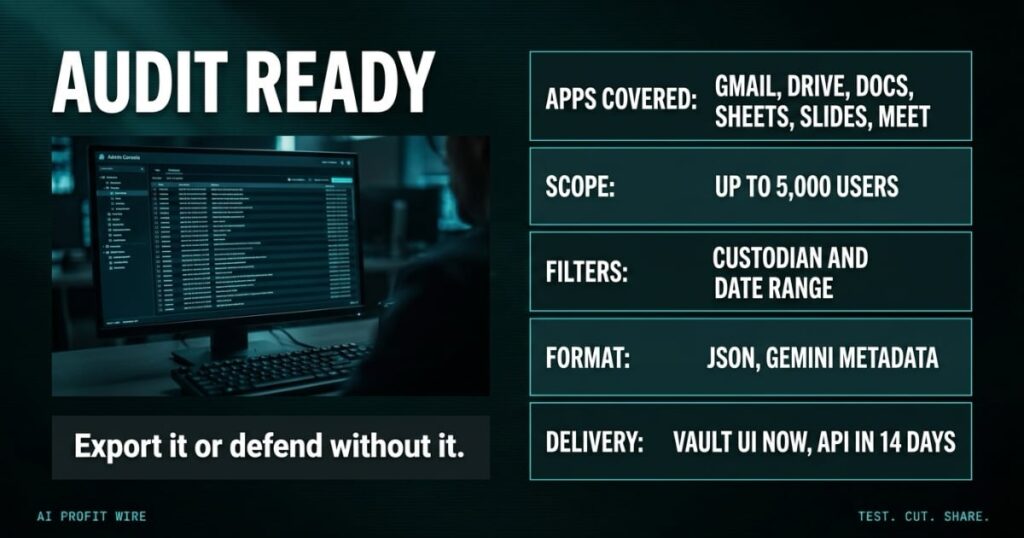
Google Vault now supports eDiscovery filtered exports for Gemini in Workspace, which turns AI conversations into records an administrator can search, filter and hand to a regulator. The official Workspace Updates announcement describes the addition as a new data source in Vault’s AI compliance capabilities, covering Gemini conversations created with history turned on across Gmail, Drive, Docs, Sheets, Slides and Meet.
The exports are thorough about context. A matching export includes user prompts, AI responses, generated attachments such as images, links to referenced Workspace files and citations, so the record shows what the user asked and what the model answered with.
The update landed on Rapid and Scheduled Release domains the same day, so every eligible admin sees it now rather than on a staggered schedule. There is no end-user setting to enable, which means the compliance perimeter is enforced centrally instead of being left to individual habits.
AI chats are now records you can produce on demand.
How Far Do Google Vault Gemini Export Filters Actually Reach?
The filtering matches what compliance teams expect from email eDiscovery. Admins define export scopes by specific user accounts or organizational units up to 5,000 users in size, filter by a date range with time zone selection, and run the export from the Vault UI today or through the Vault export API within 14 days of the UI rollout.
Output arrives as JSON with metadata tags aligned to the GenAI conversation format used in the Gemini app, which keeps exported conversations readable by the tooling security teams already run. The feature is available on Business Plus, Frontline Standard and Plus, Enterprise Essentials Plus, Enterprise Standard and Plus, Education editions and the standalone Vault add-on, per Google’s Workspace pricing tiers.
Admins start the export from the Search tab in Vault by selecting Gemini in Workspace from the service dropdown, and OU-level conversation history settings live in the Admin console. The mechanics borrow nothing new from the teams that already run Vault daily.
Scopes, filters and formats match email eDiscovery, and that is the whole point.
What Makes the Google Vault Gemini Export Different?
Vault has supported exports for the Gemini app since February 2025, so exports alone are not the news. The new data source is the Gemini in Workspace conversation, the side-panel AI that follows users across Gmail, Drive, Docs, Sheets, Slides and Meet, and it sat outside Vault’s reach until now. Google’s supported services documentation tracks that coverage as it expands.
More governance is on the schedule. The announcement notes retention rules and litigation holds for Gemini in Workspace will follow in future releases, which tells compliance teams the export capability is the first plank of a fuller AI records program rather than a one-off.
The difference is scope: the AI that lives inside your documents now sits inside your eDiscovery perimeter.
Who Is the Google Vault Gemini Export Actually For?
The feature targets administrators at organizations with compliance obligations, which in practice means Business Plus and Enterprise editions where Vault is bundled. For those teams, Gemini adoption has been gated by this question, and the export capability removes the last structural objection to rolling AI assistance out broadly.
The stakes are not hypothetical. IBM’s Cost of a Data Breach Report 2026 puts the global average breach at $4.99M, a record, and discovery gaps compound that bill when regulators ask what AI systems saw and said. We follow every governance change as it lands, and the Workspace AI changes tracked in our signals archive show compliance capability arriving in pieces, export first and retention next.
Compliance-heavy teams got the green light they were waiting for.
The client’s lawyer asks for every AI conversation a staff member had with company systems in Q3, and the admin opens a ticket instead of a dashboard. Two weeks of screenshots and browser history later, the answer is still partial. IBM prices the average breach at $4.99M, and discovery gaps cost more than anyone puts in the budget.
Vault exports turn that ticket into a query, custodian and date range included. The admin who tests one export this quarter answers the same lawyer in an afternoon.
What Should Workspace Admins Do About Gemini Exports Now?
Update the compliance manual to name Gemini in Workspace as a records source, and verify the Vault edition your organization runs covers the feature before an auditor asks. Confirm that admin permissions for Vault exports are assigned, and decide who owns AI conversation retention the same way someone owns email retention today.
Run one export end to end this quarter, from filter to JSON file, so the format meets archival standards before a real request tests it. The Vault API support landing within 14 days extends the same workflow to automated compliance pipelines, which is where most enterprises will run it.
Test the export before you need it, because discovery is a bad time for a first attempt.
Source: workspaceupdates.googleblog.com
