Improves security compliance and risk management when small businesses start deploying automated AI agents for administrative tasks.
What Is 1Password for Agents and How Does It Work?
1Password launched a tool on Thursday that lets AI assistants log into personal accounts without ever seeing the credentials behind them. The product, detailed by TechCrunch’s Lucas Ropek, is called 1Password for Agents, and it works by creating a communication channel between the agent, the user and the password manager.
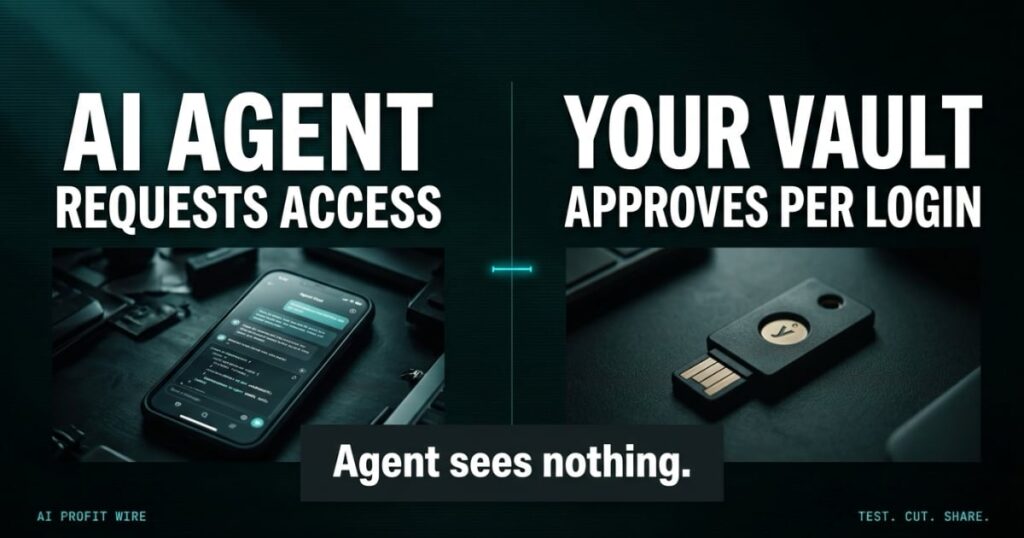
The flow runs in three steps. When an agent attempts a login, a unique digital key travels to 1Password to confirm the agent’s identity, the user receives an alert and confirms the request, and 1Password fills the credentials on the assistant’s behalf. The agent completes the task while the secret itself stays in the vault. The design keeps a human in control at the exact moment access is granted, which is the moment most delegation tools get wrong.
At launch the platform supports Claude Duet from Anthropic, OpenAI’s Dots and ChatGPT Work, Grok Bot, Meta’s Muse and agents from the AI assistant startup Town, with the company’s announcement naming more partners on the way.
The agent gets the session, and the credential never leaves the vault.
Does 1Password for Agents Actually Stop Credential Theft?
The design goal is narrower than theft prevention, and more honest about how exposure happens. 1Password’s own launch materials describe the problem as saved copies: handing a credential to an agent “can leave people with sensitive information in places they can no longer control as a copy gets saved for the next time.” A tool that fills credentials per session removes the copy, and the copy is where most leaks live.
Timing made the launch a referendum on agent trust. Axios reported the same day that US banks have begun detecting agentic activity inside user accounts, with bankers describing the situation as horrifying and institutions unable to tell agent logins from intrusions. A Chase spokesperson told the outlet that customers should not give their usernames and passwords to anyone.
The tool does not make agents trustworthy, it makes every agent login attributable and reversible.
How Is 1Password for Agents Different From Sharing a Password?
Shared credentials are permanent by default. An assistant holding a real password keeps it through staff changes, device sales and scope creep, and nothing about the arrangement expires. The agent model inverts the default: access is requested per session, approved by a human, and logged by the vault.
The developer documentation adds a bound shared passwords never have. Agent grants last 30 days at launch, after which the connection needs renewal, and the agent never holds credential values at any point in the flow. Expiry plus approval plus zero credential exposure is a different security posture from a password pasted into a settings field once and forgotten.
Sharing hands over a secret, delegation lends a session and takes it back.
Who Is 1Password for Agents Actually For?
The launch targets personal accounts first, and the pricing matches: the product page confirms the feature ships at no additional cost on 1Password Individual and Family plans. The early users are people delegating errands, research and purchases to consumer agents, the same population banks flagged for unvetted agent activity.
Small businesses sit one step behind that curve and should treat the launch as a template. The pattern to copy is architectural, whatever the vendor: agents request, humans approve, credentials stay in a vault, and every grant expires. We log launches like this one as they land, and the other AI security releases covered in our signals archive show the approval-first pattern becoming the default across vendors.
Consumers get the tool today, and small teams get the blueprint for how agent access should work.
The bookkeeping clerk pastes a shared vault password into an assistant’s settings once, in March, and forgets it by April. The credential sits in a third-party config file through two staff changes and a laptop sale. Nothing breaks, which is the trap.
1Password built for Agents exists because that unwatched copy is how exposure happens, one saved secret at a time. The launch supports 5 assistants, and none of them ever sees the password they use.
Should You Let an AI Agent Into Your Accounts Yet?
Let agents in through delegation, never through credentials. Audit every third-party tool that stores a password in a configuration file today, because those stored copies are the exposure the new model eliminates, and require human approval on any automated login that touches financial accounts.
Watch the banking front as its own track, since institutions cannot yet distinguish agent activity from intrusion and the burden of proof sits with the account holder. Monitor statements for automated activity, keep approvals per session rather than blanket grants, and the delegation habit stays an advantage instead of a liability.
Approve the session, expire the grant, and never let the assistant keep a copy.
Source: TechCrunch AI
