Provides a hands-free audio and translation tool for mobile professionals, though direct productivity impact depends on individual workflow.
What Is the Ray-Ban Meta Audio and What Does It Do?
Meta announced its first camera-free AI glasses, the Ray-Ban Meta Audio, at Connect 2026, built with EssilorLuxottica and starting at $349. The TechCrunch report confirms the audio-only frame handles calls, music, podcasts, speech translation, and access to Meta’s Muse AI assistant.
The design skips the camera entirely, which makes the frame slimmer at 43 grams and sidesteps the recording controversy that followed earlier models. Two styles ship at launch, Clubmaster and Burbank, across 23 color and lens combinations with prescription lens support.
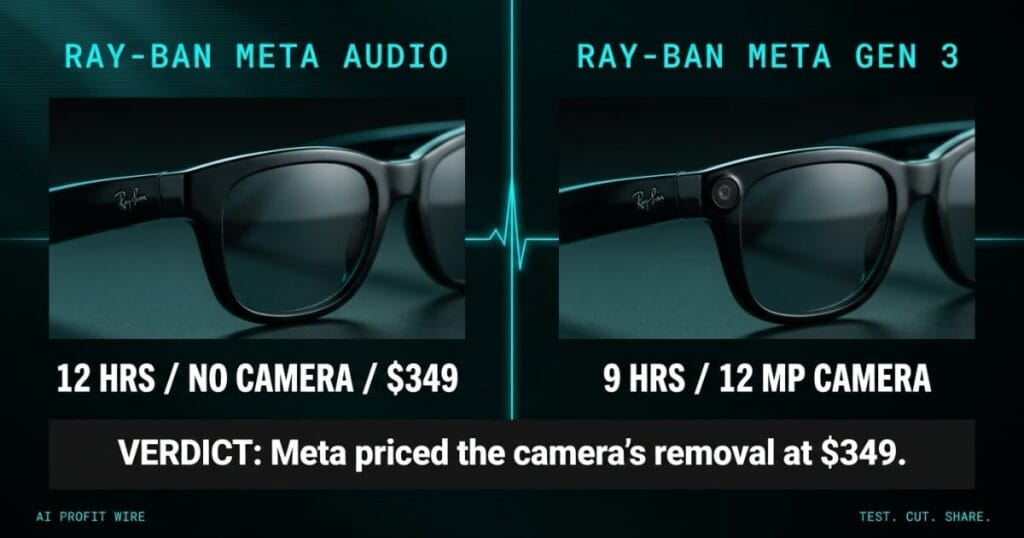
Meta repositioned AI glasses as an everyday audio tool, and priced the camera’s removal at $349.
Does the Ray-Ban Meta Audio Battery Last 12 Hours?
That’s the manufacturer claim: up to 12 hours on a single charge, extending to 48 hours with the included charging case. The camera-equipped Ray-Ban Meta Gen 3 announced alongside it caps at 9 hours, so the audio-only frame carries the endurance lead in Meta’s own lineup.
Independent testing doesn’t exist yet, because preorders open October 13. The 43-gram frame includes adjustable temple tips, swappable nose pads, and overextension hinges, which targets all-day wear rather than occasional use.
Plan around the case: a full work week of intermittent use fits in 48 hours of total charge, and the single-charge figure decides whether nightly habits change. Meta also ships hearing enhancements for users with hearing loss on its glasses lineup, which widens the use cases beyond calls.
12 hours is a claim, 48 hours with the case is the planning number, and both await independent verification.
Are Ray-Ban Meta Audio Glasses Better Than Earbuds for Work?
Earbuds already handle calls and music, so the comparison comes down to what the frame adds: speech translation, the Muse assistant, and a microphone array that works without touching a phone. TechCrunch notes the device answers products like Apple’s Siri-powered AirPods.
The official Meta AI glasses page positions the lineup around hands-free assistant access, which is the feature earbuds don’t replicate. The trade is compute style: glasses carry outward-facing cameras in every other Meta model, and this 1 deliberately gives that up.
Meta’s earlier answer to recording criticism, a camera kill switch that trips if the recording LED is tampered with, didn’t end the reputation problem, which is exactly why an audio-only frame exists. Removing the camera removes the failure mode instead of gating it.
The frame wins on hands-free assistant access and translation, and earbuds win everywhere else.
Who Should Buy the Ray-Ban Meta Audio?
Founders and senior directors who spend workdays on calls away from a desk fit the target, especially if supplier or client calls cross languages. Prescription lens support makes the frame a primary-glasses replacement rather than a second device, and Meta positions all-day wear as the design goal with the adjustable fittings to match.
Anyone whose call audio quality is the actual bottleneck should compare carefully, and the Krisp AI intelligence report covers what AI noise cancellation already does for calls on the hardware you own. Buy the frame for the assistant and translation, not for better audio than earbuds deliver.
Hands-busy, multi-language founders are the buyer, and everyone else already owns the alternative.
The supplier call starts in 90 seconds, and the translator app on the phone needs the hand that’s holding the pallet manifest. The glasses version of that call keeps both hands working while the translation runs in the frame, and the 12-hour claim means the battery outlasts the shift.
That’s the specific friction $349 buys down. The math inverts for anyone whose calls happen at a desk, because the earbuds already in the drawer do the same job for $0 more.
The camera’s absence is a relief in shared spaces and a loss for anyone who used the last pair to document site work. Count the hands-free translation moments in a real week before counting the $349.
Are the Ray-Ban Meta Audio Glasses Worth $349?
Worth it if your week contains recurring hands-busy calls or cross-language conversations, because translation and Muse access are the features earbuds don’t carry. Preorders open October 13, so the first honest reviews land before the first shipments.
Wait if your current earbuds already cover your call load, because $349 buys features you’d use weekly, not better versions of features you use hourly. Treat the 12-hour battery as a claim until independent tests publish, and factor the charging case into any all-day plan.
The privacy story cuts both ways for teams: no camera removes the consent headaches of recording devices in offices and client sites, and it also removes the documentation feature some field roles relied on. Decide which side of that trade your work lives on.
Buy it for translation and a hands-free assistant, skip it if earbuds already close your week’s calls.
Source: TechCrunch
