Saves operational hours by enabling rapid content searching and information retrieval from internal video libraries.
What Is AWS Agentic Video Intelligence and How Does It Work?
Amazon Web Services published an architectural guide for conversational video intelligence, a pattern where 1 AI agent answers plain-language questions about stored video. The guide on the AWS Machine Learning Blog builds the agent on the Strands Agents SDK, which orchestrates Amazon Bedrock, Amazon Rekognition, and Amazon Transcribe at runtime.
The agent reads the question, decides whether it needs transcription, visual analysis, or both, and calls only the services that answer it. Uploaded files and cached analysis results sit in Amazon S3 under per-user prefixes, so follow-up questions reuse what already ran.
The processing pipeline gets chosen per question at runtime, which replaces a fixed chain built for 1 query type.
Does AWS Video Intelligence Actually Return Answers in Seconds?
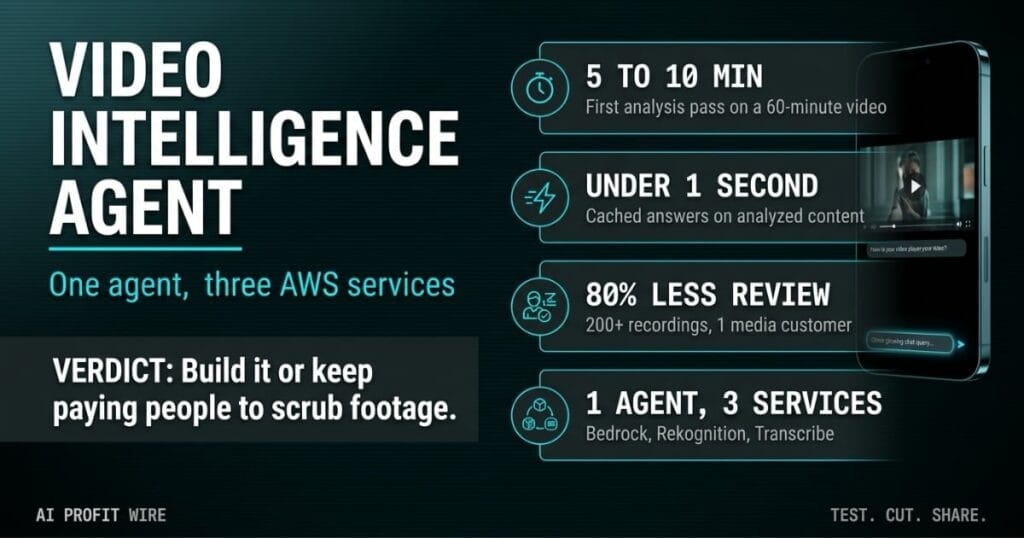
Yes for repeat questions, and the first pass is slower than the headline suggests. The guide states that questions on previously analyzed content return in under a second, because the agent reuses cached results for 24 hours.
Initial analysis of new footage runs 5 to 10 minutes on a 60-minute video while transcription or visual processing completes. The full implementation, tool code, and deployment scripts live in a companion GitHub repository, so the timing claims can be checked against working code.
1 media and entertainment company that adopted the pattern during an AWS Professional Services engagement reports cutting manual review time by about 80% across a backlog of more than 200 multi-hour recordings. AWS labels that figure as the customer’s internal before-and-after comparison of analyst hours, not an independent benchmark.
The speed claim holds for cached questions, and the 5 to 10 minute first pass is the number to plan around.
How Is Agentic Video Search Different From Fixed Video Pipelines?
The old build required a dedicated pipeline per question type: 1 for meeting transcripts, another for visual search, another for face matching. The agentic pattern routes every question through 1 agent that picks tools from their descriptions, so adding a capability means adding a tool function, not rebuilding the workflow.
The same tool contract extends past video, and the guide demonstrates it with Amazon Textract for documents and AWS HealthScribe for clinical audio. The Strands Agents SDK is open source, so the orchestration layer carries over to whichever services you wrap as tools.
Billing follows consumption instead of seats. Transcribing a 60-minute video costs about $1.44 on the Amazon Transcribe pricing page, a Rekognition pass on the same video adds about $6.00 one-time, and each cached agent turn costs $0.05 to $0.15 in Bedrock inference.
Flexibility comes from the tool contract, and the bill comes from the services the agent actually calls.
Who Is AWS Video Intelligence Actually For?
This guide targets engineering teams and technical founders already running workloads on AWS. The prerequisites include Bedrock access with Claude Sonnet enabled, Python 3.11 or later, and IAM permissions covering S3, Rekognition, and Transcribe.
Non-technical founders should wait for a vendor to productize this pattern, because the reference deployment assumes comfort with CloudFormation, ECS Fargate, and Cognito setup. If your week produces recordings that people scrub manually, the daily AI signal briefings on the AI Profit Wire archive track when patterns like this reach no-code tools.
Build it if you have the engineering bench, and watch the managed-tool market if you don’t.
The adjuster opens the claim file at 6:40 pm, and the dash-cam upload sits at 47 minutes of highway footage nobody has watched. The client wants to know when the lane change happened, and the honest answer tonight is “somewhere in there.” Scrubbing that clip by hand costs an evening, while the agentic route costs about $6.00 and a 5 to 10 minute wait for the first pass.
Multiply that evening across a backlog of 200 recordings and the math stops being an IT decision. It becomes the difference between quoting claims same-day and quoting them next-week.
That’s the trade this architecture sells: pay per question asked, or keep paying per hour scrubbed.
What Should You Do About AWS Video Intelligence Now?
Prototype on 1 real backlog recording before committing infrastructure, because the cost table makes small experiments cheap. Run transcription-only questions first: at $1.44 per 60-minute video plus $0.05 to $0.15 per cached turn, 1 pilot answers the build-versus-wait question with your own footage.
Face matching raises the stakes, so the guide recommends Amazon Bedrock Guardrails plus legal review of consent and retention rules before production. Deployment on ECS Fargate takes 15 to 20 minutes with the provided script, and teardown requires deleting Rekognition face collections explicitly because CloudFormation doesn’t own them.
Pilot it on 1 recording this week if you have the bench, and keep it on the watchlist if you don’t.
Source: AWS Machine Learning Blog
