Provides an affordable, programmatic way to create marketing voiceovers and audio content for under three cents per minute.
What Is the Gemini 3.8 Flash TTS API?
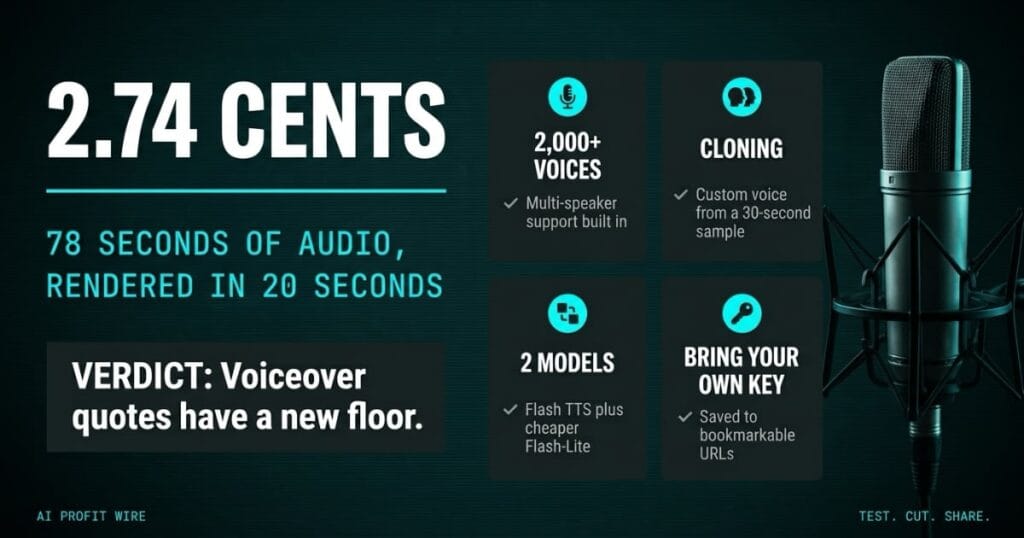
Google launched 2 text-to-speech models, gemini-3.8-flash-tts and gemini-3.8-flash-lite-tts, with a library of over 2,000 voices and multi-speaker conversation support. Developer analyst Simon Willison’s first look shows the API supports custom voice creation from a 30-second audio sample of your voice or a voice you have the rights to use.
The official Gemini API text-to-speech documentation covers single-voice narration and multi-character scripts, where each speaker carries a distinct voice and style instruction. The API runs on an open CORS policy and works through a bring-your-own-key playground that saves compositions to bookmarkable URLs.
Custom narration just became an API call with a voice library attached, not a studio booking.
How Fast and Cheap Is Gemini 3.8 Flash TTS?
The benchmark that matters is Willison’s: generating 1 minute and 18 seconds of audio took about 20 seconds using the standard Flash TTS model, at a total cost of 2.74 cents. That’s render time and price for a finished multi-speaker clip, measured on a live run rather than a vendor claim.
The Lite model exists as the cheaper tier, though the published benchmark ran on standard Flash, so the low-end price is still untested in public. Current rates live on the Gemini API pricing page, and per-run costs scale with characters rather than studio hours.
The 2,000-voice library matters for consistency too, because a recurring narration voice stays the same across every episode without rebooking the same actor. Multi-speaker scripts assign each character a distinct voice and style instruction inside 1 composition.
For context, 2.74 cents covered a 78-second finished file, which puts the per-finished-minute cost at roughly 2 cents before any markup.
78 seconds of multi-speaker audio rendered in 20 seconds for 2.74 cents, on the record.
Is Gemini 3.8 Flash TTS Cheaper Than Hiring Voice Actors?
Agency voiceover pricing runs per finished minute with session minimums, revision rounds, and turnaround days. The API runs per run: 2.74 cents for 78 seconds, a 20-second wait, and unlimited revisions at the same price per attempt.
The trade is craft. A voice actor delivers direction, interpretation, and broadcast quality, while the API delivers scale, consistency, and a voice cloned from 30 seconds of audio that stays available permanently.
Custom voice cloning carries a rights condition worth copying into your process: the source sample must be your voice or a voice you have the rights to use, which puts the legal burden on the implementer. That condition alone should keep cloned voices of executives, clients, or anyone else out of production without written consent.
For routine narration the API wins on math, and for broadcast craft the studio still wins.
Who Is the Gemini TTS API For?
Teams producing recurring audio, course narration, phone system prompts, and product walkthroughs fit the profile, because the cost per attempt makes iteration free compared to rebooking sessions. Developers with an existing Gemini API key can test in the playground without new infrastructure.
Non-technical teams should wait for a productized wrapper, because the bring-your-own-key model assumes someone comfortable handling API keys. The playground lowers the test bar: compositions save to bookmarkable URLs, so a developer can hand a demo link to a marketing lead before any integration work starts.
For teams already paying subscription prices per minute of generated audio, the ElevenLabs intelligence report covers the incumbent this API now undercuts.
Developer-led teams get the immediate win, and everyone else waits for the no-code wrapper.
The course creator finishes recording at 11 pm and finds 1 module narration runs 4 minutes long instead of 3. The old fix was rebooking the session at an hourly rate and waiting a week for the corrected file.
The new fix is a script edit and a render that costs about 8 cents and finishes before the coffee gets cold. At 2.74 cents per attempt, testing 10 script variations costs less than 1 round of studio revisions.
The per-attempt price is the whole story, because iteration is where voice budgets die.
Should You Switch Narration to Gemini 3.8 Flash TTS?
Pilot it on the audio you already pay for: take 1 finished voiceover invoice, regenerate the same script through the playground, and compare the output against what you paid. The benchmark math says a 78-second clip costs 2.74 cents on standard Flash, so the pilot spends pocket change.
Keep the studio for flagship brand work where direction and interpretation earn their rate, and route routine narration, drafts, and internal audio to the API. Clone your own voice only, because the rights condition on cloned voices makes borrowing anyone else’s a legal risk your business carries.
Move routine narration first, keep the studio for the work that defines the brand, and never clone a voice you don’t own.
Source: simonwillison.net
