Unmonitored AI storage growth can quietly balloon your operational expenses far beyond initial software subscription and compute budgets.
How Much Does AI Inference Storage Cost Now?
The honest answer is that most teams do not know, because the cost never appears on a pricing page. Western Digital’s research into AI infrastructure economics describes storage as the bill that starts as a rounding error and becomes a significant fraction of the program’s total cost within 12 to 18 months. Inference is a continuous workload, so every prompt, render and backup lands somewhere permanent.
The economics differ from compute in one structural way. GPU budgets follow predictable refresh cycles, while retained AI data compounds with every request the system serves. Most AI data by volume sits in warm and cold tiers, where hard drives hold a decisive cost-per-terabyte advantage, which is why capacity planning has become an AI expense line in its own right.
The storage bill is real, it compounds, and it arrives after the budget is locked.
What Drives the 130x AI Inference Storage Footprint?
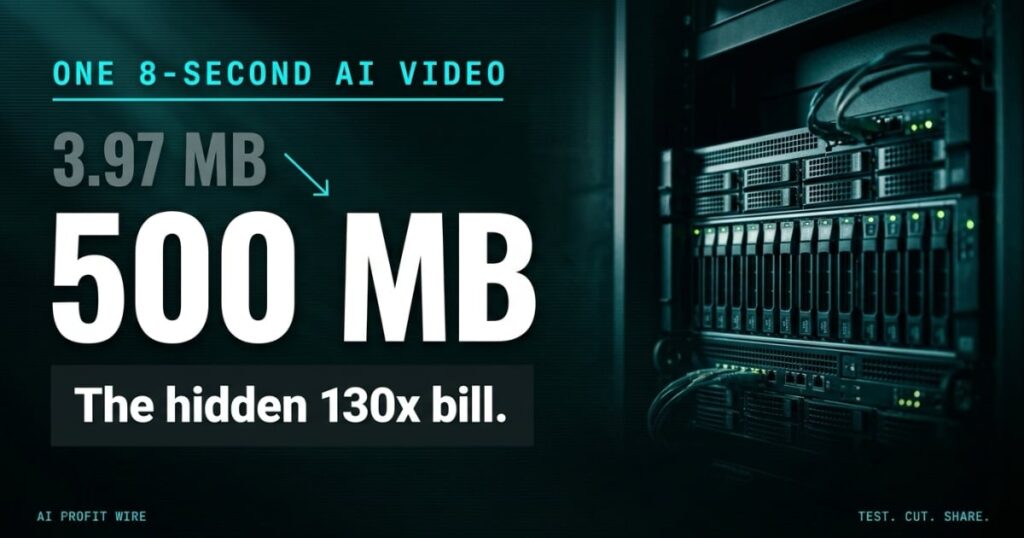
WD’s internal measurement put numbers on the multiplier: an 8-second AI-generated clip returned to the user as a 3.97MB 720p file left more than 500MB of associated data on the back end. The trailing mass includes operational logs, cached context, immediate renders, backups and safety records. That is a 130x increase over the output file the user actually saw.
At enterprise scale the footprint grows into hundreds of gigabytes per clip, because longer generations and higher resolutions multiply the back-end writes. The pattern repeats across media types, which is why teams generating product video or processing claims documents through retrieval pipelines hit the wall first.
The demand curve behind it is steep. McKinsey projects AI inference demand will grow at a 35% CAGR through 2030, against 22% for training, pushing inference past 40% of total data center demand by the end of the decade.
Every output a user sees drags a data shadow behind it, and the shadow is what you pay for.
How Is AI Storage Spend Different From Your Compute Bill?
Compute spending announces itself on every invoice, which is why it gets managed. Storage spending hides in capacity lines that grow a little every month, and the WD-sponsored IDC survey behind this research found the pattern is already widespread: 763 IT and business decision makers across 7 countries reported the squeeze, with 94.7% storing more data because of generative AI over the past year.
The survey’s deeper finding is behavioral. Roughly 61% of respondents saw data volumes grow 25% or more in 12 months, and 96% anticipate needing faster archive retrieval to support inference and retrieval-augmented generation. Storage is not a passive archive anymore, it is active infrastructure that models query at runtime.
Compute is a subscription, retained inference data is an annuity, and the annuity is the one nobody scheduled.
What Does the AI Storage Bill Cost a 10-Person Team?
A 10-person team generating media or running RAG over documents faces the same curve at smaller scale. The compounding starts when every generated asset keeps its logs, its cached context and its backups, and nobody owns the retention decision. Independent coverage of the IDC study reached the same conclusion: AI is driving storage growth faster than traditional budgeting cycles can absorb.
The practical cost shows up at renewal time. A team that scoped infrastructure as compute plus a nominal buffer discovers the buffer has become a line item with its own growth rate, and procurement suddenly negotiates capacity instead of performance. Setting retention limits on redundant outputs, and treating archives as assets the retrieval layer actually queries, keeps that negotiation survivable. Storage is half the infrastructure story, and the per-token half moves faster than most procurement cycles, which is why we log every model price change in the AI API Pricing Tracker.
The team that assigns retention ownership this quarter negotiates from strength next year.
The 3.97MB clip lands in the client’s inbox and everyone calls the project a success. On the back end sit 500MB of renders, logs and safety records nobody budgeted for, multiplied across every generation that month. Storage never sends a warning email, it sends an invoice in month 12.
A team that scoped compute plus a buffer learns the buffer is the product now. The GPU conversation gets the meeting room, and the storage line rewrites the margin underneath it.
What Should You Do About AI Storage Costs Now?
Establish a data retention policy for AI-generated content before the next budget cycle, with firm limits on redundant inference outputs instead of hoarding every background log. Align procurement with the actual data lifecycle rather than training-time performance, because the two curves do not follow the same clock.
Treat archives as active assets for retrieval-augmented generation while capping what the cold tier keeps, and put one named person on retention ownership so the decision has an owner when volume spikes. The WD research closes with three questions worth stealing for the next infrastructure review: who owns retention policy, is procurement tied to the data lifecycle, and would doubling AI usage more than double storage cost.
Retention policy written down today is the cheapest storage infrastructure you will ever buy.
Source: MIT Tech Review
