Prevents costly automated errors by catching bad AI outputs before they trigger external business actions.
How Do You Detect AI Agent Hallucinations in a Workflow?
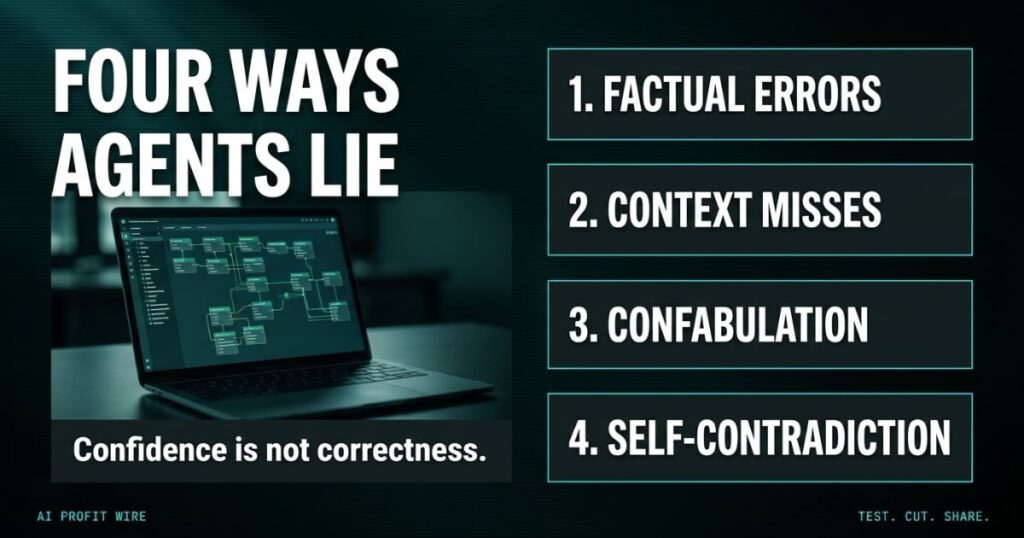
AI agents fail in 4 distinct ways during multi-step tasks, and n8n’s guide to hallucination detection methods names them: factual hallucinations, contextual hallucinations, confabulations and self-contradictions. A factual hallucination invents a statistic, a person or an event. A contextual hallucination produces an answer the retrieved context does not support, which is the failure mode that matters most in RAG pipelines.
Confabulations fill gaps with details nobody provided, coherent answers built on insufficient evidence. Self-contradictions conflict with the model’s own earlier claims. The taxonomy matters for a practical reason: each failure mode hides from a different check, so there is no universal detector.
Name the failure mode first, because the check that catches it depends on the type.
Do Faithfulness Checks Actually Catch AI Agent Hallucinations?
Faithfulness checks ask whether the model’s claims are supported by the context it received. The workflow breaks an answer into individual claims, compares each one against the retrieved documents, and scores how much of the response traces back to that context. Frameworks like DeepEval automate the scoring, which turns groundedness into a number a workflow can branch on. The scoring also turns review time into a branch condition, because a low-scoring run routes to a retry, an error workflow or a person, and nobody has to read the raw model output first.
The method has a documented blind spot: an answer can be perfectly faithful to a retrieved document that is outdated, irrelevant or wrong. Source verification covers that gap by testing important claims against authoritative repositories, databases, APIs and documentation, the way a fact-checker works against primary records instead of the folder the model was handed.
Faithfulness proves the answer matches the evidence, source verification proves the evidence deserves the match.
Is One Confidence Score Enough to Catch AI Agent Hallucinations?
Single scores miss failure modes by design. Self-consistency checks ask the same question several times and compare the answers, but different inference runs can converge on the same wrong information, so consistency is a signal rather than proof. Semantic entropy goes deeper by grouping several responses into meaning clusters and measuring how probability spreads across them.
The method comes from peer-reviewed research: a 2024 Nature paper on detecting hallucinations with semantic entropy tied the measure to confabulations as a class, computing uncertainty at the level of meaning rather than word choice. High semantic entropy flags a model that is unsure, and uncertainty is the case that deserves a second check or a human.
Layer the checks, because each one covers the failure mode the others miss.
Who Should Layer Hallucination Checks, and Who Should Skip Them?
Internal summaries tolerate uncertainty, and an agent preparing to modify a live customer record does not. The dividing line is consequence: teams whose workflows trigger external actions need confidence thresholds that route high-risk cases to a human in the loop, while low-stakes runs continue without approval. Production rates explain the urgency, because Vectara’s hallucination leaderboard shows even the best models hallucinate on roughly 2% of summarization tasks.
Platform guardrails make the layering practical instead of aspirational. n8n’s AI Agent node keeps model and tool activity inside an inspectable execution path, an Error Trigger starts a dedicated error workflow when a run fails, and execution history lets a team trace what the agent received and produced. If your agents answer customers directly, our Tidio intelligence report covers the customer-facing layer where those checks earn their keep.
Match the validation tier to the risk of the action, and log everything in between.
The scheduling agent confirms a technician for Tuesday, then repeats the slot to a second customer because the retrieval index never held the first appointment. Both customers show up. The agent sounded certain on both calls.
Confidence reads the same at 2% as it does at 92%, which is why tone is not a test. The checklist built into the workflow is the test, and it catches the failure before the second booking goes out.
What Should You Add to Your AI Workflows This Week?
Add a faithfulness check to any workflow that touches customer-facing text, and a source verification step to claims that drive decisions. Define confidence thresholds that route ambiguous outputs through additional checks and hold high-risk actions for a human, the tiered pattern n8n recommends for keeping judgment where it matters.
Test the escalation path the same way you test the happy path, because an error workflow nobody has run is a hope rather than a control. You cannot prevent every hallucination, but the FAQ in the n8n guide makes the bar concrete: catch more unreliable outputs by layering checks, and require human review when an incorrect action is expensive.
Validation is a workflow property, not a model property, and this week is the time to build it.
Source: blog.n8n.io
