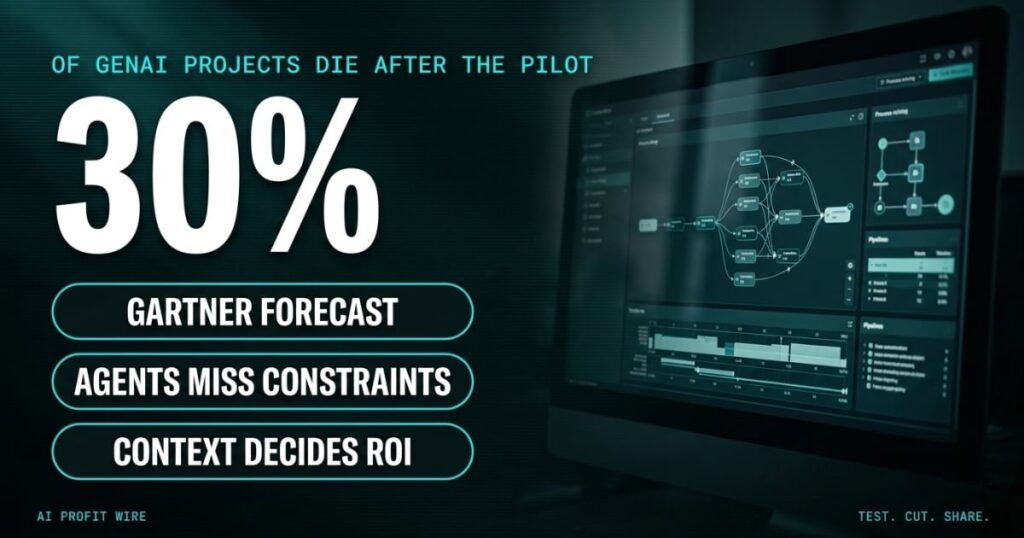
Highlights the need for businesses to map out workflows before automating tasks to avoid expensive AI errors.
What Is the Celonis Context Layer?
Celonis argues that enterprise AI fails at the decision, and the company’s answer is a context layer that shows agents how the business actually runs. Devavrat Shah, chief scientist of enterprise AI at Celonis and a professor who has taught AI at MIT for more than two decades, made the case in a conversation with MIT Technology Review Insights. His term for the outcome is decision intelligence: AI that acts inside the constraints of a specific operation instead of applying generalized principles to specialized scenarios.
The conversation aired on Business Lab, the Insights podcast produced in partnership with Celonis, so the framing comes from the vendor’s side of the table. That matters for readers weighing the claims. The argument still lands, because the failure it describes shows up in independent research, which the next section covers.
Celonis built its position on process intelligence, the discipline of reconstructing workflows from system event logs. More than 1,400 large companies run their operations through the platform, which gives the context model a deep well of execution data to draw from.
The context layer exists because agents that guess at constraints guess wrong at scale.
Why Do AI Agents Fail Without Operational Context?
The failure shows up in two places according to the conversation. An agent without context burns excess compute working out basic workflow logic that was already defined somewhere in the business. It also misses constraints and guardrails, and Shah’s warning was blunt: sometimes those mistakes are very expensive.
Independent research puts numbers on the pattern. Gartner predicts at least 30% of generative AI projects will be abandoned after proof of concept, citing poor data quality, inadequate risk controls, escalating costs and unclear business value. A separate MIT study reported 95% of enterprise GenAI pilots produced no measurable profit impact.
The two failure modes compound each other. A pilot that burns compute loses money while it runs, and a pilot that misses a constraint loses trust the first time it books something it should not. “You can’t just do that in a vacuum,” Shah said about deciding where agents belong, and the vacuum is where most pilots run.
Agents fail at decisions because the constraints never reached the model.
How Is Decision Intelligence Different From Ordinary AI Automation?
Ordinary automation hands a task to a model and hopes the prompt covers the edge cases. The Celonis context model stacks three layers instead: a system of record with event logs at the bottom, the context model in the middle, and business users plus agents on top. The context model abstracts the right pieces of the process, wraps each agent in structured guardrails, and routes output to a human for review before anything automates.
The contrast matters for anyone who has watched a pilot die. A prompt can describe a workflow, but it cannot stay current the way an event log does. Context drawn from the system of record updates when the process updates, which keeps an agent aligned after go-live instead of only on demo day.
Decision intelligence treats the process map as the source of truth and the prompt as the interface.
What Does Operational Context Change for a Small Business?
Celonis sells to enterprises, so a small business rarely buys the context model itself. The transferable move is the discipline behind it: identify one decision the team makes badly, map the process behind that decision, and test whether an AI agent improves the most difficult step before any wider rollout. Shah’s adoption advice follows that exact sequence, followed by measuring the speed and value gained.
Small teams hold an advantage enterprises do not. A 20-person company can reconstruct its core workflows in a spreadsheet in an afternoon, which is most of what a context layer does at small scale. The same guardrail logic applies: write down the rules the agent must never break, and keep a human approving output until the error rate proves itself. We track rollouts like these every week, and the agent failures logged in our signals archive trace back to a missing context layer more often than a missing feature.
Map the decision first, buy the agent second, and keep a human on the approval step.
The dispatch team wires an agent to rebook late shipments, and it picks the cheapest carrier every time. What the agent never sees is the penalty clause that doubles the cost of a same-day change with their primary carrier. One month of bookings erases the savings in a single invoice.
Nobody in that office was careless. The constraint existed, written into a contract the agent could not read. That is the failure mode inside Gartner’s 30% abandonment forecast, and it is the gap a context layer has to close before the agent ships.
What Should You Do About AI Agents in Your Business Now?
Pick the one decision where a wrong answer costs real money and map the process behind it end to end. Write the constraints into the agent’s own configuration, the surcharges, the cutoffs, the compliance lines, so the model inherits them at runtime instead of discovering them in an invoice.
Keep a human in the approval loop for any action that touches cash or customers, and measure speed and value gains over the first month before expanding the rollout. Workforce education decides the rest, because people who understand what the agent outputs and why will catch the mistakes the guardrails miss.
Context before autonomy, and the pilot budget survives long enough to reach production.
Source: MIT Tech Review
