Saves on cloud AI subscription fees by allowing developers to run an offline coding assistant directly on local hardware.
Recursive has released Flint, a free coding model that runs on an ordinary laptop, downloads from Hugging Face under the Apache 2.0 license, and was built from scratch in under 4 months by a small team working with the company’s automated research system. The pitch behind the launch is blunt: stop renting tokens from a cloud service for work your own hardware can now handle, and keep the code on your machine while you do it.
What Does Recursive Flint Do
Flint is a mixture-of-experts language model built for coding agents: its job is fixing bugs and writing tests inside an existing codebase. The sparse design activates 2.5 billion of its 40 billion parameters per task, which keeps the memory footprint small enough for consumer hardware.
Recursive, the startup behind it, emerged from stealth in May 2026 with $650 million in funding at a $4.65 billion valuation from backers including GV, Nvidia, and AMD Ventures, and the company is led by CEO Richard Socher, Salesforce’s former chief scientist. TechCrunch’s launch report frames Flint as an early public test of recursive self-improvement, the idea that AI can build better AI, and notes that some researchers fear self-improving systems could slip out of human control.
For now, Recursive’s version of that idea is bounded by design: the Eureka Machine runs the research loop itself, proposing ideas and folding the results of each experiment into the next round. People oversee the process and can stop it, and the stated long-term goal is for each new model to take on more of the work without human help.
Flint is a laptop-sized coding model and the first public output of a research pipeline where AI does most of the building.
How Fast Is Recursive Flint on a Laptop
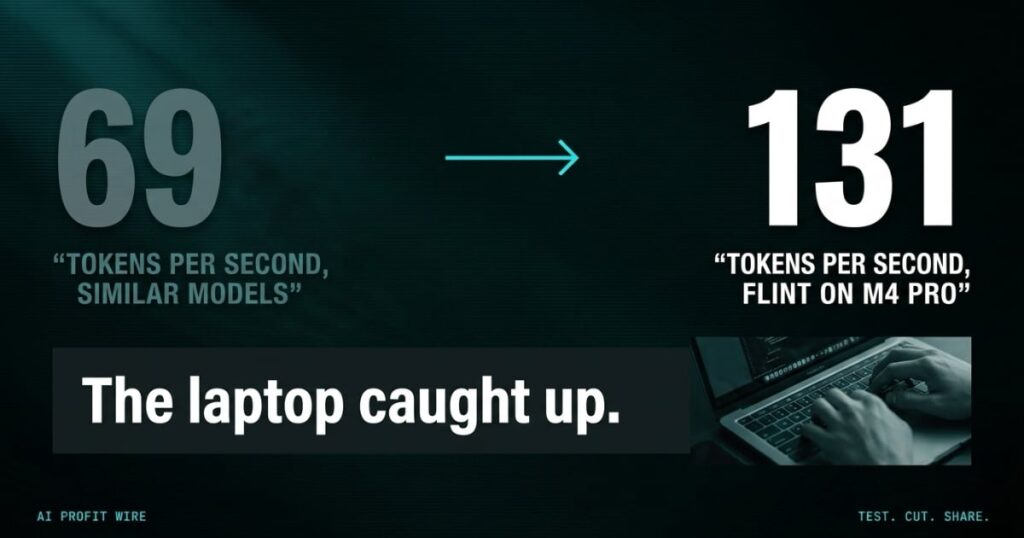
Recursive’s tests put Flint at about 131 tokens per second on a MacBook Pro with an Apple M4 Pro chip, 2x the 58 to 69 tokens per second that similar models managed on the same machine, including Google’s Gemma 4 and Nvidia’s Nemotron 3.5 Lightning. On Nvidia’s RTX Spark, the model topped 150 tokens per second.
The laptop fit comes from the architecture and the training recipe together. Flint activates 2.5 billion of its 40 billion parameters per task, low-bit training shrank the model 71 percent with almost no quality loss, and the launch announcement credits the Eureka Machine with the sparser model shape and the 4-bit quantization recipe, with the quantized build scoring within 0.7 points of the 16-bit original.
Speed needs accuracy behind it, and on SWE-Bench Verified, the benchmark that measures how well AI fixes real-world software bugs, the Hugging Face model card reports 74.2 percent, ahead of every other model under 50 billion parameters. On Recursive’s own average across 6 tests, 1 model scored higher: Alibaba’s Qwen3.8 27B.
Recursive built the fastest local coding model in Flint’s size class and backed it with a 74.2 percent score on real bug fixes.
Is Recursive Flint Good Enough to Replace a Paid Coding Assistant
For routine work, the first evidence says close enough: Wired’s Will Knight ran Flint on a Mac with 48GB of memory, built a to-do list app and a web research tool with it, and reported that it nailed his coding requests every time. He also noted the caveat that smaller coding models often run into errors or feel slow next to Claude or Codex.
Recursive’s own guidance agrees with that read: the company says Flint needs more guidance than the big paid assistants and recommends breaking large tasks into smaller steps with explicit instructions. The license is not the limitation, because Apache 2.0, the permissive open-source license Flint ships under, allows free commercial use and modification. Meta’s Muse Spark Open, released the week before, needs 816 billion parameters and at least a terabyte of memory to do its work; Flint’s 40 billion fit a laptop.
Treat Flint as a replacement for routine fixes and small builds, and keep a paid assistant for the frontier work that still needs one.
The quarterly API invoice sits open in the browser, and the line item for code suggestions climbs every month while the work it buys stays the same. Recursive’s answer weighs 40 billion parameters and costs $0 to download, with 2.5 billion of them active per token to keep a laptop inside its memory budget.
The move is the same one that lets a 3-person shop run its own bookkeeping on a machine in the back office instead of renting an enterprise system by the seat: cut the overhead until the hardware you own can carry it. The 71 percent shrink from low-bit training is what made that cut possible without gutting the model.
Frontier-scale reasoning on every request still belongs to the cloud, and forcing that work onto a local model buys you more hand-holding and smaller steps. For the routine half of the queue, the free model on your own desk is now the cheaper default, and the invoice line it removes is the one that never comes back.
Who Is Recursive Flint Actually For
Flint fits 2 groups best: small teams whose code cannot leave the building, and founders who watch the per-token line on the AI invoice and want it gone. Both get privacy and a $0 license as the default, because the model runs on hardware they already own.
It fits less well where every request needs maximum reasoning power, because Recursive itself concedes the guidance gap against the big paid assistants. Teams shipping frontier-heavy features should keep the cloud model on the hard problems and point Flint at the long tail of routine fixes.
Flint is for the team that owns its hardware and wants its code and its token budget to stay in-house.
Should You Use Recursive Flint Instead of Paying for Cloud Coding
Run the split test before you cancel anything: point Flint at your smallest recurring bug queue for a week and compare its output against what the cloud assistant returns on the same tickets. If the local results hold up, the cloud seat becomes a tool you pay for on purpose instead of a bill you pay by default.
The price math is blunt: the model is free under Apache 2.0, and the line it attacks is the per-token fee cloud providers charge based on how much text the model processes. Check the per-token prices we track across providers before you renew that seat, because moving routine work local resets the comparison to $0.
Switch the routine work first, keep the cloud seat for the work that needs it, and let the invoice tell you what to cut next.
Source: TechCrunch AI
