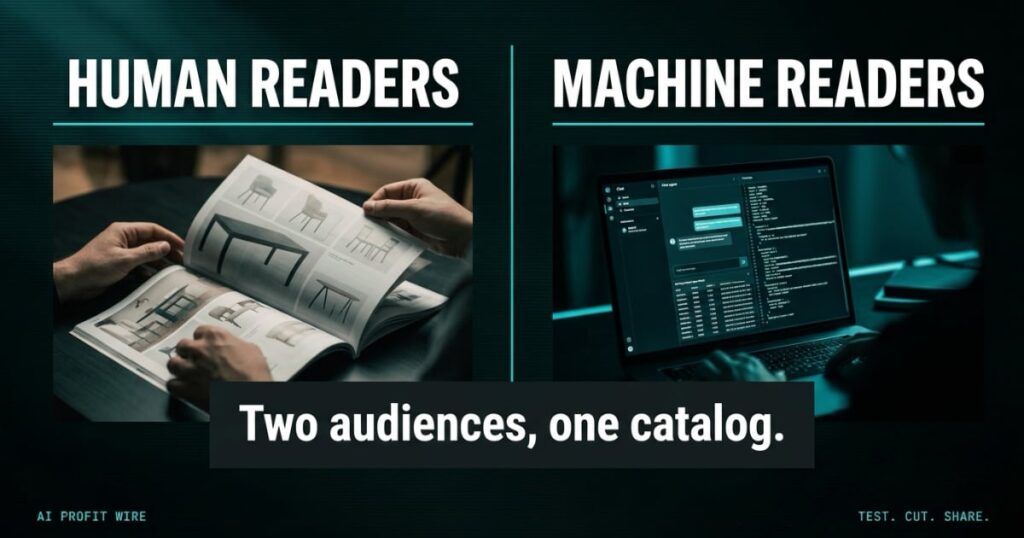
Adapting your online copy for AI discovery helps ensure your products are correctly recommended by automated shopping agents.
How Do You Optimize Brand Copy for AI Shopping Agents?
You upload a photo of an empty room to an AI agent, share a budget and a style, and the agent returns a furniture list. It can complete the purchase before you ever open a product page. Toby Coulthard, chief product and growth officer at brand language platform Jacquard, uses that scenario in a Crunchbase News guest post to describe the shift: instead of selling to one customer base, brands now sell to two, and the second audience decides on different criteria.
Optimizing for it starts with the copy machines read. Product descriptions, spec sheets and brand guidelines written for human emotion get broken down and reconstituted by agents, so the functional facts have to survive the parse. Emotive copy still sells to people, but it cannot be the only layer a machine sees.
Write for the human and structure for the agent, because both readers are already on the page.
Does Writing Brand Rules Down Actually Work for AI Agents?
Coulthard’s core claim is that unwritten voice fails when the reader is a machine: “AI tools follow explicit rules and drift without them.” In most early-stage companies the brand voice lives in the founder’s head, which works fine for a human collaborator and fails for an agent composing summaries at scale.
Jacquard’s own platform numbers suggest the discipline pays when it is applied. The company reports 30 million messages a week generated inside documented brand guardrails, with an average engagement lift of 23.3% when copy stays on voice. The mechanism is mundane: rules written down, enforced at generation time, checked before send.
What a brand sounds like matters, but Coulthard’s sharper point is the negative space. Brands should document the words never to use and the claims never to make, because drift is what agents do in the absence of boundaries.
Explicit rules hold a machine on voice, and unwritten instincts let it drift.
Is Retrofitting Brand Copy for AI Agents Worth the Cost?
Established brands face the expensive path. Decades of legacy copy, old approval processes and historical product descriptions all need updating across every digital channel before an agent reads them the same way twice. Newer founders hold a structural advantage because they can build agent-legible copy and voice guidelines from day one.
The stakes behind the retrofit question grow on a schedule. Juniper Research projects agentic commerce spend to reach $1.5 trillion by 2030, growing from the pilot deployments of 2025 and 2026, with trust flagged as the top barrier to adoption. A catalog that parses cleanly is the part of that trust a brand actually controls.
Retrofitting later is the expensive version of a decision that is cheap today.
Who Should Optimize for AI Shopping Agents, and Who Should Skip It?
Any business relying on digital storefronts for acquisition is in scope, and the sharpest consequence lands on marketing metrics: measuring output volume stops meaning anything when agents reshape copy per user. Focus shifts to revenue and qualified conversions, because those prove whether machine-tailored descriptions actually sell.
The entry-level test costs nothing. Gmail and Apple now summarize email before the recipient opens it, so send yourself the summary and check whether the offer survives. Coulthard calls it a small habit any marketing team can adopt with no tooling, and Jacquard’s guide to AI summarisation treats the one-line summary as a first-class deliverable. If the machine-visibility problem extends to search as well as shopping, our NeuronWriter intelligence report covers the content optimization side of it.
Test one summary before you invest in a platform, because the parse is the point.
The agent parses two product pages for a standing desk and buys the one with load ratings in plain text. The other page, the one with the gorgeous lifestyle copy, never stood a chance because the specs hid inside adjectives. No human compared them, and no human will.
Juniper counts $1.5 trillion moving through channels like this by 2030, and every dollar of it reads before it buys. The description is not marketing collateral anymore, it is the shelf the agent sees.
What Should You Change in Your Product Descriptions Today?
Pull your three best-selling products and check whether a machine can extract the core specifications in under a minute, because if it cannot, an agent cannot recommend the product with confidence. Document the brand rules next: the words never to use, the claims never to make, and the facts every description must carry.
Run the email summary test on your next campaign, and shift one reporting dashboard from output volume to conversions so the machine-readable rewrite proves itself in revenue. Retrofitting brand architecture later consumes capital that writing the rules down today does not.
Lock the guidelines in now, and the agent sells your catalog instead of your competitor’s.
Source: Crunchbase AI News
