Could lower customer service or meeting transcription costs by running open-source transcription on your own cloud infrastructure.
What does WhisperX on Amazon SageMaker AI do?
AWS released a deployment guide for running WhisperX on Amazon SageMaker AI using a custom deep learning container. The container packages OpenAI’s Whisper speech recognition, wav2vec2 forced alignment for word-level timing, and speaker diarization into a single GPU-ready image.
The use cases AWS names are the ones small businesses already pay transcription vendors for: contact centers measuring talk time and script adherence, teams turning meetings into searchable notes, media and e-learning teams generating captions in SRT and VTT format, and regulated fields like healthcare, legal, and finance where speaker-labeled transcripts support audits and legal discovery. The post is part of an AWS series on specialized deep learning containers that spans vLLM-Omni for text-to-speech and for image and video, WhisperX for speech-to-text, and llama.cpp, which signals where AWS expects self-hosted inference to go.
WhisperX on SageMaker AI runs speaker-labeled transcription on infrastructure you control.
Does WhisperX actually deliver speaker-labeled transcripts?
Yes, with a specific architecture. Standard Whisper produces timestamps at the phrase or segment level, and WhisperX extends it with per-word timestamps, speaker labels, and faster batched transcription, per the project’s open-source repository.
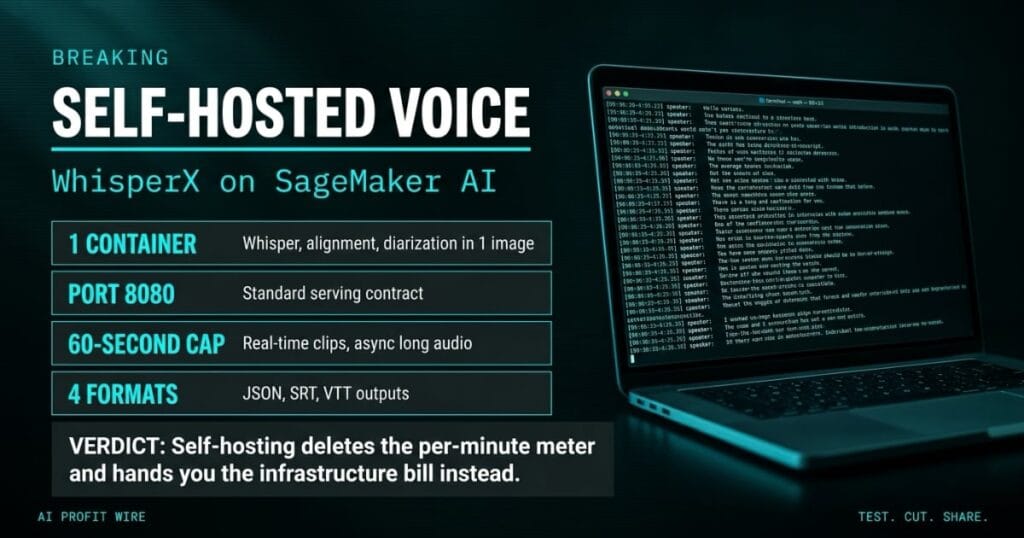
Inside the container, voice-activity detection filters silent intervals before transcription runs, alignment produces word-level timing, and diarization labels who spoke. Requests arrive as multipart/form-data with the audio as the file part plus optional fields for language, diarize, and response format, and Amazon SageMaker AI passes the content type and its multipart boundary through unchanged. Output ships in 4 formats, json, verbose_json, SRT, and VTT, so the same endpoint feeds analytics pipelines and video editors alike.
WhisperX adds word-level timing and speaker labels that raw Whisper does not provide.
Is self-hosted WhisperX cheaper than a per-minute transcription API?
The cost trade is real but it is not free. Commercial transcription APIs meter by the minute, and self-hosting on SageMaker trades that meter for instance hours, GPU capacity, and engineering time. OpenAI’s published API pricing is the yardstick most teams hold the comparison against.
The endpoints split the bill. Real-time endpoints must finish inside SageMaker’s 60-second response cap and bill while the endpoint is up, while asynchronous endpoints submit and poll through Amazon S3 and scale to zero when idle. The invocation differs too: real-time calls use InvokeEndpoint with an inline body, asynchronous calls use InvokeEndpointAsync with an S3 reference, and throughput scales by adding instances rather than raising concurrency, with 1 request per container. Instance selection runs from ml.g4dn.xlarge for cost to ml.g5.2xlarge for headroom, and the GPU AMI pin, al2-ami-sagemaker-inference-gpu-3-1, is mandatory or the endpoint fails to start with a CannotStartContainerError.
Self-hosting deletes the per-minute meter and hands you the infrastructure bill instead.
Who is WhisperX on SageMaker AI for?
The guide is built for technical teams and developers managing high-volume audio transcription on AWS. It targets teams that already operate in the cloud and need strict data privacy for recorded calls or customer interactions, because the audio never leaves your own environment. The prerequisites are concrete: an AWS account with a SageMaker execution role that can create models and endpoints, GPU service quota for the instance type, the container image URI from Amazon ECR, and for asynchronous work an S3 bucket whose name contains ‘sagemaker’.
Teams without cloud engineering support will find the container configuration, endpoint scaling, and AMI management too heavy to maintain. A complete runnable notebook ships in the AWS Samples repository our signals desk tracks, which is the cheapest way to trial the stack before committing engineering hours.
Self-hosted WhisperX suits teams with existing AWS infrastructure and real audio volume.
The support queue records every call, and the folder of untranscribed audio grows by the week. The per-minute bill for a commercial API scales with it, and procurement renews the contract without checking the math.
An engineer with the notebook open can point the container at last month’s recordings and return speaker-labeled text the same afternoon. The savings arrive after the AMI pin, the endpoint type, and the scaling policy are right, and that is the labor the per-minute bill was covering all along.
The 60-second cap on real-time calls is the boundary that decides the design: batch the archive through async endpoints, and keep the live path for short clips.
Should you self-host WhisperX or keep paying a transcription API?
Deploy it if your team already manages AWS infrastructure and your monthly audio volume justifies owning the pipeline. Skip it if you lack dedicated cloud talent and prefer paying a vendor for hands-off reliability.
Evaluate monthly transcription volume and engineering hours before provisioning GPU endpoints, because infrastructure cost scales with uptime while API cost scales with audio. The privacy case, customer audio staying inside your own account, is the tiebreaker when the money is close.
Deploy WhisperX when your cloud engineering capacity can carry the container.
Source: AWS Machine Learning Blog
