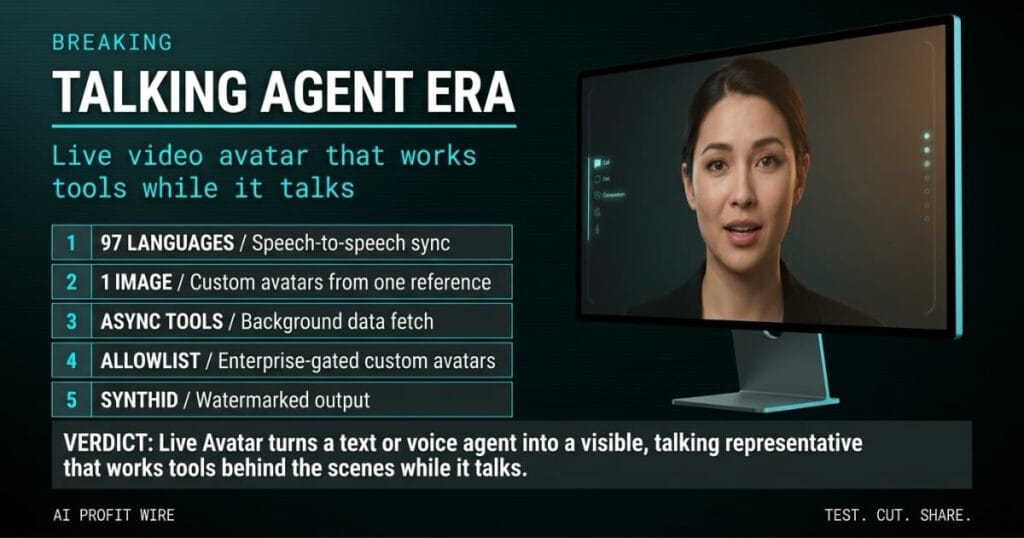
Could transform digital customer service and interactive walkthroughs once pricing and availability expand beyond enterprise allowlisting.
What is Gemini 3.8 Live with Live Avatar?
Gemini 3.8 Live with Live Avatar is Google DeepMind’s near real-time video layer for its live dialogue models, announced September 24 and available in Gemini Enterprise. It pairs near real-time video generation with speech to create a visual persona that listens, sees, and speaks.
The feature targets enterprise agents handling customer service and interactive walkthroughs. Beyond the visual layer, the system runs asynchronous tool calling, which means it triggers tool calls and fetches data in the background while the conversation keeps moving. The announcement came from Google DeepMind’s own research team, and the availability language is specific: it ships in Gemini Enterprise starting today, with API documentation to follow for allowlisted teams.
Live Avatar turns a text or voice agent into a visible, talking representative.
Does Gemini 3.8 Live Avatar work in real time?
Google claims near real-time visual presence with precise lip-syncing, natural expressions, and fluid turn-taking, with audio and video inputs processed at the same time. The multilingual claim is the hard number in the announcement: native speech-to-speech synchronization across 97 languages, with lip-sync and expressions adapting mid-conversation. The video generation pairs with speech in the same stream, and Google claims the persona holds fluid turn-taking, which is the part earlier video avatar demos kept breaking.
Every generated output carries an imperceptible SynthID watermark woven into the audio and video, which keeps AI-generated content detectable. The claim set is vendor-stated and no independent latency benchmarks ship with the announcement, so the near real-time language deserves testing against your own traffic.
97 languages with adaptive lip-sync is the measured claim, and the latency claims await independent testing.
How does Live Avatar compare to a standard support chatbot?
A standard support chatbot handles text turns one at a time and goes silent whenever it queries a backend system. Live Avatar processes visual and audio inputs at the same time and keeps talking while its tool calls run in the background, which removes the dead air that erodes trust on a live call.
The second difference is presence. A library of preset avatars ships alongside custom avatar creation, where developers generate an animated, responsive avatar from 1 high-quality reference image while preserving reference likeness, brand styling, and character identity. The launch post on Google’s blog shows the hotel check-in demo, where the avatar books a guest without breaking conversation to fetch data.
Live Avatar adds a visible face and background tool execution to what a chatbot does with text.
Who is Gemini 3.8 Live Avatar for?
Right now it serves enterprises already inside Gemini Enterprise, because custom avatar creation sits behind enterprise allowlisting and Google published no pricing. Teams running customer service or interactive walkthroughs at volume are the natural fit, and the watermark defaults make it usable where disclosure matters.
Small business owners outside the enterprise tier should watch the adjacent market instead. Conversational support tools you can deploy today, like Tidio, the AI chat and lead capture platform we profiled, cover the text tier of the same job while the avatar tier matures and prices settle. The watermark default matters for disclosure policies too, because detection tooling can verify AI output without the caller ever seeing a label.
Today it serves enterprise allowlisted teams, and everyone else should be mapping workflows.
The Tuesday queue holds a Spanish ticket and a Japanese ticket, and both wait for the same bilingual agent who starts at 10. The English tickets move, the others age, and the customers behind them watch the clock.
An avatar that switches languages mid-conversation, 97 of them with lip-sync intact, covers the whole queue with 1 deployment. The bilingual agent covers 2, and the second one costs a salary.
Google’s demo checks in a hotel guest while the avatar’s tools run behind the dialogue, which is the part that matters at small scale: the customer hears no hold music, no silence, no transfer. The 97-language number is the budget case, and the unpublished pricing is the only thing standing between it and a purchase order.
Should your business wait for Gemini Live Avatar pricing?
Yes, wait on the purchase and prepare the case. Pricing is unpublished, custom avatars are allowlist-only, and no independent benchmarks exist, which makes this a mapping exercise instead of a buying decision.
Pull your last 30 days of customer conversations and count 2 things: interactions that stalled on a language barrier, and interactions that stalled while someone went to fetch data. Those counts are your business case and your budget ceiling the day Google publishes pricing. A business that finds a handful of stalls has a small case, and a business that finds hundreds has a budget conversation waiting on the price sheet.
Map the 2 stall counts now, and buy when the price sheet lands.
Source: Google DeepMind
