Shifts in consumer attention away from social feeds and toward AI interactions may require small businesses to rethink their digital marketing and content strategies.
What is AI slop?
AI slop is mass-produced content made with generative tools and optimized for reach instead of meaning. It fills feeds with images, video, and text that look close enough to human work to scroll past, and it costs every business that buys attention in a feed.
Bloomberg recorded a conversation at the Vermont in Hollywood with 2 veteran internet commentators: Rachel Karten, a social media consultant and author of the Link in Bio newsletter, and Taylor Lorenz, founder of User Mag. Karten consults on social strategy for brands and Lorenz has covered internet culture for a decade, so both were working through the question their clients keep asking: what does a professional feed strategy mean when the feed itself changes under you.
AI slop is a distribution problem that lands on every business that buys reach in a feed.
How much AI slop do users actually see?
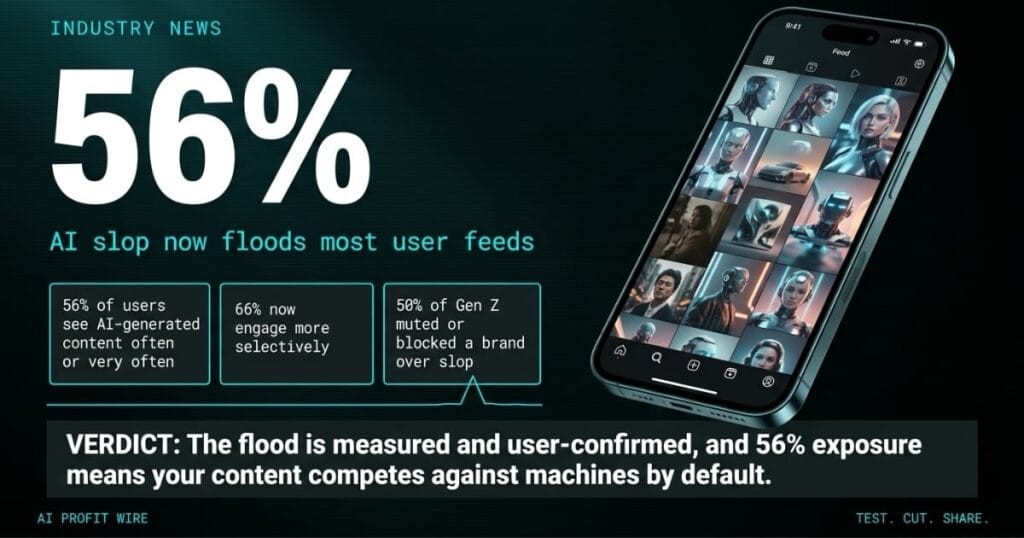
56% of social media users say they see AI-generated content often or very often in their feeds, per Sprout Social’s Q1 2026 Pulse Survey. The exposure is measured and user-confirmed, which settles the argument that slop is a niche annoyance.
The behavioral numbers are worse for brands. The same survey found 66% of users have become more selective about what they engage with, and the blocking scales by generation: 29% of Baby Boomers, 38% of Gen X, 44% of Millennials, and 50% of Gen Z have already unfollowed, muted, or blocked a brand or creator because their content felt like AI slop. Unlabeled AI content is the number 1 brand turn-off, with 28% of users naming it the single thing they most wish brands would stop doing in 2026, per aggregated survey stats.
A majority of the audience now sees machine-made content by default, and a large share punishes brands for it.
How is the chatbot shift different from feed scrolling?
The old playbook assumed a human scrolls a feed and a post interrupts them. The emerging behavior the Bloomberg panel described is a human asking a chatbot and receiving 1 answer.
A feed post wins by stopping a thumb for 2 seconds. A chatbot answer wins by being the clearest, most citable source on a specific question, and it carries attribution with it, naming the source it quotes while a feed impression dissolves the moment the thumb moves on. The performance metrics slop erodes, reach, engagement, watch time, saves, belong to the feed model, and none of them measure whether an AI assistant would quote you.
Feed content optimizes for interruption, and chatbot visibility optimizes for being the answer.
What does the AI slop shift mean for a content team?
The shift lands on the content calendar first. Money spent on feed content assumes a human scrolls past it, and when 56% of what that human sees is machine-made, the odds of stopping them drop every quarter. The calendar question is which pieces earn their slot, because content that answers a real question keeps its budget and content that exists to fill the schedule loses it.
The migration play is owning a channel where the audience still asks a direct question, and a newsletter is the cleanest version of that move. Beehiiv, the newsletter platform we profiled, is built for the owned-audience model this shift rewards, because an inbox list is the asset a feed algorithm cannot dilute and the subscription is consent a chatbot answer can build on.
Feed-first content plans are the budget this shift exposes, and owned channels are the hedge.
The Monday metrics review shows reach down again, and nothing in the dashboard explains it. The graph trends softer every week while the posting cadence holds.
It plays like a contractor who keeps leaving flyers in a neighborhood where the mailboxes now route to a sorting service that bins printed ads. The flyers are fine. The delivery route died.
The fix is finding the 1 channel where the reader still asks a question and gets your name as the answer, which is the chatbot conversation the Bloomberg panel described. The 56% exposure number is the reason the route died, and it will not warn you on the way down.
What should you do about the feed migration now?
Audit content for citability this week, because reach metrics will not warn you before the feed stops delivering. Take the last 5 published pieces and ask whether an AI assistant would surface any of them as an answer to a customer question.
Whatever passes that test gets more budget, and whatever fails gets rebuilt as a citable page or cut. The audit takes an afternoon with existing analytics, it needs no new tooling, and it reorders next quarter’s calendar before the media budget locks instead of after. A shorter accurate answer beats a longer scroll-stopper every time the reader is an assistant.
Audit 5 pieces for citability this week, before the next media budget locks.
Source: Bloomberg Tech
