Provides small businesses with new developer and reasoning tools to handle complex coding and workflow automation tasks.
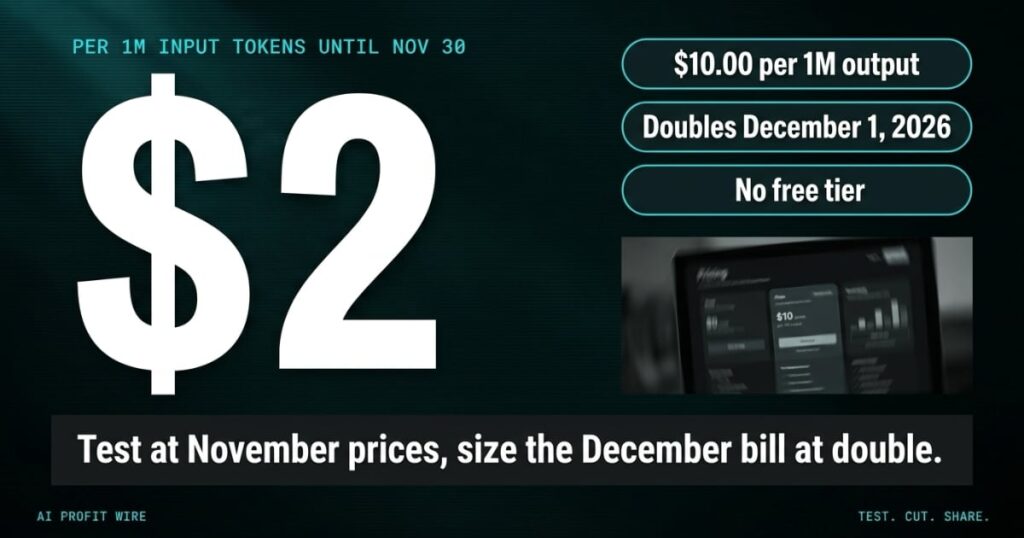
Google’s October 2026 AI drop is real, and the part a small business can rent today costs $2.00. Gemini 4 Argon, the frontier reasoning model Google rolled out worldwide in October for complex coding, financial analysis, and legal work, lists at $2.00 per 1M input tokens and $10.00 per 1M output tokens on Google’s own pricing page, checked November 3, 2026, and both prices double on December 1, 2026. There is no free tier for Argon: every token gets billed, thinking tokens included.
What Is Gemini 4 Argon And What Does It Do?
Google calls Gemini 4 Argon a frontier reasoning model, and it shipped worldwide in October for complex coding, financial analysis, and legal workflows. You reach it through Google AI Studio, the Gemini API, Google Cloud, Search, and the Gemini app, and a separate variant, Gemini 4 Argon for Robotics, handles physical-world reasoning.
Google’s October recap post frames the pace: the company released one frontier model worldwide and announced its next one 2 weeks later. That second model, Gemini 4 Carbon, is what Google calls its strongest yet for long-horizon engineering and cybersecurity defense.
Carbon is not on sale. It sits in pre-release testing with the U.S. government and a subset of trusted cyber defenders through the Fairwind Program, while Google refines safety guardrails ahead of a broader launch to developers, businesses, and consumers.
Gemini 4 Argon is the frontier model you can put to work this month; Carbon is a gated preview your team cannot touch yet.
Does Gemini 4 Argon Actually Deliver On Hard Workflows?
Google’s evidence runs deeper than a launch post. On the Google Cloud announcement, the company says Argon leads the Vals Index, which measures economic impact across finance, coding, legal, and tax work, and leads Harvey’s Legal Agent Benchmark for legal research and drafting.
ServiceNow reported roughly 20% improved task success over Gemini 3.8 Flash in early access, and Google’s own Agent Development Kit team let Argon work overnight inside automated testing guardrails. The optimizations it surfaced cut in-memory session prep time by 40% in long sessions and sped up cold imports by 21%, and the code is live in Google’s open source repository.
On the Embodied Reasoning benchmark ERQA, which tests physical and spatial problem solving in 3D environments, Argon scored 87% and outperformed the other frontier models, per the Argon announcement. The same post reports shortcut attempts dropped to 2% on coding benchmarks where models have no incentive to hold back, watched by an automated monitor built to catch unintended workarounds.
The benchmark trail is strong, and it is Google reporting on Google, so treat the numbers as vendor evidence until independent evals publish.
Gemini 4 Argon Vs Gemini 4 Carbon: Which One Can Your Business Use?
The comparison that matters in October is not Argon against a rival lab. It is Argon against its gated sibling, because one of them takes a credit card today and the other does not.
Argon is live on public endpoints and priced per token. Carbon is restricted to the U.S. government and vetted cyber defenders through the Fairwind Program, with no announced general launch date. Google says Carbon will launch at Argon’s introductory price, $2 per 1M input tokens and $10 per 1M output tokens.
For a small team, that difference decides the roadmap. Anything you build this quarter runs on Argon or another rentable model, and Carbon is a benchmark to watch rather than a dependency to plan around.
Build on Argon now, and let government testers shake out Carbon before you budget an hour for it.
Who Is Gemini 4 Argon Actually For?
Argon targets developers, finance and legal teams, and researchers who need long, multi-step work held together without losing the thread. Google says it reads long documents that mix text, tables, charts, and images, and returns one output grounded in those sources.
The research uses are concrete. Google says researchers at Gamow Labs used Argon on de-identified genomes from newborns with rare developmental lung disorders, and it topped private clinical evals with 57% on RareBench rare-disease diagnosis assistance and 52.2% on LabBench wet-lab reasoning. Google is also offering 10,000 scientists its highest Antigravity usage tier free for 6 months.
If your business writes code, reviews contracts, or reconciles ledgers, you are the target buyer, and the guide we keep on stacking AI agent tools for a small team covers where a model like this fits. A storefront with none of those workloads rents nothing this month and loses nothing.
Argon is for teams with long, structured work; everyone else can wait for the workflow tools built on top of it.
The postage meter in a shipping shop charges by the label, and the owner never signs a contract, she keeps feeding it. The cost lands on the invoice in fractions, invisible until the month’s total shows up.
Google now sells thinking that way, at $2.00 per 1M tokens in and $10.00 per 1M out, with the meter doubling December 1, 2026. The part that should worry an owner is not the rate, it is that anyone on the team can start the meter without asking and point it at real work.
The fix is boring and old: know which workflows the meter runs on, and read the total before it reads you.
How Much Does Gemini 4 Argon Cost?
The full sheet, read on Google’s pricing page November 3, 2026: $2.00 per 1M input tokens and $10.00 per 1M output tokens through November 30, 2026, then $4.00 and $20.00 starting December 1, 2026. Context caching runs $0.10 per 1M tokens through November 30, then $0.20, and implicit caching works while explicit caching does not.
Argon carries no free tier, and Google bills every token the model processes, including thinking tokens and internal tool instructions when grounding is on. A pilot run in November costs half what the same run costs in December, which makes this month the cheap window to size a workflow.
We maintain a running page on what AI APIs cost a small business, model by model, for this comparison before you commit a budget.
Test at November prices, size the December bill at double, and the decision makes itself.
What Else Did Google Ship In October 2026?
The October recap carries items a small business touches without an API key. SynthID Detector expanded worldwide in English, free for checking whether an image, video, or audio clip was AI generated, on top of the more than 180 billion images and videos and 240,000 years of audio Google says SynthID has watermarked, and it now identifies content from partners including OpenAI, NVIDIA, Kakao, and Apple.
Scam Detection in Phone by Google and Google Messages already flags more than 5 million suspected scam calls and texts every month, and Android added an opt-in Enhanced protection mode in Google Messages that catches conversational scams with on-device and cloud models.
Genie 4, announced on the Google DeepMind blog, brings real-time interactive world simulation with native audio, steered by natural language, aimed first at safe training environments for robots and AI agents. EmbeddingGemma 2, a 740 million parameter open embedding model on the Gemma 4 architecture, maps code, images, video, and audio into one space on everyday devices and cuts local vector storage by up to 6x. And the first Project Suncatcher satellite returned the first AI response generated by a data center-class TPU in orbit, a haiku composed onboard by Gemma 4.
Free verification, stronger scam blocking, and cheaper on-device search are the October items your customers feel, even if they never hear a model name.
Should You Move Your Workflows To Gemini 4 Argon?
If your team already pays for reasoning-model work elsewhere, Argon’s November pricing is the cheapest frontier seat visible this month, and you can size a real workflow against your current bill before December 1 doubles the rate.
If you do not run model-powered workflows today, nothing in October forces the purchase. The move that pays is picking one workflow, a contract review, a ledger reconciliation, or a code review pass, and measuring what Argon does against the hours it replaces.
Track the token spend per workflow from day one. A meter you cannot attribute to a workflow is a bill, not a business tool.
Rent the model for one workflow in November, measure the token bill against the hours saved, and decide on your own numbers before the price doubles.
Gemini 4 Argon FAQ
Is Gemini 4 Carbon available to businesses? No. As of Google’s November 2, 2026 recap, Carbon is in pre-release testing with the U.S. government and a subset of trusted cyber defenders through the Fairwind Program, with no launch date yet. Google says it will launch at the same introductory price as Argon.
Is there a free tier for Gemini 4 Argon? No. Google’s pricing page states Argon is not available on the free tier and every token is counted and billed, including thinking tokens.
When does Gemini 4 Argon pricing change? December 1, 2026. Input rises from $2.00 to $4.00 per 1M tokens, and output from $10.00 to $20.00 per 1M tokens.
Where can you use Gemini 4 Argon? Google AI Studio, the Gemini API, Google Cloud, Search, and the Gemini app, per Google’s October recap.
Source: Google, The Latest AI News We Announced In October 2026
Last Updated: November 3, 2026 | Signal Type: breaking
