Can significantly reduce product design and prototyping time for hardware startups and consumer brands by catching manufacturing issues early.
What is Suzanne AI and what changed?
Suzanne AI is an industrial design tool that generates manufacturable 3D products from sketches, photos, or text prompts. It combines generative design with physics and manufacturing intelligence to bridge the gap between concept and production.
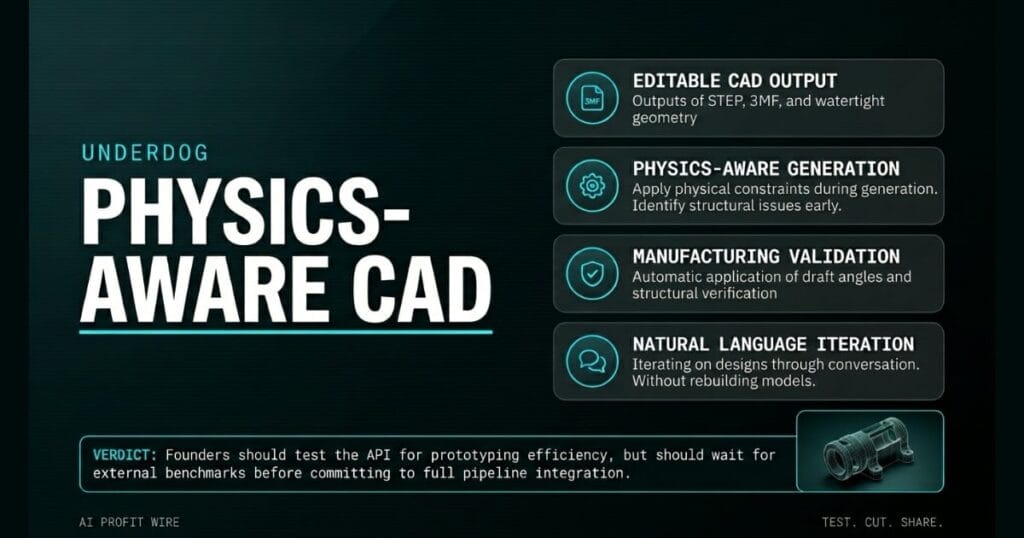
The tool outputs editable CAD files, including STEP, 3MF, and watertight geometry for direct engineering workflows. It applies physical constraints during generation, which helps teams identify structural and manufacturing issues early.
Users can iterate on designs through natural language conversation, adjusting form and function without rebuilding models from scratch. The platform currently offers API access and is backed by Founders, Inc.
Suzanne AI changes the product design pipeline by embedding physics-aware validation directly into the concept generation phase.
What is the evidence behind Suzanne AI?
The tool demonstrates its capability through specific design outcomes shown on its website. One example includes an AI-generated enclosure that was made 31% lighter while maintaining structural requirements.
The system verified the structure of the optimized geometry and updated the model with production-ready geometry. It also applied draft angles to ensure the design was ready for manufacturing processes.
The evidence confirms operational functionality, showing how the tool handles physical constraints during the design phase.
How does Suzanne AI compare to the alternatives, and what background do small business owners need?
Most AI 3D tools stop at generating visual geometry, leaving engineering teams to fix physical and manufacturing issues later. Suzanne AI integrates physics, mass, and load considerations directly into the generation process.
Traditional workflows force designers to spend hours modeling every concept before evaluating physical viability. Suzanne AI allows teams to explore more possibilities and validate constraints before committing budget to physical prototypes.
This approach targets consumer hardware companies, wearables startups, and DTC brands that need to move from concept to functional prototype quickly. The API access allows businesses to integrate this generation and validation into their own applications.
Compared to standard 3D generation tools, Suzanne AI provides a closer starting point for physical production by solving engineering constraints upfront.
How does Suzanne AI affect day-to-day operations for small businesses?
Small hardware startups can reduce the time spent between initial concept and functional prototype. The ability to iterate through plain language reduces the need for specialized CAD knowledge during the early design phase.
Catching manufacturing issues early prevents expensive physical prototyping errors. Teams can export clean CAD files and move directly into their existing engineering workflows.
Founders can explore more concepts without spending hours modeling every variation. You can track signals on tools that automate physical product design to stay ahead of these operational shifts.
Day-to-day operations shift toward faster iteration and fewer physical prototyping failures.
You’re on the phone with your custom bracket supplier, and they tell you the latest mold design lacks the proper draft angles for a clean pull. You open the file your junior designer sent over, and right there on screen is a geometry that will bind in the steel mold, costing you thousands in rushed machining fixes to salvage the run.
Suzanne AI catches that before you ever send the file. It applies draft angles during generation and verifies the structure, so what reaches your supplier is already optimized for their process. No last-minute redesign, no expedited tooling fees.
That 31% weight reduction on the enclosure means less material to buy and less weight to ship. For a hardware startup on a first production run, that’s real cost savings on every single unit.
What is the final verdict on Suzanne AI?
Suzanne AI offers a distinct advantage for hardware startups by validating manufacturing constraints during the design phase. It reduces the friction between concept and functional prototype.
Founders can request API access to test its operational value for prototyping efficiency. The current evidence is limited to website demonstrations showing the tool’s physics-aware generation approach.
It targets a specific pain point in the product design pipeline that standard 3D tools ignore. The physics-aware generation approach catches expensive errors early.
Founders should test the API for prototyping efficiency to evaluate its value for their pipeline integration.
Source: suzanne3d.com
