Dramatically cuts hours spent searching internal media libraries, translating into significant labor cost savings.
What Did Condé Nast Build With Amazon Bedrock?
Condé Nast built a multimodal video discovery system on Amazon Bedrock and Amazon OpenSearch Service, working with the AWS Generative AI Innovation Center.
The system searches a library of more than 140,000 videos by what the footage contains, and it serves editorial teams across brands including Vogue, GQ, Vanity Fair, and Wired.
The engine underneath is the TwelveLabs Marengo embedding model, accessed through Amazon Bedrock’s multimodal embedding models, which jointly encodes visual, audio, and transcript signals so a clip is findable by what is said, shown, or heard.
This is a custom enterprise build on AWS infrastructure, not a packaged product a small business can subscribe to today.
Does Multimodal Video Search Actually Cut Discovery Time?
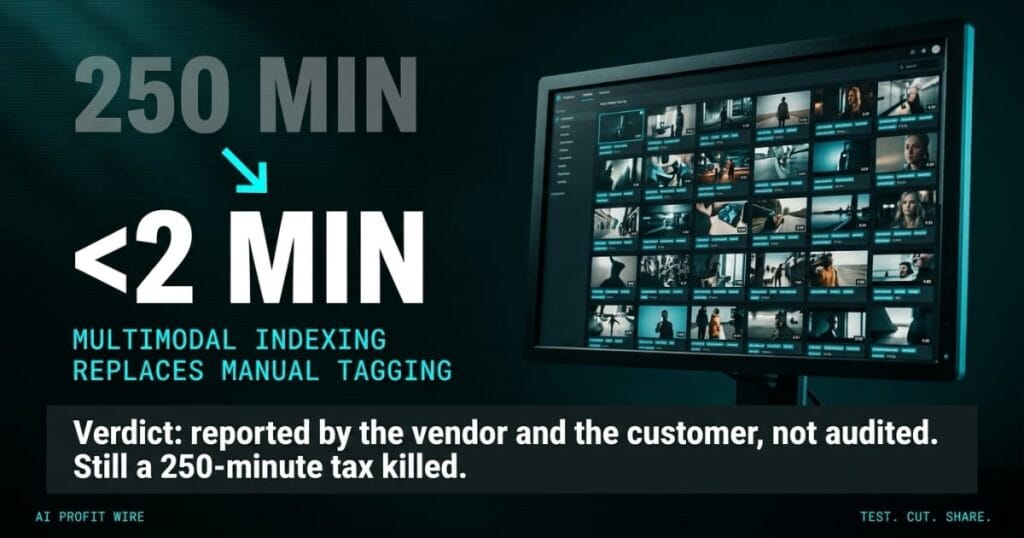
Yes, by the numbers Condé Nast and AWS published: average discovery time fell from 250 minutes per task to under 2 minutes, a 99.2 percent reduction.
Those figures come from a benchmarking workshop Condé Nast ran in May 2026, which the companies documented on the AWS Machine Learning Blog.
The same workshop measured a reduction of more than 90 percent in manual video review effort and an estimated $800,000 in annual operational savings from the recovered hours. Teams receive targeted clips with precise timestamps instead of scrubbing through individual videos, which is where the recovered hours actually come from.
The system has run in production for 6 months, and search stayed available while the ingestion pipeline reprocessed the full archive.
The claimed saving is dramatic, and it comes from the vendor and the customer together, so treat it as a reported outcome rather than an audited benchmark.
How Is Amazon Bedrock Video Search Different From Keyword Search?
Keyword search matches words in a filename or description, while multimodal search matches what appears inside the video itself.
Under the old approach, a clip tagged poorly in 2019 stayed invisible, because the search could only find what the tagger typed, and institutional knowledge about the archive lived in specific people’s heads.
The new layer converts natural language into vector similarity search using the k-nearest neighbor engine in Amazon OpenSearch Service, which returns relevant clips with precise timestamps and tolerates typos in the query.
The capability list runs deeper than text queries: editors can upload a reference image to find visually similar content across the archive, and the search resolves intent rather than exact strings, so “beginner yoga content with calming backgrounds” finds footage no filename ever described.
Search stops depending on how disciplined a team was at labeling files and starts depending on what the files contain.
Who Does AI Video Search Actually Affect?
Any business sitting on a large library of media or records that staff search by name pays this tax, and the Condé Nast case measures it at 250 minutes per task.
Media companies feel it first because video is expensive to store and hard to tag, and agencies with years of client footage carry the same problem at smaller scale.
Teams can adopt the same intent-based pattern on managed infrastructure, because Amazon documents the Bedrock platform for multimodal embeddings and the vector search layer behind it, although the integration work still belongs to your team.
Teams already sitting on long-form video face the same economics one step downstream, because turning hours of raw footage into short-form clips starts with knowing what the archive actually contains.
The affected group is whoever pays wages for hunting, and that description fits far more industries than publishing.
The raw kickoff recording sits in a drive folder named 2026-Q1-Raw while the account lead rereads the brief for the third time.
A client disputes what was agreed in March, and the proof lives somewhere in 3 years of project footage. The team burns an afternoon scrubbing timelines because the only index is filenames, and that afternoon is the 250-minute figure wearing a small-business shirt.
Index what the footage contains and the same question becomes a search box, because describing the moment returns the timestamp. The gap between 250 minutes and under 2 is the difference between answering a client this week and answering them this month.
What Should You Do About AI Video Search Now?
Measure your own search cost before you price any fix: time the last few hunts your team ran for a file, clip, or record they knew existed.
If the average runs long, the metadata is the bottleneck, and content-level indexing is the category of solution worth evaluating.
Watch for packaged tools built on this embedding-then-search pattern rather than commissioning a bespoke system, because the Condé Nast result came from a custom enterprise engagement with AWS specialists.
If your library is smaller, the same discipline still applies in plain form: name files consistently, keep descriptions honest, and measure the search tax before you spend on any fix, because a baseline number is what turns a vendor pitch into a business case.
Get your own baseline number this week, because you cannot judge a 250-to-2 improvement until you know what your version of 250 costs you.
Source: AWS Machine Learning Blog
