These new developer tools and subscription tiers may impact operational costs and workflow automation options for businesses.
What Did OpenAI Launch at DevDay 2026?
OpenAI used DevDay 2026 in San Francisco to launch personal AI agents called Dots, an Ultrafast inference tier, a cheaper flagship-class model called GPT-6.1 Sol, and a Pro 500 subscription plan, according to Simon Willison’s live blog from the keynote.
Dots are personal agents powered by the Astra model, each with its own name and avatar, and they shipped to ChatGPT Pro and Enterprise customers on keynote day alongside ChatGPT Spaces, a shared workspace where a team collaborates with its agents.
The platform side added an Agents API with computer use, plugin extensions that run as full applications inside ChatGPT, and the OpenAI Marketplace, with OpenAI’s own DevDay 2026 recap collecting the announcements.
The shape of the day: a consumer-style agent launch and a pricing restructure, and the pricing half is what hits a business first.
Is Ultrafast Actually Worth 6 Times the Price?
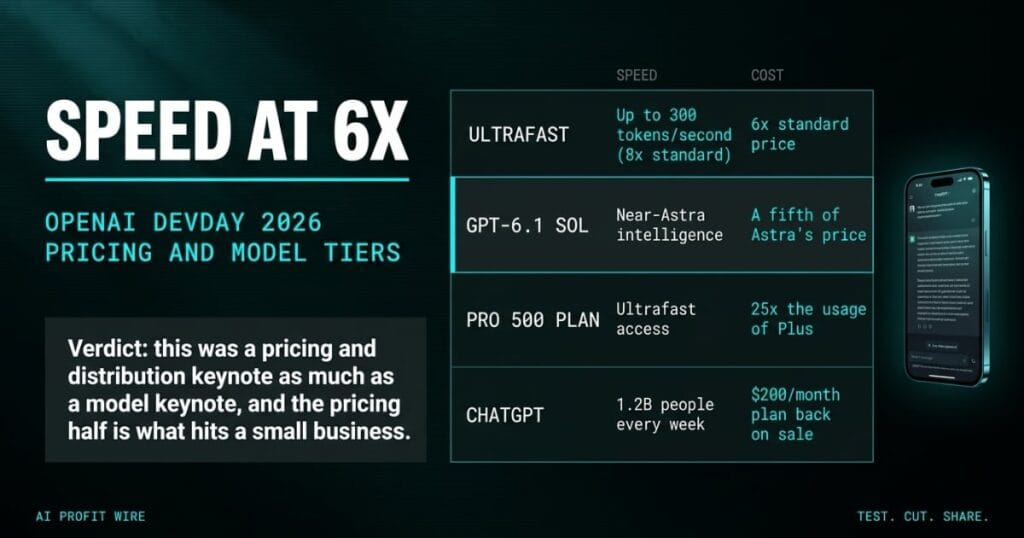
Ultrafast runs up to 300 tokens per second, which OpenAI describes as 8x faster than standard, and it costs 6x the standard price in the API, ChatGPT, and Codex.
Sam Altman’s on-stage framing was “you know what, it’s worth it,” and the honest read is that the answer depends on what a second of latency earns: the 300 tokens per second figure is a vendor ceiling to test against, not a guarantee your workload sees.
Availability is staged, with Ultrafast supporting Astra 6 today and GPT-6.1 Sol support arriving soon, so the speed premium cannot attach to the cheap model yet.
OpenAI also previewed a Decisions API that lets a model respond in a fraction of a second by choosing from a predefined set of options, a sign the firm is pricing and engineering latency as a product surface of its own.
The claim is testable in an afternoon on your own workload, and the workload that cannot tell the difference is the one that should never pay it.
Which DevDay Model Should Your Team Pay For?
OpenAI positions GPT-6.1 Sol as near-Astra intelligence at a fifth of the price, and the company’s launch announcement frames it the same way.
Astra remains the model behind Dots and the default for the most ambitious agentic work, which makes the 5x price spread the practical dividing line between the 2 tiers.
Customer-facing agent work where response time is the product justifies premium inference, and internal batch work, summarization, drafting, and routing move to Sol, because no human watches the spinner.
The split is about human attention: pay the premium where someone feels the wait, and take the discount where the wait is invisible.
Who Do the DevDay 2026 Launches Actually Affect?
Developers and teams already building on OpenAI feel this first, because Ultrafast and Sol both land in the API and Codex, and the Pro 500 plan bundles Ultrafast access with 25x the usage of Plus.
Altman also put the user scale on record: 1.2 billion people use ChatGPT every week, and OpenAI brought the $200-per-month Pro plan back on sale for new subscribers, which sets up the Pro 500 tier above it.
For small businesses building on the platform, sign-in with ChatGPT, ChatGPT Sites, and the marketplace shorten the path from prototype to product, and specialist Dots for legal and finance are on the roadmap with Microsoft 365 integration. The pricing behind your AI stack changes faster than the tools do, so check any new tier like Ultrafast against our AI API pricing tracker before you commit a workload to it.
The audience is teams automating real workloads, and the launches reprice what those workloads cost to run.
The support queue peaks at 4 in the afternoon and the AI agent answering tickets watches the same clock the customers do.
Response time is the product there, so the 6x premium buys something a customer can feel. Three desks away, the same company runs an agent that summarizes yesterday’s tickets overnight, and that agent does not face a customer, so 6x buys it nothing but a bigger invoice.
The 300-token-per-second tier is for the queue with humans in it, and the fifth-price model is for the overnight batch, and a stack that confuses the 2 pays flagship prices for work nobody watches.
What Should You Do About Your OpenAI Bill Now?
Audit your agent workloads by who waits on the output, and put customer-facing latency in one column and background batch work in the other.
Test Ultrafast on the 1 workflow where response time demonstrably earns revenue, and hold the 6x until the test proves the speed converts, because the price applies per token and it compounds.
Route the batch column to GPT-6.1 Sol where availability allows, price the Pro 500 plan against your actual Plus usage if the team keeps hitting caps, and revisit the split every quarter.
The bill you save arrives before the speed you miss, and the split takes an afternoon to set up.
Source: simonwillison.net
