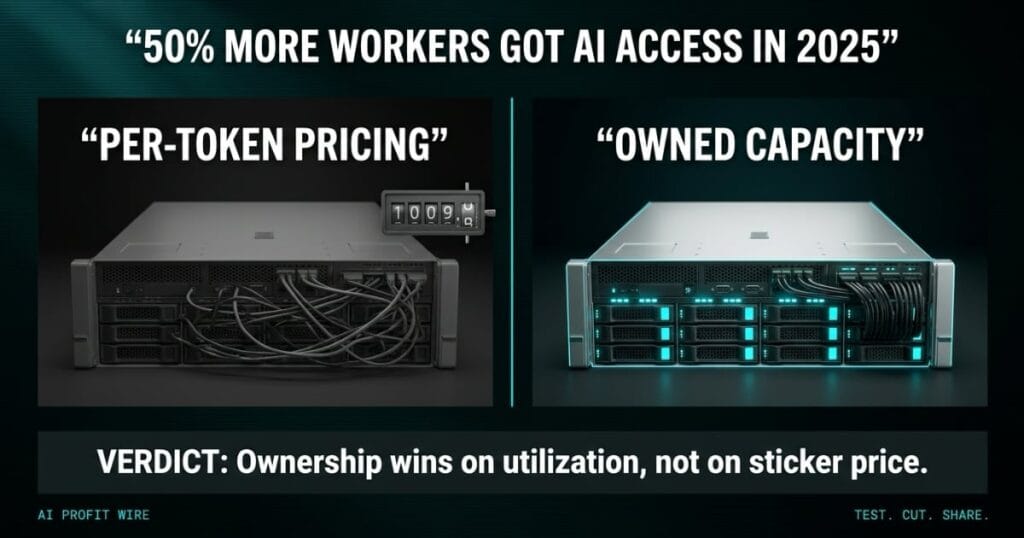
Helps small business owners forecast whether owning dedicated AI infrastructure makes more economic sense than paying per-token cloud fees as usage scales.
What is the AI infrastructure crossover point?
The crossover point is the level of sustained AI usage at which owning capacity becomes more economical than buying it one request at a time. It applies to any business moving AI from experiments into production workloads.
Deloitte’s 2026 State of AI in the Enterprise shows why the question is landing now: worker access to AI rose 50% in 2025, and the number of companies with at least 40% of their AI projects in production is set to double within six months.
As AI becomes a portfolio of always-on workloads, assistants, retrieval systems and agentic applications create recurring demand, which is where consumption pricing stops behaving.
Every organization has a crossover point, and no two share the same number.
Does per-token pricing actually fail at steady usage?
Per-token pricing does not fail outright: it fails your ability to forecast the month. A consumption-only approach turns AI spending into a variable monthly line item that becomes difficult to predict as usage and model requirements change.
That is the central claim of an HPE-sponsored analysis published in MIT Technology Review, which states that consumption pricing gives teams flexibility and limits commitment, but the economics change once demand becomes steady and business-critical.
The published rate cards show the same structure across vendors. Google’s Vertex AI pricing page lists pay-as-you-go rates per token or per character, which keeps the monthly total pinned to usage volume.
Rent while usage is lumpy, and expect the invoice to surprise you the month a workload goes steady.
How is owning AI capacity different from per-token cloud pricing?
Per-token pricing charges per request with no commitment, while ownership is a fixed capital investment that only pays off when utilization stays high. The source is direct on this point: ownership is not the lower-cost answer by default, and it only makes sense when an enterprise can keep capacity productive.
When multiple workloads share infrastructure, fixed costs spread across more productive use, which improves the economics of ownership.
The crossover depends on the models used, the balance of input and output tokens, performance requirements, system design, energy costs and the operating model, which is why generic cost benchmarks cannot settle it.
Independent hardware analysis points the same direction. Lenovo’s 2026 total-cost-of-ownership study puts on-premises breakeven under 4 months for high-utilization generative AI workloads.
Workload shape moves the number more than vendor choice does. A retrieval-heavy knowledge system processes far more context per interaction, so it carries a different cost profile from a simple assistant, and agentic workflows run hotter still because a single business task can involve repeated reasoning, retrieval, model calls and tool use.
Ownership wins on utilization, not on sticker price.
A 60-person software company crosses its second straight month of five-figure AI bills, and the CFO opens the budget meeting with one question: is this a cost problem or a capacity problem. Nobody in the room has modeled utilization, because access expanded 50% in a year and the billing arrived before the planning did.
That moment is the crossover point, and it shows up looking like a pricing dispute. The per-token line is a symptom, and the real question is whether demand has steadied enough that owning capacity beats renting it request by request.
The move is a workload audit, not a vendor negotiation. Twelve to 18 months of demand, one spreadsheet, and a utilization number per workload settles it.
What does the shift to AI production workloads require a business to do?
It requires modeling actual workloads and demand over the next 12 to 18 months before committing capital, then sizing capacity against expected utilization.
The analysis frames the decision as 3 questions: whether demand is steady and large enough to justify dedicated capacity, at what usage level ownership makes economic sense, and whether the business can keep that capacity productive.
Capital is half the equation, because capacity creates value only when workloads reach production fast and stay running, which takes an operating model covering adoption, governance and utilization review.
Seeing that utilization picture starts with the rates you pay today, and what the major AI APIs charge per token right now is the baseline every ownership model gets compared against.
Map your 12 to 18 month demand before you sign anything.
What should you do about AI infrastructure costs now?
Pull your AI spend by workload this week, identify which ones run steady and business-critical, and model each against dedicated capacity before the next budget cycle.
For most businesses still in pilot mode, consumption pricing remains the right call, because flexibility and limited commitment matter more than a theoretical crossover. The signal to watch for is a workload that runs every day, ties to a business process, and grows month over month, because that is the one worth modeling against dedicated capacity first.
Rent while usage is lumpy, model ownership the moment it goes steady, and never buy capacity you cannot keep working.
Source: MIT Tech Review
