Could eventually reduce software subscription costs and simplify team workflows by centralizing document creation and collaboration within ChatGPT.
What did OpenAI launch in ChatGPT’s new office suite?
OpenAI announced a set of office-style features inside ChatGPT at its Dev Day conference in San Francisco on September 29, 2026, and the package resembles a Microsoft Office suite. TechCrunch’s announcement coverage walks the full feature set, which lands on a chatbot TechCrunch reports OpenAI says now reaches 1.2 billion weekly users.
The headline feature is Space, a shared workspace inside ChatGPT where coworkers can collaborate with the chatbot and with Dots, the AI agent personas OpenAI launched at the same event that carry out tasks on a user’s behalf. CEO Sam Altman said pages and files live together in Space the way they would in a drive, and that spaces “feel alive” rather than static.
OpenAI also launched Pages, a companion word processor it describes as “a new type of document, built for human and agent collaboration,” which reads as a direct answer to Google Docs and Microsoft Word. Users can write, research, generate charts, create images, and visualize information inside one document, and a third feature, collaborative slides, targets PowerPoint and can be created by talking about them inside ChatGPT.
OpenAI has moved from powering Microsoft’s AI features to competing with the suite those features live in.
Does ChatGPT Space actually work like a shared drive?
Based on the official presentation, Space behaves like a drive with instructions attached, although no independent benchmarks exist because the features were announced the same day.
Altman said users can give a page specific instructions, such as checking a team channel and updating the page with what it finds. That is a standing automation layered on top of file storage, which a traditional drive does not do on its own, and it is the one capability that separates Space from a shared folder.
What the announcement leaves out carries the same weight: no performance benchmarks, no pricing, and no confirmed release date for Slides beyond the coming weeks. Everything known so far comes from OpenAI’s own stage demo, reported by TechCrunch.
Treat the Dev Day demo as a product direction until independent testing exists.
How is the ChatGPT office suite different from Microsoft 365?
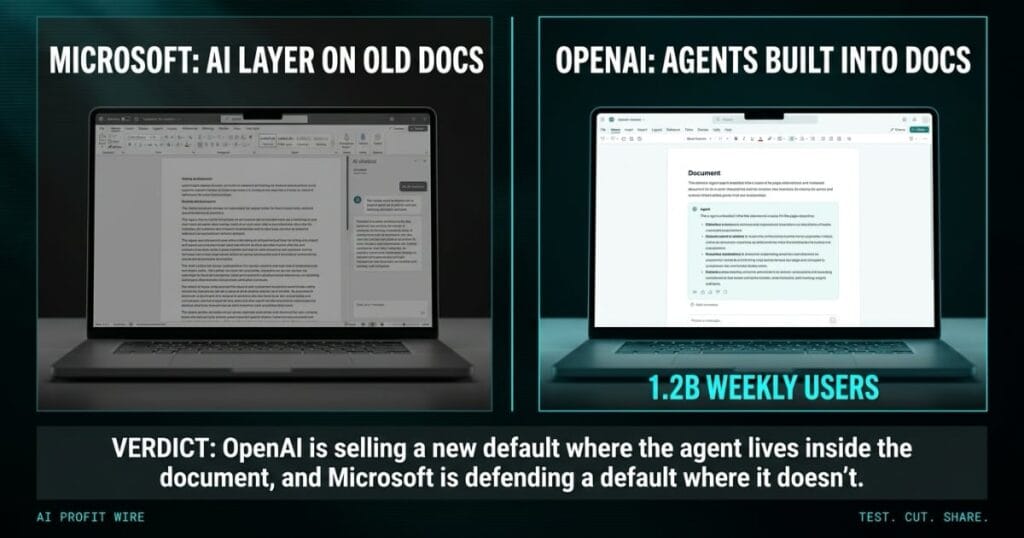
The core difference is that OpenAI built documents around AI agents first, while Microsoft built an AI layer on top of documents that already existed.
In ChatGPT, multiple workers and agents can work together inside a slide deck, leave comments, and edit it, and Pages is described as a document built for human and agent collaboration. Microsoft describes Copilot as AI integrated into Word, Excel, PowerPoint, Outlook, and Teams, which is the exact suite OpenAI’s new features are chasing.
Microsoft and Salesforce have spent the past year shipping AI products that move in the opposite direction, adding agents to established software, and OpenAI spent that same year as Microsoft’s closest AI partner, a relationship the two companies documented for years. The overlap is now direct: Pages against Word, collaborative slides against PowerPoint, and Space against the shared drive model.
The gap is maturity, since OpenAI’s slides feature is not available yet and rolls out in the coming weeks, while Microsoft’s suite has decades of enterprise deployment behind it. OpenAI is selling agents inside documents on a platform whose office features shipped yesterday, and Microsoft is defending a suite that already runs inside most companies.
OpenAI is selling a new default where the agent lives inside the document, and Microsoft is defending a default where it does not.
Who is the ChatGPT office suite actually for?
The features target teams already inside ChatGPT, which means the first realistic audience is the small team that already runs its day through the chatbot.
If your team’s files, research, and drafts already start in ChatGPT, Space removes the step of moving output into a separate doc or drive. Pages adds chart generation, image creation, and research inside the same document, which compresses 2 or 3 separate tools into 1 workflow.
Larger organizations face a different calculation, because migrating shared files and decks means migrating permissions, habits, and history, and none of that was addressed in the announcement. If consolidation is the draw, our coverage of ChatGPT’s push into office software will tell you when the price and the release dates make it real.
The suite fits the team already living inside ChatGPT, and everyone else is watching a price that has not been named.
The office is a series of windows: a spreadsheet for the day’s jobs and a chat thread where the photos landed overnight.
Every one of those windows is a separate subscription and a separate login, and the information between them moves by copy and paste. A photo of a part sits in the chat thread while the quote for that job sits in the spreadsheet, and nobody notices the mismatch until the customer calls about the number.
This is the exact problem Space is aimed at, inside an app 1.2 billion people already open: files, conversation, and an agent that updates the page on its own, in 1 place. The catch is that the Slides equivalent ships in the coming weeks and the price is still unknown, so consolidate after the tool is finished, not before.
What should you do about the ChatGPT office suite now?
Do nothing this week, because the suite is incomplete and unpriced, and there is no cost figure to run against your current subscriptions.
Slides rolls out in the coming weeks, and pricing for the new office features has not been announced, although The Verge’s Dev Day coverage pegs ChatGPT’s top paid tier at $500 a month, which frames the ceiling an OpenAI stack can reach. Any switch decision made before the price and the release dates land is a guess.
The useful work is preparation: list which of your team’s documents, decks, and shared files live in the tools you pay for, and which workflows are recurring tasks disguised as documents, since Space’s standing instructions target those. When OpenAI publishes a price, that list turns into a migration decision in an afternoon instead of a quarter.
Map your document workflows now, and let OpenAI finish shipping before you move a single file.
Source: TechCrunch AI
