Automates vendor contract review and analysis, saving hours of manual document parsing.
What Is the AWS Contract Intelligence Platform?
AWS published an architectural guide for an AI-powered contract intelligence platform built on Amazon Bedrock agents, with Amazon Quick handling the analytics layer.
The platform targets a specific failure point: manually extracting data from hundreds of vendor contracts does not scale. The guide frames a 250-contract portfolio at 10 to 20 pages each as up to 5,000 pages of unstructured text, more than a week of skilled reading before any new contract arrives.
AI agents do the extraction and field verification instead, and the whole design ships as a reference architecture a technical team can rebuild on its own account.
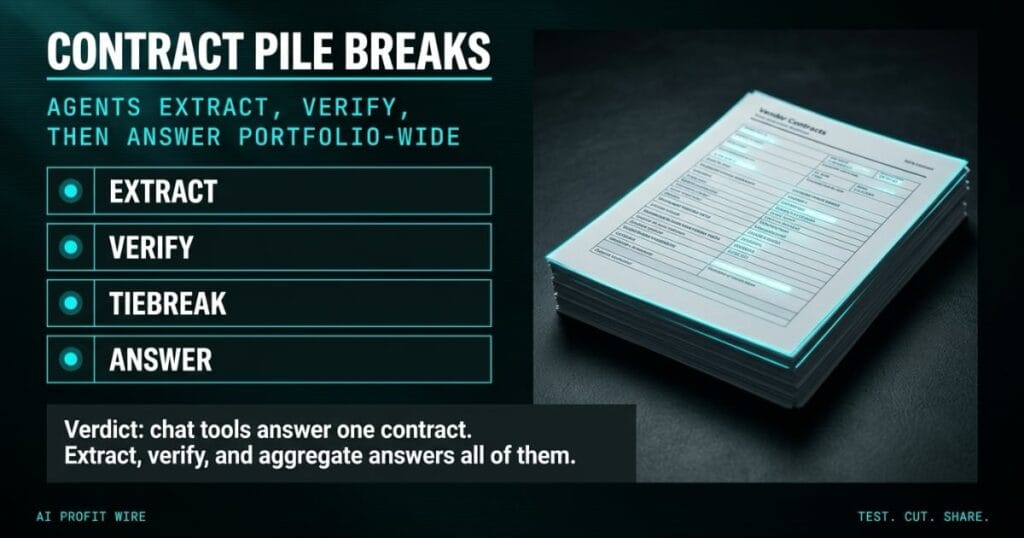
The core claim: 2 agents extract and verify contract fields, then Amazon Quick answers both single-contract and portfolio-wide questions on top.
Does AI Contract Extraction Actually Work?
The guide ships with no headline accuracy rate to check against, although it documents how the team measured itself: a 20-contract sample, 8 fields per contract, 160 values hand-labeled as ground truth.
The design pairs 2 different models, Claude Sonnet 4.6 for extraction and Claude Haiku 4.5 for verification, because 2 independent models disagreeing is the signal that routes a field to human review.
The guide’s own failure story proves the point: the verifier flagged contracts as signed with 95 to 100 percent confidence when no signature existed, so the team added Amazon Textract’s computer-vision signature detection as a tiebreaker that runs only when the 2 agents disagree.
The overall pipeline can process a contract in seconds under typical conditions, and the serverless design is built to scale across many contracts in parallel, so the extraction step itself is not where the hours go.
Treat this as a proven architecture pattern, and run the same hand-labeled test on your own contracts before trusting any extracted field.
How Is This Different From a RAG Chat Tool for Contracts?
AWS states the limitation outright: RAG chat tools retrieve the passages most relevant to a question and answer from those, so a question spanning every contract never lands in front of the model.
A chat tool finds a clause in one agreement, but asking which vendors can raise prices next quarter requires structured fields across the whole set, which retrieval alone cannot total.
This pattern adds a third step: verified structured fields feeding an analytics layer, with the original documents still attached for the single-contract questions retrieval handles well.
On the analytics side the guide connects the extracted records in PostgreSQL to Amazon Quick, so portfolio totals come from the structured data while clause lookups still read the source PDF behind the answer.
Questions that start with “across all our vendors” need a database, and the guide’s answer is to build one from the contracts automatically.
Who Is the AWS Contract Intelligence Platform For?
This fits teams managing enough vendor contracts that manual review already broke, and a business with 12 contracts gains little from multi-agent extraction.
It also fits teams already on AWS, because the build runs on Bedrock AgentCore with security policies defined outside the agent code, which AWS documents as an enforceable boundary around agent operations.
Once the extract-then-aggregate idea lands, it generalizes beyond contracts: the same reporting shape exists off the shelf in BI dashboards that pull a hundred tools into one scored view, without a custom build, for teams whose aggregation problem is metrics rather than contracts.
The fit test is a real contract pile and a technical person to maintain the pipeline, not enthusiasm for agents.
The vendor renewal sits open on the second monitor while the ops manager counts signatures nobody remembers collecting.
Renewal season turns 250 contracts into a week of PDF reading, and the answers leadership wants, total exposure, who can raise prices, what expires, all live on pages 11 and 14 of documents nobody indexed. The analyst assembles the spreadsheet by hand and knows it is stale before the file is saved.
Two agents that read every contract and show their disagreements turn that week into a query, and the tiebreaker is what stops a confident hallucination from becoming a renewal mistake.
What Should You Do About AI Contract Intelligence Now?
Start by counting vendor contracts and timing one full manual review cycle, because that pair of numbers decides whether the build pays for itself.
If the pile is small, a well-organized folder and a renewal calendar beat an agent platform, and if it runs to hundreds, the AWS guide is a credible blueprint.
Copy the measurement discipline along with the architecture: hand-label a small sample, score the extraction against it, and keep the signature tiebreaker for fields where a confident error costs money.
Set a confidence threshold that routes low-scoring fields to a person, because the guide’s design treats disagreement as a feature: the moment 2 models disagree is the moment a human should look.
Run the pilot on contracts with known answers before you let an extracted field touch a renewal decision.
Source: AWS Machine Learning Blog
