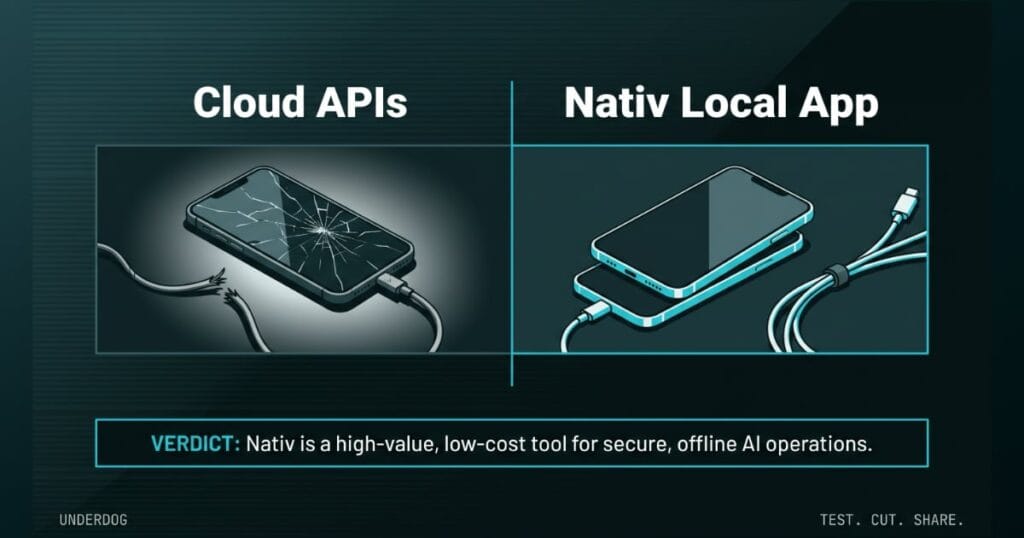
Running models locally can reduce AI subscription costs and ensure sensitive business data remains private.
What is Nativ and what changed?
Nativ is a free, open-source macOS desktop application from developer Prince Canuma that wraps the MLX-VLM library to run AI models locally on Apple Silicon Macs. The app requires an M1 chip or newer and is tuned for Metal and unified memory, with no wrappers or translation layers.
Built on the same MLX-VLM library Canuma maintains, Nativ ships with a chat interface and a localhost API server, mirroring the shape of LM Studio for users who want local model serving without a SaaS layer.
The entire application is 100% MIT-licensed, with no accounts, no subscriptions, and no cloud calls. It supports language, vision, video, code, and audio modalities, and integrates with 5 coding agents including Claude Code through its local endpoint.
Nativ turns any Apple Silicon Mac into a self-contained, free AI inference server.
What is the evidence behind Nativ?
The primary validation comes from Simon Willison, who tested Nativ on July 21, 2026, and confirmed it picked up the MLX models he had already cached from Hugging Face on first launch.
Willison called the project “exciting” and noted its similarity in shape to LM Studio, with both a chat interface and a localhost API server for accessing models. His test confirmed that Nativ integrates with established local model workflows.
The project ships with 3 verified partner models at launch: Gemma 4 E2B from Google at 10.28 GB, North Mini Code from Cohere at 19.38 GB, and LFM2.5-VL 1.6B from Liquid AI at 3.20 GB, each sized for Apple Silicon unified memory.
Expert testing and a public partner model list confirm Nativ runs production-grade local inference today.
How does Nativ compare to the alternatives, and what background do small business owners need?
Nativ competes with LM Studio and cloud APIs by stripping the SaaS layer off local inference and shipping the entire stack as MIT-licensed open source. Where other local AI apps are proprietary shells built on top of open-source engines, Nativ’s project page states that every line, every model loader, and every telemetry chart is open for audit.
LM Studio offers a similar chat UI and localhost API, but Nativ differentiates by tying directly into Canuma’s MLX-VLM library for vision-LLM work on Apple Silicon. Cloud APIs require internet access, accounts, and per-token billing, while Nativ processes everything on the local machine with no cloud calls.
Nativ’s telemetry surface shows tokens per second, memory pressure, thermal state, and time-to-first-token in real time, matching the observability founders expect from a cloud provider. The 3 verified partner models at launch cover distinct workload types: Gemma 4 E2B from Google handles vision plus audio at 10.28 GB, North Mini Code from Cohere handles code plus tools at 19.38 GB with a 500K context window, and LFM2.5-VL 1.6B from Liquid AI handles vision plus language at 3.20 GB.
For founders who already own Apple Silicon hardware, Nativ removes the API bill and the privacy question in one download.
How does Nativ affect day-to-day operations for small businesses?
Small business owners can run Nativ on a Mac to process sensitive client documents, generate reports, and serve a local API to internal tools without sending data to external servers.
The localhost API server means founders can connect internal tools, scripts, and coding agents like Claude Code to a local model endpoint, skipping per-token API costs for high-volume workflows.
Founders tracking cost-reduction signals from the AI Profit Wire can deploy Nativ as a free inference layer for batch document processing or internal automations.
Nativ moves the cost of local AI inference to zero for any founder already running Apple Silicon hardware.
A stack of client tax returns sits on the desk at 9 PM in a 4-person accounting firm, and the partners are arguing about whether they can use a cloud AI to draft the summary memos without violating the engagement letter.
You can’t. Uploading those P&L statements to a metered API hands client financial data to a third party, and the billable rate on the prompt tokens eats the engagement margin before the memo goes out the door.
Nativ runs the same inference on the firm’s M3 MacBook Studio for $0, with the documents never leaving the device. The 100% MIT license and the no-cloud architecture mean the privacy question is closed before the partner review meeting starts.
What is the final verdict on Nativ?
Nativ delivers a working, free, open-source local AI environment for any small business owner running Apple Silicon hardware.
The app combines a chat interface, localhost API server, multi-modal support across language, vision, video, code, and audio, and integrations with 5 coding agents including Claude Code.
Verified partner models from Google, Cohere, and Liquid AI ship at launch, sized between 3.20 GB and 19.38 GB for Apple Silicon unified memory.
Founders who want private, free AI inference should install Nativ today.
Source: simonwillison.net
