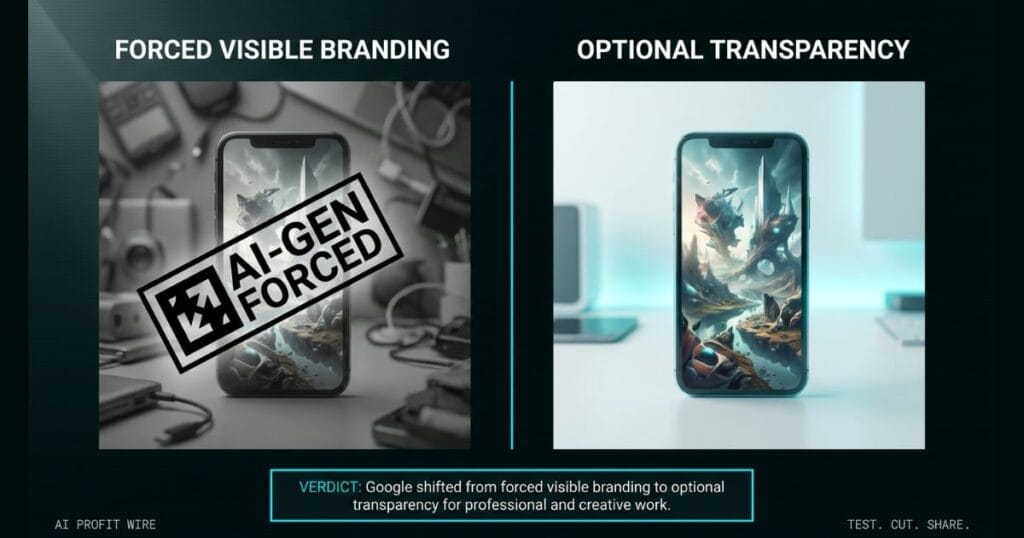
Small businesses can now use Google's AI generations for professional marketing and client work without distracting visible watermarks.
What is Google AI watermark removal and what changed?
Google now lets users disable visible watermarks on media generated by 3 specific AI models. The change targets professional and creative workflows where visible marks reduce utility.
Josh Woodward, the company’s VP for Gemini, announced the toggle for the Nano Banana, Omni, and Lyria models. The setting is available in Gemini, with support for Search coming soon.
The feature rolls out over the coming days via Settings > Media Watermark. A new open-source library accompanies the launch to let developers embed a local validation mechanism in their apps.
Google shifted from forced visible branding to optional transparency for professional and creative work.
What is the evidence behind Google AI watermark removal?
The evidence comes from an official announcement by a senior Google executive covered by TechCrunch on August 14, 2026. Josh Woodward specified the 3 models involved and confirmed the platforms where the toggle will appear.
Woodward clarified that turning off the visible watermark applies to the Nano Banana, Omni, and Lyria models, with the toggle live in Gemini and Search support coming soon.
He also confirmed that invisible SynthID watermarks and C2PA metadata remain active, which ensures images, videos, and songs remain identifiable as AI-generated even after the visible mark is removed.
Google relies on embedded metadata instead of visible stamps to maintain content provenance.
How does Google AI watermark removal compare to the alternatives, and what background do small business owners need?
Previously, visible watermarks made raw Google AI generations less useful for professional workflows, and founders had to work around the marks. The new toggle eliminates that friction by letting users turn the visible mark off completely.
This aligns with evolving labeling approaches for professional work, where a visible stamp on a generated asset reduced its utility for client-facing deliverables.
Unlike basic generation tools that lack provenance tracking, Google retains invisible SynthID and C2PA metadata so a generated asset remains identifiable even after the visible mark is gone. You can read more signals on AI media provenance as the labeling landscape continues to shift.
Google matches creative utility for professional work while retaining invisible metadata for accountability.
The three printed banners arrive at the self-storage facility on Route 9 in a cardboard tube, and the contractor swears the job is done. The visuals look clean, the colors are bright, and there is no visible mark on any of them.
The hidden defect is the invisible SynthID metadata embedded in each file, which proves the images are AI-generated but tells you nothing about whether they actually match your brand guidelines. If you trust the contractor and ship the banners to the entrance without opening the metadata panel, you find out two weeks later when a tenant asks why the logo on the banner does not match the one on the website.
Google removed the visible watermark from 3 AI media models, but the invisible metadata is still in the file. You still have to verify what is actually inside the file before you deploy it, because the absence of a visible mark is not the same as the absence of a problem.
How does Google AI watermark removal affect day-to-day operations for small businesses?
Founders can now use Google AI generations directly in professional and creative work without a distracting visible mark on the output. The toggle removes a cosmetic barrier that previously forced teams to crop, edit, or regenerate assets to clean them up.
Teams can generate media via the Nano Banana, Omni, and Lyria models without post-production editing to remove visible stamps, and the embedded SynthID and C2PA metadata stays in place so the asset remains identifiable as AI-generated.
The invisible metadata means you can still verify if a piece of media is AI-generated by using Gemini or Search, which preserves content provenance without forcing a visible mark onto every output. That provenance trail matters when a client or platform asks for proof of how an asset was produced, and the invisible metadata answers the question without compromising the visual quality of the deliverable.
Small business owners gain production-ready AI media assets while underlying metadata maintains transparency.
What is the final verdict on Google AI watermark removal?
Google removed the visible watermark from 3 AI media models and kept invisible SynthID and C2PA metadata in place for transparency. The change targets professional and creative workflows where a visible stamp previously reduced utility.
Small business owners can now deploy Google AI generations directly in client work without cropping or editing around a visible mark, while the underlying metadata preserves content provenance and accountability.
The new open-source validation library lets developers embed a local check in their own apps, which closes the loop between a generated asset and a verifiable provenance record.
Google AI watermark removal is a direct operational upgrade for small business creative pipelines that rely on AI-generated media.
Source: TechCrunch AI
