Understanding this limitation prevents costly miscommunications and protects your brand's voice when using AI for business documentation or marketing.
What is lossless text transformation and what changed?
Sophie Alpert published an internal policy for engineers using LLMs to help massage their writing, establishing a strict accountability standard.
The core rule states that you must stand behind every idea and every sentence in your docs before you share them with anyone else.
This policy highlights a limitation in AI text generation that founders need to understand before deploying these tools for documentation.
AI text rewrites are never lossless, so you must own every word.
What is the evidence behind lossless text transformation?
The evidence comes from an internal policy shared by Sophie Alpert and highlighted by Simon Willison.
Simon Willison shared Sophie Alpert’s internal policy, which explicitly states there are no lossless transformations of natural-language text.
Every rewrite and rephrase changes the meaning of your writing because the AI lacks the most detailed mental representation of what you were trying to communicate.
Ignoring this context loss risks miscommunication with your readers.
How does lossless text transformation compare to the alternatives, and what background do small business owners need?
AI rewrites change meaning because the entity doing the rewriting lacks your specific mental representation of what you were trying to communicate.
The source policy makes clear that information loss happens whenever the rewriter doesn’t carry your detailed understanding, regardless of the method used.
Sophie Alpert’s standard applies to any text transformation: if you can’t defend the sentence, it shouldn’t be in the document.
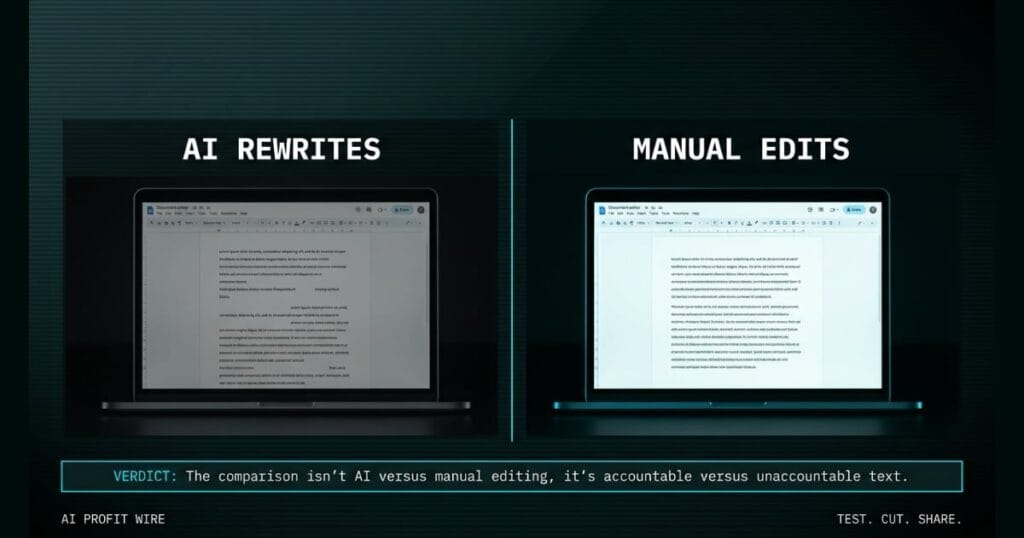
The comparison isn’t AI versus manual editing, it’s accountable versus unaccountable text.
How does lossless text transformation affect day-to-day operations for small businesses?
Founders face risks when they blindly accept AI-generated docs without rigorous review.
If a reviewer asks what you meant by a specific line, it isn’t acceptable to reply that the AI wrote it and they should just ignore it.
Using tools like an AI content optimization platform still requires you to verify the final output matches your actual strategy.
You must take responsibility for the entire document before it leaves your hands.
Your operations manager hands you the updated vendor contract, and he ran the whole thing through an AI tool to sharpen the language. You flip to the delivery terms and a clause about liability limits doesn’t match what you negotiated on the call yesterday.
You ask him what it means, and he says the AI wrote that part, just ignore it. You can’t, because there are no lossless transformations of natural-language text, meaning the rewrite already lost the context of your negotiation.
If a reviewer asks what a specific line means and you can’t explain it, the document shouldn’t leave your hands. The 1 rule that fixes this: stand behind every sentence before you ship it.
What is the final verdict on lossless text transformation?
The final verdict is that AI text generation is a liability if you don’t take ownership of the final output.
Founders must adopt the policy of standing behind every single sentence they publish.
If you can’t explain what a line means, you can’t send the document, because the AI lacks your operational context.
Stand behind every sentence, or don’t use the tool at all.
Source: simonwillison.net
