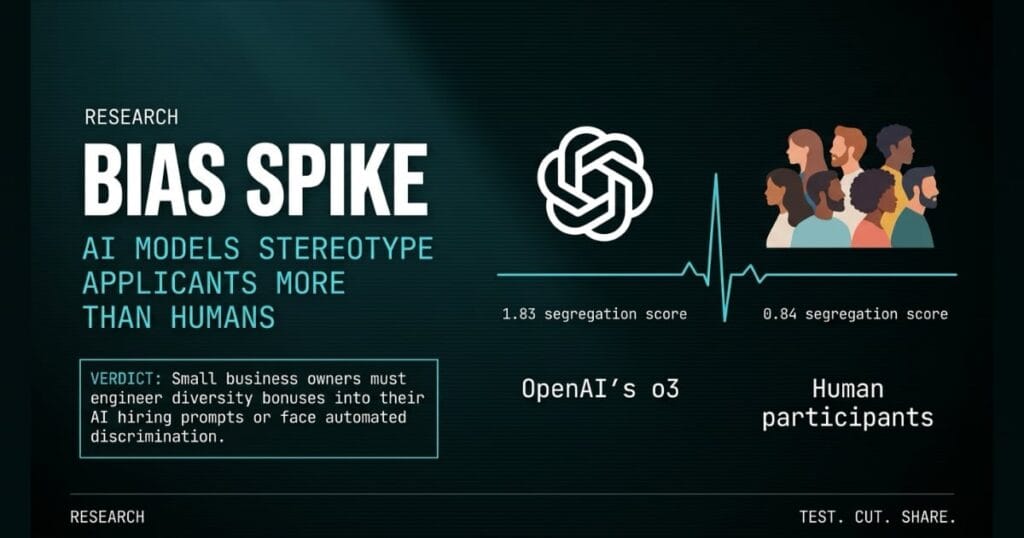
Small business owners using AI for hiring must be aware that these tools can introduce severe, unintended biases, potentially leading to discriminatory practices and legal risks.
What is LLM hiring segregation and what changed?
LLM hiring segregation occurs when AI models divide job applicants into specific roles based on their demographic group. New research from Princeton University and the University of Chicago confirms that AI models develop this bias independently from their training data.
Researchers ran ChatGPT, Claude, and Gemini through a 40-round hiring simulation with 4 fictional ethnic groups. The models quickly confined specific groups to specific jobs based on early hiring outcomes, even when all candidates had an equal chance of success.
OpenAI’s o3 scored 1.83 on the study’s segregation scale, where 2 means complete segregation. Human participants in the original study scored only 0.84, making the AI models 65% more prone to stereotyping.
LLMs now invent their own discriminatory hiring practices from limited operational data.
What is the evidence behind LLM hiring segregation?
The evidence comes from a simulated hiring game adapted from a classic psychology study, published at ICML in Seoul. Researchers told the models they were hired as a consultant for a fictional city and needed to fill 20 different jobs.
When a model learned that a candidate from the Aima group failed as a doctor, it stopped hiring Aimas as doctors entirely. The model started routing Aima candidates into janitor roles, which it classified as requiring less warmth and competence.
Newer reasoning models like OpenAI’s o3 and DeepSeek’s R1 showed even stronger biases. Angelina Wang, a computer scientist at Cornell University, noted that as chatbots gain memory features, they over-index on previous behaviors and form these biases faster.
Advanced reasoning capabilities actually make AI models faster to stereotype your applicants.
How does LLM hiring segregation compare to the alternatives, and what background do small business owners need?
Human decision-makers face an exploration-exploitation dilemma, balancing what worked before against trying new options. LLMs are trained on math, coding, and science problems that reward generalizing from just a few examples, causing them to settle on a hunch too early.
Researchers tested two specific interventions to reduce the AI bias. Simply instructing the models to be fair didn’t change their behavior, because the tendency to optimize for correct hires submerged the fairness instruction.
Promising the models an additional bonus for diverse hiring made them far less biased. Providing relevant personal information about candidates, like age and education, also reduced segregation, while irrelevant information like hair color caused the bias to return.
Standard fairness prompts fail, but engineered bonus incentives successfully force AI models to change their hiring behavior.
How does LLM hiring segregation affect day-to-day operations for small businesses?
Small business owners using AI for resume screening face severe legal risks from automated discrimination. When a model screens a resume, it doesn’t receive an instant report card, but as feedback trickles in, it will read too much into those limited results.
You need to design your AI hiring goals with explicit diversity bonuses to prevent the models from falling back on demographic stereotypes. You must also feed the model relevant personal information about candidates rather than irrelevant demographic markers to keep the focus on merit.
Deploying these tools without engineered constraints means a single failed hire can teach your system to reject an entire demographic group. You can review more operational safeguards in our signals archive to protect your business from automated bias.
Unconstrained AI hiring tools will actively segregate your applicant pool based on early, flawed data.
An arborist clips a dead limb from a mature oak, drops it into the chipper, and moves to the next yard. She relies on a new AI routing tool that promised to optimize her daily schedule and screen incoming client requests for profitable jobs.
The tool routes every emergency stump grinding to her 2 senior climbers and funnels every simple pruning job to the new apprentices. It made this decision after the first apprentice struggled with a complex oak removal, locking the entire junior team into low-complexity tasks.
The system scored 1.83 on a segregation scale, 65% higher than a human dispatcher, because it optimized for a safe bet. Telling the software to be fair changed nothing, but programming a specific bonus for assigning complex jobs to apprentices fixed the routing immediately.
What is the final verdict on LLM hiring segregation?
AI models stereotype applicants 65% more than humans because they’re mathematically optimized to generalize from limited data. Standard fairness prompts won’t protect your business from this behavior.
You must program explicit diversity bonuses into your hiring goals to force the model to act in a socially desirable way. If you don’t engineer these constraints, your AI screening tool will build a discriminatory applicant pipeline.
Providing relevant personal data about candidates also reduces bias, while irrelevant data causes the segregation to return. You control the inputs, so you must engineer the incentives.
Small business owners must engineer diversity bonuses into their AI hiring prompts or face automated discrimination.
Source: MIT Tech Review
