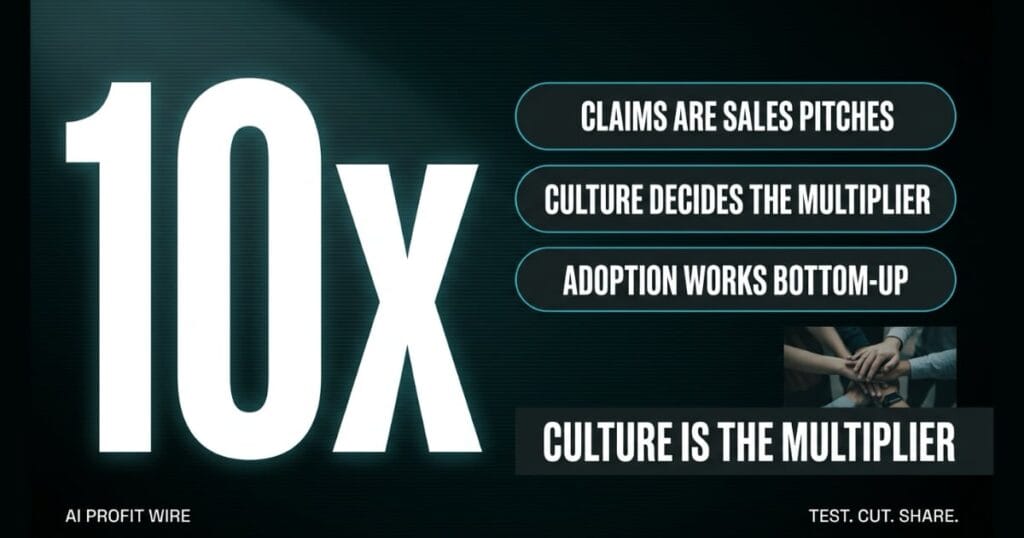
Prevents costly turnover and failed AI adoption by prioritizing leadership and psychological safety over tools.
How does company culture affect AI productivity?
AI productivity is a multiplier on the culture you already run, not a standalone result of the software you buy. An engineering leadership newsletter with over 196,000 subscribers just made that case directly: AI helps productivity, but only when the right culture is in place first.
The author, Gregor Ojstersek, has spent 13 years in the engineering industry and describes culture as the prerequisite for everything else, the way health is for a person. He leans on Conway’s law, the observation that organizations design systems that copy their own communication structures.
Bad culture produces a bad end product regardless of the toolset, because the dysfunction ships straight into the work. Good culture hands AI a better blueprint of what good looks like, which is why the same tool lands so differently across teams.
Culture is the prerequisite, and AI is the multiplier that amplifies whichever version of it you already have.
Does AI actually increase productivity without a good culture?
No, and the source is blunt about why: executives believe AI will magically lift everyone’s productivity, and Conway’s law is the reason it usually doesn’t. The fastest culture-breaker is the sentence “this is very easy to build now that we have AI, and we don’t need as many people”, especially when it comes from a CEO, CPO, or CTO.
That single line collapses psychological safety and leaves everyone wondering whether they will still be needed. He reports hearing it repeatedly from executives through 2025 and early 2026.
Blame the team for missing a benchmark and it shows them you don’t trust them to make good decisions. The people you most need engaged are the ones who disengage first.
Without culture underneath it, an AI rollout mostly accelerates the problems you already had.
Are the 10x AI productivity claims actually real?
Mostly not, and the incentive is the tell. The source says a lot of the reporting of AI increasing productivity by 10x is more or less selling a certain AI product or a partnership promoting one.
The damage comes from how executives react to those numbers: they panic, feel FOMO, and start blaming their people for missing benchmarks nobody verified. That blame cycle lands hardest on the engineers expected to drive adoption in the first place.
His recommendation is to always check the incentives behind whoever is reporting a number before acting on it. The same piece dismisses the belief that introducing a tool makes a team magically 2-5x more productive overnight.
Treat every 10x claim as a sales pitch until the incentives behind it check out.
Who actually owns AI adoption in a small business?
The team does, and the source is emphatic that this is the only shape that works. AI adoption only works bottom-up, because the tools change too fast for a mandate to keep up and adoption depends on knowledge moving between people constantly.
For an owner, that makes the job messaging and environment rather than enforcement. The recommended framing is that great engineers learn and use every tool that helps them do the work better, and AI is simply the newest one.
The line you never cross is anything close to “replacing”, because that message breaks morale and the culture that makes tools pay off. Adoption framed as augmentation earns momentum, and adoption framed as headcount reduction earns resistance.
The same dynamic runs through every tool decision we cover in the weekly signal briefings on what AI actually changes for small teams.
Adoption is owned bottom-up, and the owner’s job is to message AI as a tool, never a replacement.
The crew lead at a 2-truck pressure washing company stops photographing cracked driveways before quoting the wash. The owner bought an AI quoting tool in March and told the room it would make the route 2-5x more productive, so nobody wants to be the one questioning a quote now.
By June the reviews mention hairline cracks that a pre-wash photo would have caught, and the crew had stopped flagging them. The last person who questioned a quote lost the argument to the software’s reputation.
That is the 10x promise doing exactly what the newsletter describes, amplifying a culture where bad news doesn’t travel up. The fix was never a better model, it was making it safe to say the driveway is cracked.
What should you do about AI adoption this quarter?
Stop asking how to get everyone using AI and start asking how to build an organization where great people can do their best work, then use AI to multiply them. That is the article’s closing argument, and it holds up against a small business budget.
Run the author’s 9 culture questions with your team, including whether people feel safe challenging leadership, whether priorities are clear, and whether teams trust each other. They cost nothing to ask, and they predict whether tool spend pays back better than any vendor demo.
If several answers come back no, the communication problem is the quarter’s project and the AI budget can wait. Time to market still matters, and the author’s wider argument is that the best companies hire more engineers rather than fewer, because capable people compound.
Fix the culture questions first and the tool budget second, in that order.
Source: newsletter.eng-leadership.com
