Helps retailers and resellers verify product authenticity to protect brand reputation and consumer safety.
Can Google Gemini detect counterfeit cosmetics?
Google Gemini can identify counterfeit cosmetics by spotting packaging errors and distributor mismatches that humans often miss. Grover Lab tested the Gemini 3.6 Flash model using 6 photos per product, 4 of the cardboard box and 2 of the tube, and the AI correctly identified 2 out of 3 counterfeit Rhode Peptide Lip Tints.
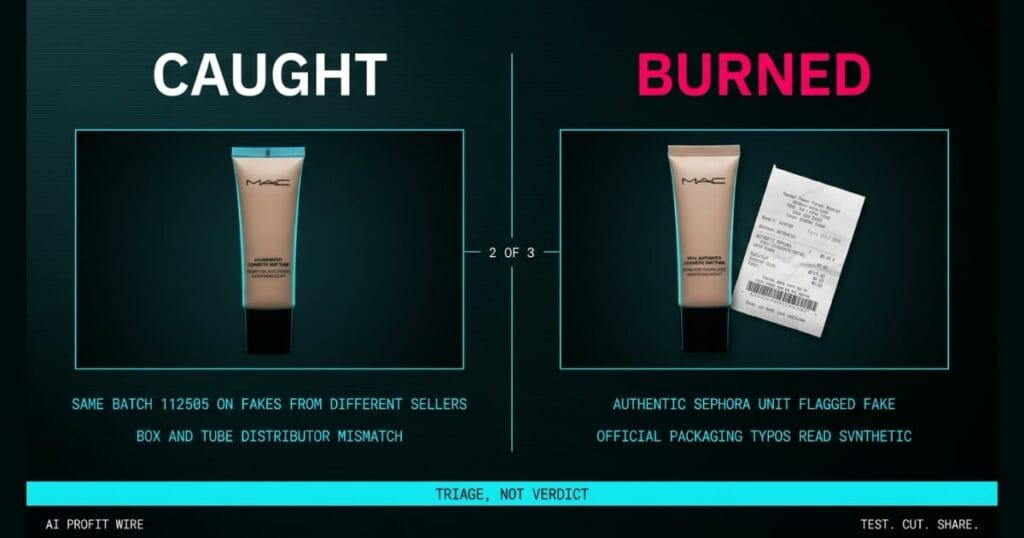
Gemini successfully spotted a mismatch where the outer box listed BIORIUS as the responsible person while the tube listed PWC Services. It also identified a fake batch number, 112505, which appeared across multiple counterfeit samples from different sources.
General AI models are faster than humans at spotting inconsistencies but lack the nuance to be 100% reliable.
How accurate is Google Gemini at spotting fakes?
The research shows that while AI is highly capable of OCR and cross-referencing, it’s easily fooled by photographic artifacts.
Gemini mistook lighting glare on a tube for a printing typo and incorrectly claimed a product had shrink wrap when it did not. These errors suggest the model struggles with the difference between a physical defect and a photo quality issue.
Most critically, the AI flagged an authentic product purchased from Sephora as counterfeit. It based this decision on typos in the ingredient list, such as “Svnthetic” instead of “Synthetic,” which were actually present on the official brand packaging.
The AI’s inability to distinguish between a fraudster’s mistake and a brand’s own typo makes it a risky sole arbiter of authenticity.
Is Gemini better than humans at spotting fake cosmetics?
AI detection shifts the verification process from expert manual inspection to rapid pattern recognition across multiple images.
A human expert might miss a malformed Irish postal code or a missing accent in an Italian translation, both of which Gemini caught in seconds. Traditional verification requires the inspector to have deep knowledge of every version of a product’s packaging.
However, humans are better at ignoring glare and understanding that a brand might have a known printing error. AI treats every deviation from a perceived standard as a red flag, leading to higher false positive rates.
AI provides a scale of inspection that humans can’t match, but it lacks the contextual judgment to handle brand-level errors.
A padded furniture wrap slips from a mahogany dresser during a move, leaving a deep gouge in the wood. The crew lead marks the job complete and the client signs the ledger without a close look.
Two days later the client finds the gouge and demands a refund, and the owner is stuck holding a report that said everything was fine. The report wasn’t dishonest, it was blind, and blindness is what a single-pass check sells you.
Grover’s test is that report in miniature. Gemini caught 2 fakes out of 3 in seconds, then flagged the one authentic tube because the brand itself ships typos on its own packaging.
Which businesses should use Gemini for product vetting?
This technology primarily affects retailers, resellers, and small business owners who source high-demand beauty products from third-party marketplaces.
Retailers using platforms like eBay, TikTok Shop, or Vinted face a massive problem, as some studies estimate 2/3 of branded makeup on these sites is fake. Using AI to pre-screen these shipments can protect a store’s reputation and prevent the sale of products containing heavy metals or bacteria.
For those scaling their operations, logging every AI flag beside the supplier it came from builds a vendor scorecard, the same way I track the market in my weekly AI risk feed.
Small business owners can use AI to reduce the time spent on initial vetting, provided they maintain a human-in-the-loop for final decisions.
What should you do about AI authenticity checks now?
Small business owners should use AI as a triage tool rather than a final judge for product authenticity.
Implement a workflow where AI scans photos for red flags like the 112505 batch code or distributor mismatches. If the AI flags a product, move it to a manual inspection queue for a human to verify.
Don’t automatically reject inventory based on AI typos, as the study proves that even authentic brands make printing errors in chemical names. The cost of a false positive is a broken supplier relationship and lost stock.
Use AI to find the needles in the haystack, but use a human to decide if the needle is actually a threat.
Source: groverlab.org
