High risk of sudden revenue loss and operational shutdown due to automated legal claims.
How does Tracer.AI automate DMCA takedowns?
Tracer.AI is a brand protection platform that uses AI agents to monitor digital channels and automate the removal of copyright infringements.
The system streamlines workflows to identify suspected infringements across thousands of platforms. It removes the need for human teams to manually scan for unauthorized assets.
The company claims its AI agents provide better business intelligence insights while increasing the speed of takedown requests.
Tracer.AI replaces human legal review with automated agents to scale copyright enforcement.
Is Tracer.AI actually accurate in its copyright detections?
Evidence suggests the AI agents produce systemic errors by filing baseless claims against non-infringing software.
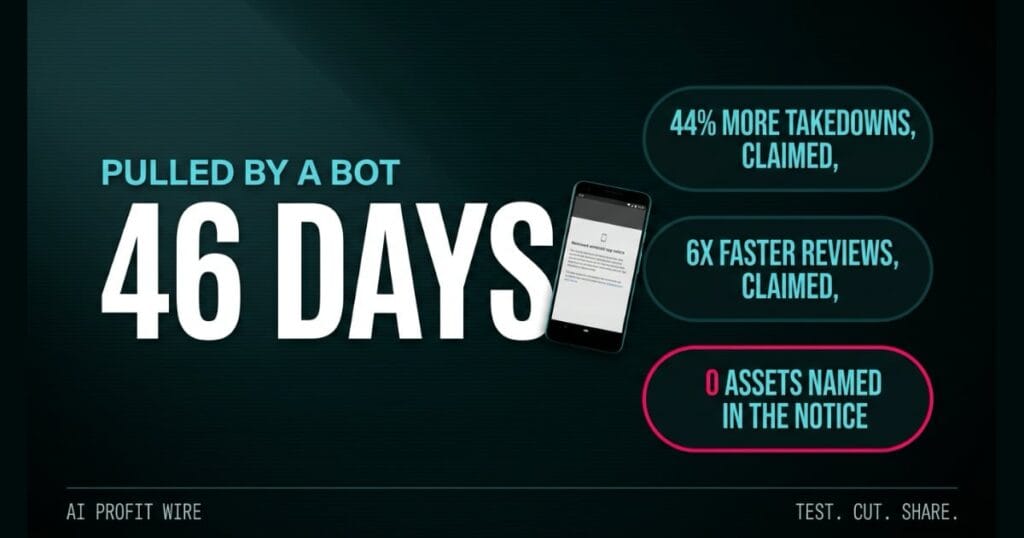
Tracer.AI filed a DMCA notice against the Luanti Android app on behalf of Microsoft, alleging it used Minecraft assets. Luanti contains no proprietary code or assets from Minecraft, and the notice never names a single infringing file.
Luanti received the same notice from the same company in 2023 and won the appeal, but the app stayed down for 46 days. DMCA rules give platforms 10 to 14 business days to restore content after a valid counter-notice, so Google blew past the legal window by more than a month.
The same company filed a notice this year against Allumeria, another indie game with a similar voxel art style, temporarily pulling it from the Steam store until Microsoft dropped the claim.
The AI agents prioritize volume over accuracy, leading to unfounded legal claims.
How is AI-led enforcement different from traditional DMCA notices?
AI-led enforcement operates at a scale and speed that traditional human-led legal teams can’t match.
Tracer.AI claims its technology delivers 85% faster takedowns and review times that are 6x faster than traditional methods. The volume claim is 44% more takedowns month-over-month.
Traditional notices typically require a human to identify specific infringing assets, whereas these AI notices can be vague and lack tangible proof.
Automation has shifted the burden of proof entirely onto the small business owner.
The red banner sits where the app listing used to be: removed, copyright claim, contact your legal team. For 46 days the Luanti team could only watch a listing they could not touch while players asked if the project had died.
It’s the same bind as an automated inventory bot flagging a full shelf as counterfeit stock. The bins lock, the audit runs for weeks, and the customers who needed those parts buy from someone else before the all-clear comes.
When the tool built to protect your catalog is the thing that locks it, enforcement speed becomes the liability.
Who does automated copyright enforcement actually affect?
Small developers and non-profit projects are most vulnerable because they lack the legal resources to fight automated claims.
Luanti, an open-source project, noted that small companies relying on app income would find these sudden removals devastating.
Platforms like Google Play follow notice-and-takedown processes to avoid liability, meaning they often remove the app first and ask questions later.
You can track similar market shifts and risk factors by monitoring the AI signals archive to see how automation impacts digital distribution.
Small business owners without in-house legal teams face the highest operational risk from AI agents.
What should small business owners do about AI takedowns now?
Founders must move from a reactive posture to a proactive defense strategy for their digital assets.
Maintain a strict log of all asset provenance and licenses to expedite the counter-notice process.
Diversify distribution channels so a single automated takedown on one platform doesn’t result in a total operational shutdown.
Prepare a pre-written counter-notice template to reduce the time between a takedown and a legal response.
Source: blog.luanti.org
