Provides a reference architecture for secure, cited AI-driven content curation, though requires internal development.
The build pattern Gen Digital published this week is worth studying, and the entry cost is on the vendor’s own page: Web Search on Amazon Bedrock AgentCore costs $7 per 1,000 queries, consumption-based with no minimum fee or upfront commitment, checked November 4, 2026. That is the meter behind Norton Revamp’s AI news engine, a system that reads the live web, cites every source it uses, and keeps the data inside AWS. Gen Digital’s engineers say a small group took it from concept to production in months.
What is Norton Revamp’s AI-curated news engine?
Norton Revamp is a generative AI-powered professional reputation management platform from Gen Digital, launched in March 2026, per the company’s March 19, 2026 press release. Its core is an AI-curated News Engine grounded by Web Search on Amazon Bedrock AgentCore, per the AWS Machine Learning Blog’s engineering writeup.
The flow is event-driven: when a user sets or updates a professional goal, Amazon Nova generates targeted search queries based on the goal, recent activity and engagement patterns. AgentCore Web Search returns cited results that stay inside the AWS environment, and the platform’s AI Learning System ranks them for relevance, recency and source credibility before Amazon Nova Lite drafts content suggestions in the user’s authentic voice.
What the user sees is a personalized content stream tied to their goal, with weekly themes and milestones that refresh every session. A full scan pulls up to 1,000 historical posts for reputation-impact analysis, per the blog.
Norton Revamp is a goal-aware research feed, and every suggestion it drafts arrives with its sources attached.
Does the zero data egress claim hold up?
The claim is the vendor’s own, stated in the engineering post: AgentCore Web Search is “fully managed with zero infrastructure overhead, operates entirely within AWS with zero data egress, and returns cited sources with URLs and publication dates.”
Zero data egress means the search queries and results stay inside the customer’s AWS environment instead of flowing through an outside retrieval service. For a platform handling professional reputation data, that boundary is the difference between a compliance conversation and a data-flow diagram.
Amazon’s AgentCore product page pitches the same boundary as the platform’s core promise: production AI agents, any framework, any model, secure at scale. Gen Digital adds a lightweight credibility scoring layer to prioritize authoritative sources, and the press release states posts are only published upon approval.
The egress claim is AWS’s own language about its own service, and the architecture puts retrieval inside the perimeter it describes.
How is this different from a chatbot with web search?
A chatbot with web search answers one prompt. This engine runs a pipeline: an EventBridge-triggered daily scan, Lambda-generated weekly goals built from past engagement plus real-time trend data, and a synchronous Analyze, Refine, Post coaching flow grounded with search results at every step.
The output carries its evidence with it: relevant snippets, source URLs, titles and publication dates, which the model uses to produce grounded responses. A static RSS aggregator collects, and this system ranks, drafts and attributes.
The stack behind it is ordinary enterprise parts, which is the point: React, TypeScript and Tailwind on the front end, Node.js on ECS, Lambda, DynamoDB, S3 and EventBridge, with Terraform and blue-green deployment. Stability AI generates images, and Claude through Amazon Bedrock handles complex reasoning alongside Amazon Nova Lite.
The difference is the citation trail: every drafted post traces to a ranked source list a human can check before approving.
The Monday ritual in every advisory firm: an analyst pulls the same 30 sources into a spreadsheet, and the client pays for the ritual as much as the reading. Gen Digital priced the alternative on AWS’s own page at $7 per 1,000 queries, and every line its engine drafts arrives with a source URL and publication date attached.
The savings are the smaller half of it. A feed a client can verify changes who signs off on it, because the review becomes a click on the source instead of trust in whoever summarized it.
For a small team, the decision is which 1 recurring research task earns a grounded pipeline first, and which keeps burning hours on manual pulls.
Can a small team ship a production AI agent?
Gen Digital’s answer is yes, with a caveat about review time. The platform was built by a small group of engineers, and the team’s own words close the engineering post: “We went from concept to production in months, and AgentCore Web Search was a key enabler.”
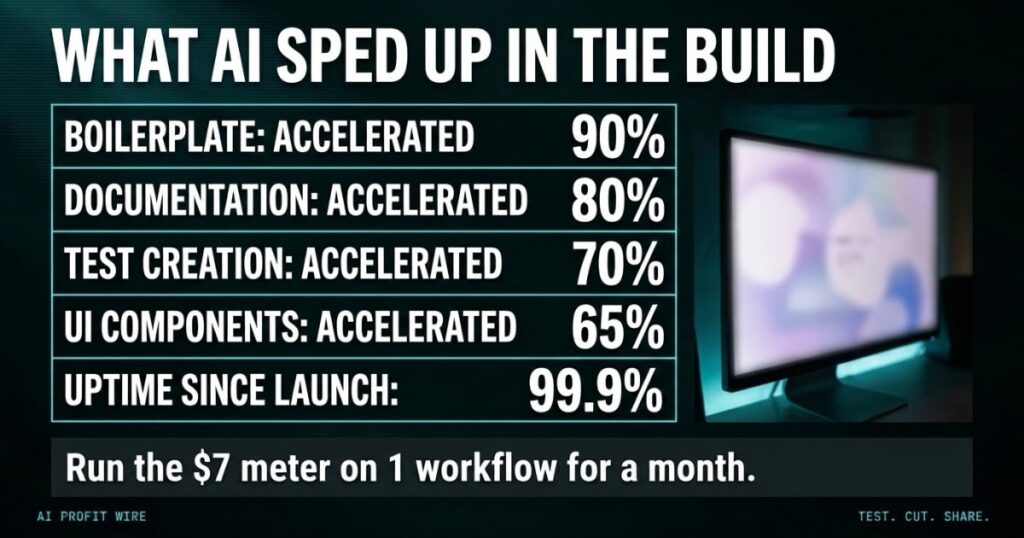
The velocity numbers behind that quote: 3x faster feature implementation, boilerplate generation accelerated by 90 percent, documentation by 80 percent, test creation by 70 percent, and UI component generation by 65 percent.
The engineering discipline held alongside the speed: 85 percent code coverage through automated test generation, 99.9 percent uptime since launch with real-time monitoring, and blue-green deployment managed through Terraform. The team treated output review as part of the build, and that choice is why the uptime number holds.
A small team can ship a grounded agent in months when the search, ranking and citations come from a managed service.
Who should copy the Norton Revamp architecture?
Teams with recurring research and monitoring work: brand monitoring, market intelligence, compliance watch. The platform itself targets professionals building an online presence, and the architecture underneath it is a pattern any team with engineers can borrow.
If you are deciding which AI agents a small team can run instead of building from scratch, the Gen Digital build is the benchmark for what the from-scratch path buys.
The cost the same engineers admit: AI output review consumed 20 to 30 percent of their time. That number is the honest price of a cited pipeline, and it belongs in every build estimate.
Copy the grounding pattern, respect the review burden, and the architecture pays for itself on any recurring research workflow.
How much does Web Search on AgentCore cost?
$7.00 per 1,000 queries, per AWS’s AgentCore pricing page checked November 4, 2026. Billing is consumption-based with no minimum fees or upfront commitments, and the cost scales with how often the agents retrieve from the web.
Web Search and Bedrock Managed Knowledge Base have their own rates, per the same page, and the language models underneath bill on their own token rates. Before you model the full pipeline, what AI APIs cost at token rates is the reference to run the numbers against.
On the buyer’s side, Norton Revamp launched with free access for a limited introductory period, per the March 19, 2026 press release. Current consumer pricing sits on the product’s own site, and the March 2026 free-access window should be read as history, not a live offer.
The search meter is $7 per 1,000 queries, and everything above it depends on which models you route through the pipeline.
Should your business build custom AI agents on Amazon Bedrock?
Build if you have a recurring cited-research workflow, a data boundary requirement in writing, and engineers who own the review. Gen Digital’s small group went concept to production in months, and usage-based pricing means the first month costs proof, not a platform.
Buy if you have no internal AI developers: the managed tools in this category cover monitoring and drafting without an architecture. The honest middle path is a prototype on 1 workflow, measured against the manual baseline, before anyone commits engineering time.
Gen Digital’s stack choice is the tell: the novel parts are the news engine and the credibility ranking, and everything underneath is standard AWS components. The build effort concentrated in the part users notice.
Watch the number their engineers published: 20 to 30 percent of their time went to reviewing AI output. If your review burden eats the savings, the build was premature, and the managed option was the right call.
Run the $7 meter on 1 workflow for a month, and let the review burden make the build-versus-buy call.
Norton Revamp and AgentCore: quick answers
When did Norton Revamp launch?
March 2026. Gen Digital announced the platform on March 19, 2026, and the AWS engineering writeup was published November 3, 2026.
How much does Web Search on AgentCore cost?
$7 per 1,000 queries on AWS’s pricing page as of November 4, 2026, consumption-based, with no minimum fee. Model usage has its own token rates.
Does Norton Revamp publish posts on its own?
No. The press release states posts are only published upon approval, and content stays in the user’s control through the drafting flow.
What models power the news engine?
Amazon Nova Lite drafts content suggestions, Stability AI generates images, and Claude through Amazon Bedrock handles complex reasoning tasks, per the engineering post.
Source: AWS Machine Learning Blog
