Provides advanced coding and cybersecurity defense capabilities at competitive API pricing for engineering teams.
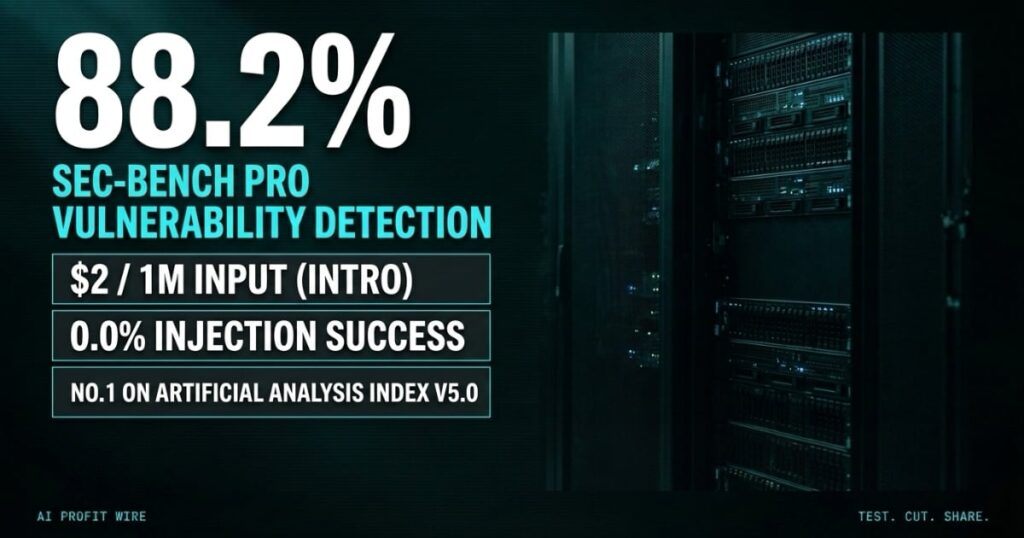
Gemini 4 Carbon is worth a test plan, not a purchase: Google calls it its strongest model for cybersecurity, and a small business can’t buy it yet. As of October 28, 2026, Google is making it available only to a subset of cyber defenders, with developers, businesses and consumers to follow on a date it hasn’t announced. The price on Google’s announcement of October 28, 2026 is a dated list price for later: an introductory $2 per million input tokens and $10 per million output tokens, with cached input at 95 percent off, rising to $4 and $20 after the introductory period ends.
What Is Gemini 4 Carbon and What Does It Do?
Gemini 4 Carbon is Google DeepMind’s next frontier model, described by the company as its strongest model with state-of-the-art cybersecurity and long-horizon capabilities. It ranks first on version 5.0 of the Artificial Analysis Intelligence Index, with a score of 59, per the index’s own model page, and it is built for sustained agentic workflows that run for days.
The target workload is complex, multi-step engineering: root-causing and patching subtle bugs across large codebases and low-level systems, persisting through dead ends instead of stopping at the first failure. DeepMind reports its own teams have seen Carbon do exactly that internally. Carbon is a long-horizon engineering and security model, and the cybersecurity numbers are the headline.
Is Gemini 4 Carbon Actually Good at Cybersecurity?
On the external benchmarks DeepMind cites, yes, with the caveat that all of them come from the vendor’s own announcement. Carbon achieves a stated 88.2 percent on SEC-bench Pro for autonomously finding real vulnerabilities, 54.8 percent on ExploitGym for exploitation validation, and 71.0 percent on Collinear’s CWE-bench for turning validated findings into working code fixes, each evaluated without guardrails.
The safety and reliability numbers are the part security teams should read twice. Successful cheating on Terminal-Bench 4.0 dropped to 0.0 percent with attempts at 0.4 percent, unsupported claims fell by approximately 2x over Argon in Google’s internal testing, overreach dropped 26 percent, under-service dropped 29 percent, and high-severity misalignment alerts in internal live coding environments fell by almost 80 percent.
Prompt injection resistance is the number with a named independent benchmark behind it. On Gray Swan’s Indirect Prompt Injection evaluation, Carbon posts a 0.0 percent attack success rate where Argon previously led with a very low 0.7 percent, meaning it resisted every evaluated attack attempt. One behavioral detail rounds out the picture for teams that plan to trust it with work: rather than guessing through ambiguity, Google says Carbon retrieves the relevant sources and surfaces discrepancies to the user before acting. The cybersecurity results are vendor-reported, and they are strong enough to test against your own suite.
How Is Gemini 4 Carbon Different From Gemini 4 Argon?
Carbon arrives 2 weeks after Argon and builds on the same multi-layered safety stack, which makes the comparison clean. Argon launched as the frontier; Carbon takes the same architecture further on security-specific benchmarks and on sustained agentic behavior, and on internal benchmarks Google reports more than 2x uplift over Argon in success rate for generating secure code.
The external validation is narrower than the marketing but real. The Chrome team reports Carbon performed more than 10X better than another lab’s large frontier model when generating high-quality patches, and Wiz, which Google calls its leading cloud security platform, observes Carbon leading on benchmarks for web penetration testing, a core capability of Wiz’s Scan for Good initiative. On general web development, Carbon jumped 89 elo points to fourth place, at 1768, on WebDev Arena. Carbon is Argon’s safety posture with a security workload on top, not a different family.
A nightly vulnerability sweep is the job this pricing is built for, once access opens. Teams that scan only part of their code on a schedule, to keep the bill down, are the ones the cached rate speaks to: a sweep that re-sends the same codebase context pays 5 percent of the input price on the repeated part, so the cost of a full night becomes a number you can work out from your own token counts.
None of that runs today. It is the math to do now, so the day Carbon reaches your account type you already know what a night costs.
Price the nightly sweep now, and run it when the door opens.
Who Is Gemini 4 Carbon Actually For?
The first audience is named in the announcement: cyber defenders. DeepMind’s rollout starts with a subset of cyber defenders this week and phases access to additional trusted partners through its Fairwind Program, with the company engaged in the US government’s voluntary process for pre-release model testing.
Developers, businesses and consumers get access later, through DeepMind’s product surfaces “as soon as possible” in the company’s words, which is a promise without a date. Engineering teams with sustained multi-step workloads are the eventual fit, and everyone else is reading the numbers early. Cyber defenders get it first, and general availability has no announced date.
How Much Does Gemini 4 Carbon Cost?
The introductory price is $2 per million input tokens and $10 per million output tokens, the same introductory price Argon launched at, read on Google’s announcement on October 28, 2026 and unchanged when we read it again on October 29. Cached input tokens are priced at 95 percent off the input rate, and after the introductory period expires the price moves to $4 per million input tokens and $20 per million output tokens.
The structure matters more than the headline for teams planning continuous workloads. A nightly scan that re-sends the same codebase context runs on cached input at 5 percent of list, which is the rate that decides whether “sweep everything every night” is a rounding error or a budget line, the same math we track in what model APIs cost per token this month. Google’s own Gemini API pricing page, read on October 29, 2026, lists Argon at $2 and $10 per million tokens through November 30, 2026 and $4 and $20 from December 1, 2026. Carbon isn’t on that page yet, so its own introductory period has no published end date. The intro rate matches Argon, the cached rate is the quiet bargain, and the post-intro price doubles.
What Should You Do About Gemini 4 Carbon Now?
Plan the test now and skip the migration until general availability lands. The highest-value preparation is a staging codebase with a known vulnerability backlog, so the day Carbon reaches your account type you can score its findings against bugs your team has already triaged.
Until then, the honest posture is a watched brief: the model is vendor-benchmarked, limited to cyber defenders, and priced for continuous use once it arrives. The other frontier releases keep moving, and we log each one in every frontier model release we have logged this fall. Build the test bench this month, run it the week Carbon opens up, and let your own backlog be the benchmark.
Gemini 4 Carbon Questions Teams Ask
Is Gemini 4 Carbon available now?
As of October 28, 2026, Carbon is available to a subset of cyber defenders, with access phasing to additional trusted partners through the Fairwind Program. Developers, businesses and consumers are next, with no announced date.
How much will Gemini 4 Carbon cost after the introductory period?
$4 per million input tokens and $20 per million output tokens, double the introductory rates, per the footnote on Google’s announcement. Cached input stays priced at 95 percent off the input rate.
Can Gemini 4 Carbon resist prompt injection attacks?
On Gray Swan’s Indirect Prompt Injection benchmark it posted a 0.0 percent attack success rate, resisting every evaluated attempt, up from Argon’s very low 0.7 percent. That is one benchmark from one evaluator, so treat it as evidence, not a guarantee.
What is the Fairwind Program?
It is Google DeepMind’s phased access program that gradually extends model availability to additional trusted partners before general release. DeepMind named it as the route the next Carbon users will take after the initial cyber defender cohort.
Source: Google DeepMind
