Could automate repetitive monitoring and background workflows for small business teams over time.
What is OpenAI Dots and how does it work?
OpenAI Dots is a personal agentic assistant, announced at OpenAI’s Dev Day event on September 29, 2026 and powered by GPT-6 Astra, that OpenAI describes as “remarkably capable, always-on agents built to handle everything.” TechCrunch’s launch coverage carries the full announcement.
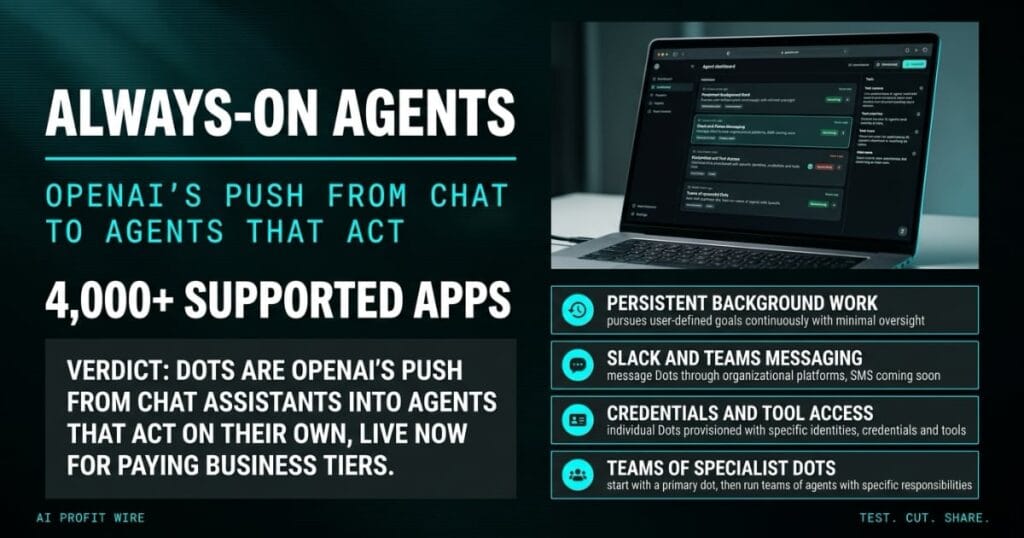
Unlike Codex or ChatGPT, Dots operate independent of any specific hardware or interface, pursuing user-defined goals in the background with minimal oversight. Each Dot runs on its own cloud computer, and The Verge reports it reaches more than 4,000 supported apps and a web browser from there.
Users start with a primary dot, give it a name, and can go on to run teams of Dots together, although for now each account can create 1 Dot. Dots is live for Pro and Business Premium users in eligible markets, and you can message a Dot through Slack, Teams, and other organizational platforms, with text message support coming soon.
Dots is OpenAI’s push from chat assistants into agents that act on their own, and it is live now for paying business tiers.
Does OpenAI Dots actually work?
The launch came with no performance benchmarks and no usage data, so the capability claim is unverified today.
OpenAI’s scenarios include a developer’s dot monitoring customer feedback and shipping bug fixes, and a scientist’s dot rerunning analysis as new experimental data arrives. The company says Dots carry built-in rules for when to act on their own, custom rules that block specific actions, and an auto-review step that checks whether an action complies with your rules before it completes, handing off tasks like password changes to the user.
Much of this functionality was already possible through Codex and similar agentic harnesses, which suggests Dots repackages existing capability with a focus on independent action rather than introducing a new technical breakthrough.
Treat the always-on claim as a product direction until third-party testing lands.
How is OpenAI Dots different from Codex and ChatGPT?
Dots runs in the background toward ongoing goals, while ChatGPT responds when you ask and Codex works inside a coding session you start.
You can message Dots through Slack, Teams and other organizational platforms, and users can launch Dots from Codex or ChatGPT. Codex itself got its own Dev Day refresh, with reusable cloud development environments accessible from any device and a new code review experience, which makes the boundary between the 2 products a scheduling choice rather than a capability wall.
Individual Dots can be provisioned with specific identities, credentials and tools through existing systems, and OpenAI is working with Microsoft to integrate into Agent 365 security controls. The persistence is the real difference: a session tool stops when you close it, and a Dot does not.
The real difference is persistence and access: Dots holds credentials and keeps working when you are not watching.
Who is OpenAI Dots actually for?
The first realistic users are small teams that already trust ChatGPT with daily work and want monitoring jobs handled without a human opening a laptop.
OpenAI’s own examples point at developer and analyst work: a dot that watches a feedback channel and ships fixes, and a dot that reruns analysis when new data lands. Those jobs share a shape, they are repetitive, they watch a stream, and they act on rules, which is the workload a 2-person consultancy or a 10-person product team can hand off first.
Teams already running OpenAI’s broader product stack will meet Dots where they already work, since the agents surface inside ChatGPT and Codex, and our coverage of always-on AI agents follows where that platform is heading. Teams outside the platform will be buying the whole platform to get 1 assistant, which is a harder sell.
The first Dot owners are teams already inside the OpenAI stack, and the first safe jobs are watching work, not judgment calls.
The new hire got a master key on his first morning, because the job listing said self-starter.
By Wednesday he had rewritten the filing system and answered 2 customer emails nobody asked him to touch. Every one of his changes made the office faster, and the second email quoted a price the owner had never approved.
That is Dots with credentials: 1 agent, more than 4,000 apps, and no manager in the room. OpenAI’s answer is Agent 365 controls and auto-review, which is the vendor admitting the handyman problem is real.
Should your team use OpenAI Dots yet?
Wait for the first wave of real usage reports before handing Dots any system with write access.
The Microsoft Agent 365 integration indicates that OpenAI treats unsupervised agent access as a security problem that needs external controls, and no benchmarks or community usage data exist yet to price the risk. The Verge’s Dev Day coverage pegs ChatGPT’s top paid tier at $500 a month, so the early buyer is a team already committed to the platform.
If you want to test it, start with a read-only task, like monitoring a feedback channel or rerunning a report, and keep every action that changes a customer-facing system behind your approval.
Pilot it on tasks where a mistake costs nothing, and expand access only after clean runs.
Source: TechCrunch AI
