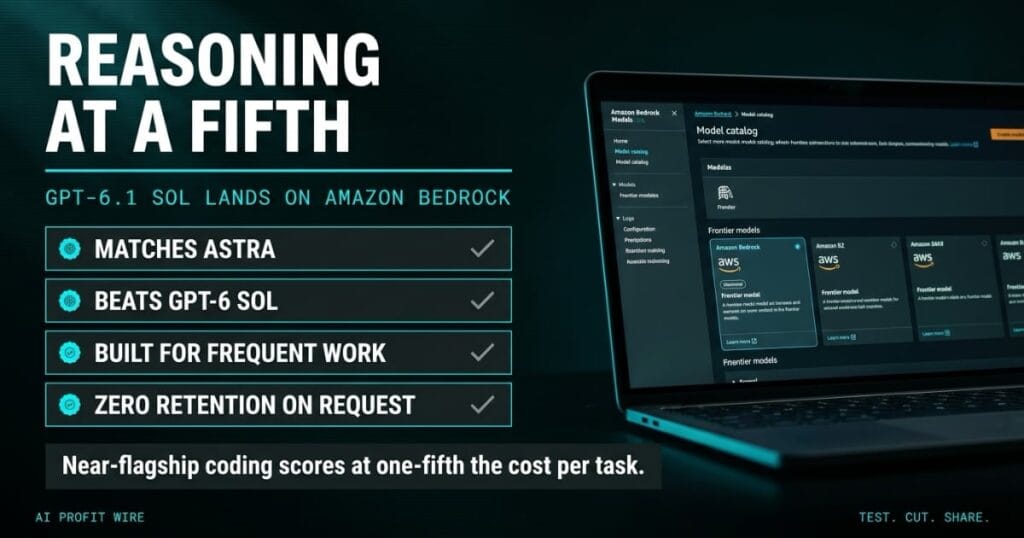
Can improve efficiency on automated coding and routine professional tasks run frequently on AWS.
What Is GPT-6.1 Sol on Amazon Bedrock?
GPT-6.1 Sol is now generally available on Amazon Bedrock, and AWS positions it for coding, computer use, and professional workloads that run frequently.
The model is a major upgrade to GPT-6 Sol, and OpenAI’s own announcement describes it as near-Astra intelligence for everyday work, which places it just under the firm’s flagship tier.
AWS announced the launch on the AWS Machine Learning Blog, and the model runs on an inference engine AWS built for performance, security, and reliability at scale.
The coding story is the practical entry point: Codex can be configured to use GPT-6.1 Sol on Bedrock for work spanning investigation, implementation, and testing, and AWS ships an Agent Toolkit that connects Codex to AWS documentation, APIs, and services through a single terminal command.
The short version: a flagship-adjacent OpenAI model is now rentable inside AWS accounts that already run on Bedrock.
Does GPT-6.1 Sol Actually Match Astra?
On the evidence AWS and OpenAI published, close: OpenAI states GPT-6.1 Sol matches GPT-6 Astra on the DeepSWE v1.1 agentic coding benchmark at roughly one-fifth the cost per task.
The same statement puts GPT-6.1 Sol 6.4 percentage points above the best score from GPT-6 Sol, achieved at a lower reasoning effort, which matters because reasoning effort is part of the bill.
OpenAI also reports gains on complex document analysis and multistep workflows across business tools, and improvements in transparency, user intent, and respecting explicit restrictions, the failures that force a human to intervene before an agent finishes a task with bad information.
These are vendor numbers on vendor-selected benchmarks, so the honest answer is probably close, test it, and the test costs one afternoon on a task you already measure.
GPT-6.1 Sol vs GPT-6 Astra: Which Model for Which Job?
Astra remains the flagship for your most ambitious agentic work, and AWS documents that model separately on Bedrock.
The pricing split is the decision input: Sol delivers Astra-matching coding scores at roughly one-fifth the cost per task, so every high-frequency workload sitting on Astra pricing is now a candidate for migration.
Computer use, long-horizon agentic work, and anything where a failure costs more than the token spread belong on the flagship, and frequent coding, document processing, and workflow automation belong on Sol.
Pick by cost per completed task, not by sticker price per token, because a model that reaches the answer in fewer steps changes the math twice.
Who Is GPT-6.1 Sol Actually For?
Teams already running production workloads on Bedrock are the audience, because the model plugs into existing IAM access controls, CloudTrail auditing, and VPC endpoints powered by AWS PrivateLink, with inference running on hardware-isolated infrastructure where no AWS staff member can read prompts and completions.
The data story is part of the fit: AWS states inference data is not used for model training, classifier-flagged traffic is retained for up to 30 days for automated abuse detection, and zero data retention is available on request, which matters for client-facing workloads.
Teams not on AWS can read the same launch as pricing pressure, because near-flagship reasoning at one-fifth the cost resets expectations across every model vendor, and you can compare it against per-token rates across the major model vendors before you move a workload.
The launch is aimed at builders running frequent workloads, and it prices the rest of the market down by comparison.
The monthly model invoice sits in the founder’s inbox while the agent stack that caused it runs 300 overnight tasks nobody watches.
Astra-grade quality at a fifth of the cost per task reorders that invoice, because the frequent, unglamorous work is where the tokens actually go. The 6.4 percentage point gap over the incumbent is the number the engineering lead checks, and the bill is the number the founder checks, and this launch claims both at once.
For a small team the lever is routing: give the recurring work the cheap reasoning and save flagship spend for the few tasks that genuinely need it.
Should You Switch to GPT-6.1 Sol?
If your workloads already live on Bedrock, run one high-frequency task through GPT-6.1 Sol and price the full task against your incumbent model, not the per-token rate.
The Amazon Bedrock documentation for OpenAI models lists supported regions, endpoints, APIs, features, inference profiles, and pricing, so check regional availability before you plan a migration.
Hold the flagship for work where failure is expensive, request zero data retention if the traffic touches client data, and let your own task metrics make the call.
If the first benchmark shows no gain on your tasks, the decision is made: the incumbent stays, and the invoice thanks you, because a model only earns its migration when the completed tasks come back faster or cheaper.
Switch the workload, not the company: migrate the one recurring task whose output you can measure, and expand from the result.
Source: AWS Machine Learning Blog
