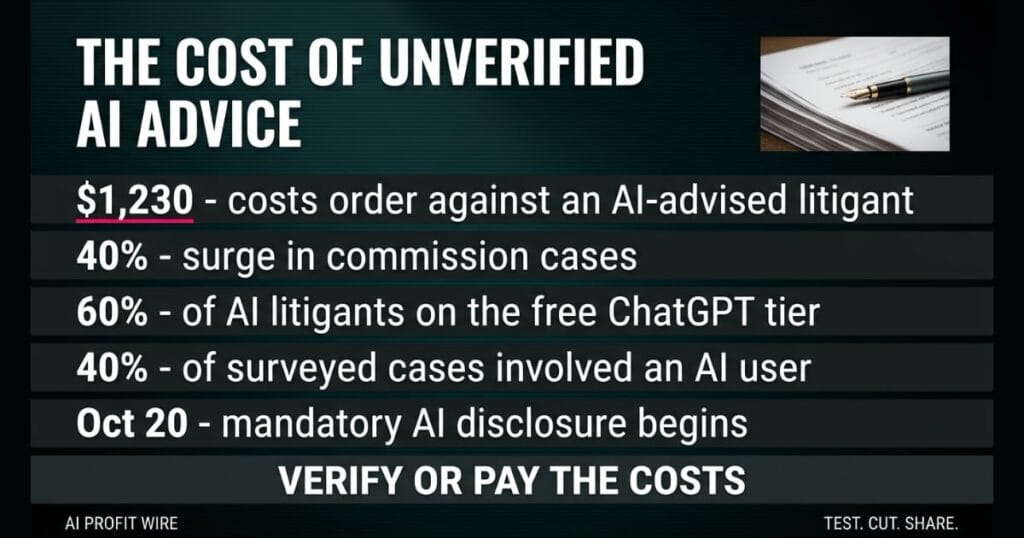
Using AI for employment law without professional verification can lead to costly legal errors and tribunal penalties.
Who does the Fair Work Commission AI warning apply to?
The warning applies to anyone preparing a document for a Fair Work Commission matter with generative AI, applicant or respondent, represented or self-represented. The commission’s new requirements state that they apply to all commission matters from October 20, 2026.
The trigger case is Sadnan Khan, a former ALDI employee who used AI as a “quasi-legal advisor” to challenge his dismissal. He was ordered to pay $1,230 toward the supermarket’s legal fees after continuing a case the tribunal had warned had no substantial prospects of success.
The commission’s own guidance page names the tools in scope, with ChatGPT, Claude, CoPilot, and Gemini as examples, and states the rule in one line: GenAI should not be used as a substitute for legal advice.
The rule covers every party in a commission matter, not just self-represented applicants.
Can AI legal advice get a Fair Work Commission case thrown out?
Yes, and the consequences now sit in writing on the commission’s own guidance page. Documents prepared with AI that skip verification can be given less weight or disregarded entirely, the case can be dismissed, and the commission can order you to pay the other side’s costs.
Research commissioned by the workplace umpire found its cases grew 40 per cent between 2023-24 and 2024-25, with generative AI in part responsible. In 40 per cent of surveyed cases a litigant was using AI, and of that cohort more than three-quarters used ChatGPT, with 60 per cent on the free version.
Mr Khan’s own filing contained the evidence against him, because he forgot to remove the AI chat instructions from his submission. Deputy President Michael Easton’s summary: “If Mr Khan had properly read his own AI generated replies … he would have known that his case was doomed.”
Unverified AI advice produces doomed cases and cost orders, and the tribunal is saying so publicly.
How is AI legal advice different from general AI research?
Research that turns out wrong costs you time, while a filing that turns out wrong costs you the case and sometimes the other side’s fees. Legal documents demand verified facts, real authorities, and current law, which is exactly where generated content fails.
The commission’s guidance spells out the failure modes plainly: incorrect facts, fake legal cases, misleading information, or outdated law. Genevieve Grant, a Monash University law professor quoted in the ABC’s coverage, adds that AI has a sycophantic tendency that encourages people to believe there are legs in a claim when there are none.
The counterexample in the same coverage is Gregory Baker, a Macquarie University computer science lecturer who became the first person to successfully challenge casual employment laws using a team of AI agents. He treated the filing like a software project, with a repository for his documents and a build process that checked every citation and the logical coherence of the argument.
The difference between winning and losing was a verification process, not the model.
What does the Fair Work Commission require a small business to do?
From October 20, 2026, any document prepared with AI for a commission matter must carry a disclosure and a completed verification. You tell the commission you used GenAI and how, you check the document yourself for accuracy against real evidence and legal authorities, and you state in the document that the checks were done.
The commission has published a copy-paste disclosure note that begins “GenAI was used in preparing this document”, and it has released set-up prompts designed to make the AI’s answers more balanced. Witness statements carry an extra bar: they must reflect the witness’s own knowledge and own words.
The consequences of skipping the requirements are listed on the same page: documents given less weight or disregarded, costs orders, or dismissal of the application. Employers responding to claims should hold their own filings to the same standard, because the requirements bind all parties.
Regulators formalizing AI rules this fast is exactly the pattern we track in the weekly signal briefings on compliance and automation shifts.
Disclosure, verification, and a stated check are now part of filing correctly.
The vendor on the phone swears the shipment is already on the dock, and the warehouse lead is standing in front of a pallet of gaskets that don’t fit a single engine in the catalog. His AI inventory audit came back 100 percent clean, so he never opened the boxes to check the part numbers.
The error costs nothing on Tuesday. It costs 3 waiting customer jobs on Friday, when the parts that were never really in stock hold up every schedule built on the clean report.
That is the $1,230 mistake in warehouse form: the summary said clean, nobody verified against the physical shelf, and the error surfaced at the most expensive possible moment. Outsourcing the thinking doesn’t save the time, it just delays the discovery of the mistake until it’s expensive.
Does the Fair Work Commission AI rule change anything for your business this quarter?
It changes 2 things: how any AI-drafted employment document gets checked before it leaves your business, and how seriously to treat an AI-built claim from a former employee. The tribunal acknowledges AI improves access to justice for meritorious claims and says sophisticated users treat it as one tool among many.
Professor Grant’s read is that a costs penalty is one of the limited tools courts have to send the community a message, and that standards for litigants will keep ramping up. The dividing line the commission keeps drawing is verification, and it will keep drawing it in public.
The practical rule for a small team without a lawyer on retainer: draft with whatever tool you like, verify every fact and citation against current law, and pay for a professional read before anything is filed. Mr Khan is appealing and says his plan for round 2 is to run “two or three” different AI agents.
Use the tool for drafting, keep the verification human, and never let a summary argue your case.
Source: abc.net.au
