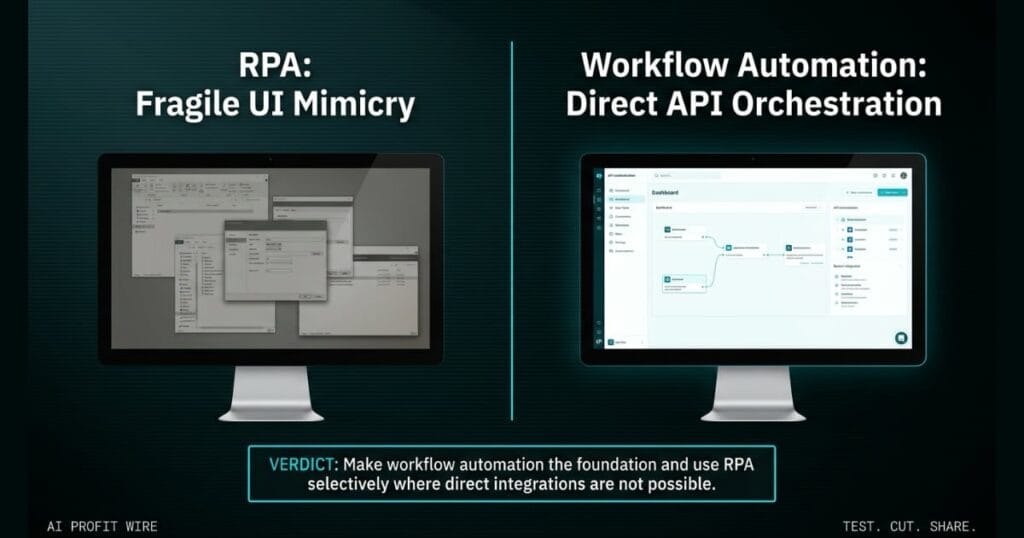
Choosing workflow automation over RPA reduces maintenance costs and prevents automations from breaking when software interfaces update.
What is RPA vs workflow automation and what changed?
RPA automates tasks by mimicking human actions inside a user interface, while workflow automation orchestrates underlying systems directly through APIs. The distinction dictates your maintenance costs and operational reliability.
RPA bots click buttons and navigate menus, which makes them inherently fragile. A minor interface update can break a bot and require immediate maintenance.
Workflow automation coordinates work using APIs, events, and business logic, which avoids the failure points tied to user interfaces and scales more easily.
Choosing workflow automation over RPA reduces maintenance costs and prevents automations from breaking when software interfaces update.
What is the evidence behind RPA vs workflow automation?
The evidence comes from technical comparisons of reliability, security, and scalability across both architectures. RPA platforms depend on frontend elements, while workflow platforms depend on direct system integrations.
RPA troubleshooting starts with understanding what happened on the screen, which takes time when pages load unexpectedly. Workflow platforms maintain explicit state and execution histories, making failures easier to audit.
Scaling RPA often means deploying additional bots and managing more infrastructure, while workflow automation handles larger workloads without relying on the user interface as an intermediary.
Workflow automation provides greater maintainability by leaning on APIs and modular business logic instead of fragile screen interactions.
How does RPA vs workflow automation compare to the alternatives, and what background do small business owners need?
RPA works well for legacy software that does not expose APIs, serving as a bridge when direct integrations are unavailable. Workflow automation is the better choice when you need to coordinate work across multiple systems.
Using UI automation when reliable APIs already exist is a recognized anti-pattern. Building high-volume processes around fragile screen interactions creates constant maintenance overhead.
RPA platforms typically store credentials in secure vaults because bots need to log into applications like a human user would, while workflow automation uses scoped API tokens that follow the principle of least privilege at the system level. The architectural split also changes how teams audit failures, since workflow platforms expose execution state and audit trails that RPA bots hide behind screen-level UI glitches.
Many organizations use workflow automation as the orchestration layer and reserve RPA for situations where a user interface is the only available integration point, which limits the impact of failures to a single step rather than the entire process.
Treat workflow automation as your foundation and use RPA selectively where direct integrations are not possible.
The banker’s box of receipts thuds on the desk as Lydia runs her monthly close macro, which clicks File, Import, CSV, in that exact order. The vendor shipped an update overnight that moved Import under a new Data menu, and the macro now dumps every receipt into a temp folder nobody can find.
Lydia’s reports are late by morning, and the consultant who built the macro has to log a ticket to rewrite the script. That is exactly how RPA fails inside modern systems. The bot depends on a frontend button staying put, and 1 interface update from a vendor you do not control breaks the entire flow.
Workflow automation bypasses the interface entirely and connects through APIs, which means a vendor can move every menu they want and your job still finishes. You need durable systems that survive software updates, not fragile bots that demand a specialist every time a developer ships a UI refresh.
How does RPA vs workflow automation affect day-to-day operations for small businesses?
Small business owners pay a real cost when RPA breaks on systems that already have APIs, because the constant need to fix broken bots drains time and resources. Workflow automation reduces human error and streamlines operations by coordinating business processes visibly, which lets you review audit trails and logs that show exactly where a process failed.
Building a workflow-first strategy starts with picking the right automation backbone for your stack, which means weighing API access, pricing models, and maintenance load before you commit. A platform that exposes triggers, databases, and conditional logic from a single interface beats stitching together fragile UI bots that break on every vendor update.
Building a workflow-first strategy reduces operational risk and limits the impact of failures to a single step.
What is the final verdict on RPA vs workflow automation?
RPA and workflow automation are not interchangeable technologies. RPA bridges UI gaps in legacy systems, while workflow automation orchestrates business processes across modern systems.
Small business owners should make workflow automation the foundation of their operations and use RPA selectively only when direct integrations are impossible. This combination streamlines operations while reducing the risk of human error and prevents minor interface updates from breaking critical business processes.
Make workflow automation the foundation and use RPA selectively where direct integrations are not possible.
Source: blog.n8n.io
