Understanding these pricing models helps small businesses avoid costly vendor lock-in and unexpected bills as automation usage grows.
What is n8n automation pricing and what changed?
n8n is a source-available, AI-native automation platform that gives small businesses deployment flexibility without penalizing sophistication. It runs on a fair-code licensing model, which means you can self-host the infrastructure and keep data in house rather than relying entirely on a vendor cloud.
The platform ships with over 1,000 pre-built integrations alongside community-created nodes, plus a drag-and-drop builder that lets developers drop into JavaScript or Python in a code node without leaving the platform.
Unlike cloud-only alternatives, n8n resolves the architectural tension between operational complexity and deployment control, so you can scale workflows from simple automations to complex AI orchestrations without hitting a per-task billing wall.
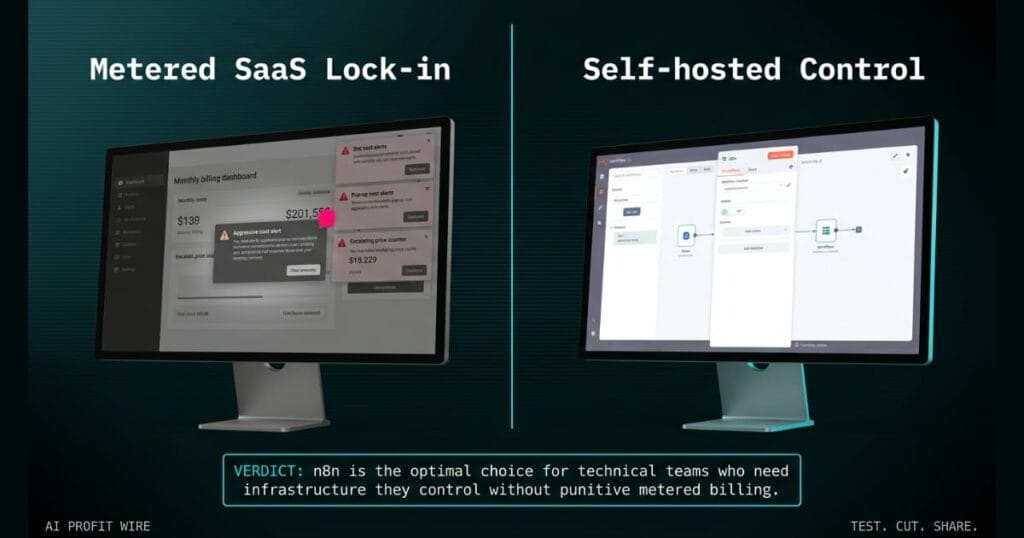
n8n changed the deployment paradigm by prioritizing self-hosted control over metered SaaS lock-in.
What is the evidence behind n8n automation pricing?
The evidence comes from a vendor comparison of 8 distinct architectural approaches to AI workflow automation. Zapier integrates with over 9,000 apps but charges per task, which gets expensive quickly at high volumes.
If you have more than 25 users on Zapier, you are forced into enterprise pricing where an automation running thousands of times a month risks hitting your annual task limit. Make uses a per-operation model where one busy multi-step scenario can quickly drain your operations budget.
Pipedream uses a credit-based pricing model tied to invocation and compute, so high-traffic workflows get expensive fast. Workato offers no self-hosting option, and if you want to leave, you have to rebuild recipes manually.
Per-task and per-operation pricing models create cost traps at scale.
How does n8n automation pricing compare to the alternatives, and what background do small business owners need?
Small business owners need to evaluate AI automation platforms based on deployment model, execution reliability, and integration depth. Zapier is built for non-technical teams running simple, low-volume automations, but caps agent usage at 400 times a month on lower tiers.
Make is a visual builder for small teams automating moderately complex app-to-app work, but hosts your data in its own cloud storage and requires higher tiers for role-based access control. Temporal is a code-first engine with no workflow canvas or app catalog, built strictly for engineering teams needing bulletproof orchestration.
Microsoft Power Automate is built for the Microsoft ecosystem and offers desktop robotic process automation, but pricing per user or per flow makes costs hard to predict as you scale. Apache Airflow handles scheduled batch jobs, not event-driven automation, and requires maintaining a group of platform engineers.
Founders must cross off any platform that does not solve their primary constraint without inflating costs.
The leased production printer hums through a client run at the print shop on Fifth Street, and the meter on the side ticks up like a taxi in rush hour. The lease charges per impression, not per finished page, so every jammed sheet, every calibration test, and every misfed cover counts against the monthly quota.
The owner watches a stack of test sheets disappear into the recycling bin before the run locks in, and the invoice still bills for every one of them. That is exactly how Zapier drains a small automation stack, because every half-finished run and every retry counts against your task quota. You scale past 25 users and the enterprise pricing tier opens automatically, even if half those runs were failures.
n8n flips the model by letting you self-host on infrastructure you already pay for, with 1,000+ integrations and a fair-code license that does not charge per execution. You need automation that scales with your business, not a meter that ticks every time a workflow hiccups.
How does n8n automation pricing affect day-to-day operations for small businesses?
Day-to-day operations suffer when a high-volume automation runs thousands of times a month and triggers unexpected enterprise pricing tiers on Zapier. Platforms that charge per execution create friction because half-finished runs and retries directly impact your monthly bill.
n8n handles execution reliability through error workflows and records every run in execution history, so you can debug failures cost-effectively. Your team can build production-grade agents with human-in-the-loop checks and error fallbacks without fearing a massive bill spike, and you can dig into more billing and pricing breakdowns across the wider automation landscape before you commit.
Internal access stays secure through single sign-on, role-based access control, and audit logs, which prevents the operational bottlenecks that show up on lower-level tiers of Make. These governance features matter when multiple users share workflows.
Operational resilience improves when you control the hosting environment and predict the execution costs accurately.
What is the final verdict on n8n automation pricing?
n8n provides an adaptable architectural foundation that avoids the per-execution cost traps found in Zapier, Make, and Pipedream. The fair-code licensing and JSON-based workflow export mean you are never locked into a cloud-only vendor ecosystem.
Small business owners can start self-hosting with the Community Edition today, or test n8n Cloud with a 14-day free trial. The platform scales from simple automations to complex AI orchestrations without leaving the platform, and you get enterprise-level governance features like single sign-on and audit logs without enterprise-only pricing.
n8n is the optimal choice for technical teams who need infrastructure they control without punitive metered billing.
Source: blog.n8n.io
