Implementing these techniques can reduce AI hallucinations in automated workflows, saving time on debugging and preventing costly errors in customer-facing or operational tasks.
What is chain-of-thought prompting and what changed?
Chain-of-thought (CoT) prompting elicits intermediate reasoning steps from large language models to arrive at a final response. It makes logic transparent, helping teams debug incorrect outputs and verify the validity of conclusions.
n8n allows teams to design these prompting techniques on a visual canvas without writing application code. All steps are visible, and teams can manage variations through native workflow primitives.
Users can start with deterministic Basic LLM Chain nodes for predictable results, then grow into AI agents. Agents use external tools to verify reasoning against real-world databases.
CoT prompting reduces clipped answers by simulating human logic and reducing complex problems into manageable parts.
What is the evidence behind chain-of-thought prompting?
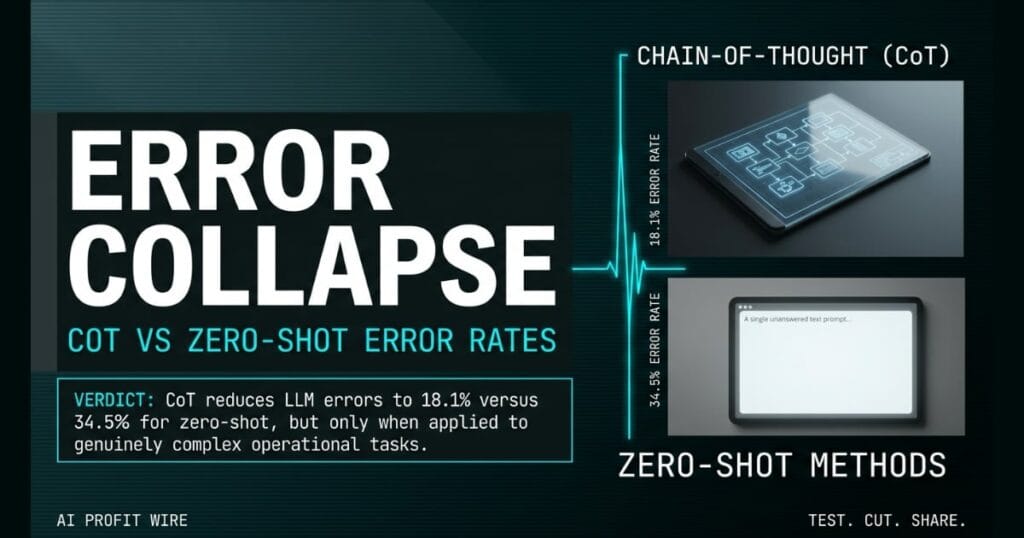
A study published by Frontiers Media SA showed CoT reduces LLM errors to 18.1% compared to 34.5% for zero-shot methods. The comparison focuses on multi-step reasoning tasks where intermediate steps catch mistakes that a direct answer misses.
The n8n platform provides execution history that makes reasoning chains fully inspectable. Each execution leaves a record of the full prompt and completion pair at every node, letting admins inspect the reasoning chain.
Teams can open the logs to see exactly where a model stumbled during its internal processing, which closes the gap between a confident output and a verifiable one.
n8n’s execution history provides the audit trail needed to verify CoT outputs in production.
How does chain-of-thought prompting compare to the alternatives, and what background do small business owners need?
Zero-shot CoT triggers reasoning without providing examples by adding simple instructions to the prompt. Developers use this to generate explanations for complex debugging tasks or algorithmic logic.
Few-shot CoT provides the model with 3 to 5 high-quality examples with intermediate reasoning steps. Business analysts use this for calculating break-even points or optimal production levels after a price increase.
CoT with self-consistency generates multiple reasoning paths and chooses the final answer through a majority vote. It mitigates one-off errors by averaging out individual logical missteps across 5 to 20 samples.
Step-back prompting instructs the system to abstract high-level principles before tackling the specific task. Thread-of-thought prompting keeps a coherent line of logic across 10 or more conversational turns.
Choosing the right CoT variation depends entirely on the query type and the specific operational use case.
The receiving dock log at the hardware distributor on Junction Boulevard shows 20 high-security deadbolt cylinders arrived Tuesday morning, but the bins underneath the counter are empty. The automated inventory system processed the delivery record and reported zero discrepancies, and the dashboard glows green for the third shift in a row.
A hidden defect in the math caused the system to subtract 10 returned units, add 12 backorder fills, and subtract 8 damaged skus in the wrong order, and the final count landed on a number that looked right. Standard zero-shot prompting does exactly this when you ask it a multi-step arithmetic question. The model spits out a confident answer without showing its work, and you discover the discrepancy during a customer emergency when 20 missing cylinders delay a job site install.
Chain-of-thought prompting forces the model to lay out 34 minus 10 plus 12 minus 8 in that exact order on the table, and n8n’s execution history logs every intermediate step at every node. When the final count comes out wrong, you open the log and see the exact node where the math broke down. The Frontiers Media SA study showed CoT reduces LLM errors to 18.1% compared to 34.5% for zero-shot, and that delta is the difference between a system you trust and a system you babysit.
How does n8n chain-of-thought prompting affect day-to-day operations for small businesses?
Implementing these techniques in n8n can reduce AI hallucinations in automated workflows, which saves time on debugging and prevents costly errors in customer-facing or operational tasks. Each run leaves a permanent record that an admin can replay step by step to isolate the exact node where reasoning failed.
However, using step-by-step instructions for simple tasks could hurt performance and reduce output quality. Factual lookups require fast answers and rarely need multiple steps, and forcing step-by-step reasoning on a basic query can encourage the model to second-guess itself.
Asking for step-by-step reasoning on a simple chatbot query creates unnecessary strain on processing and may push the model to hallucinate when its immediate answer would have been correct. Small business owners should map every prompt in their stack to the right CoT variation before they ship, because mismatched strategies cost both tokens and customer trust.
Small business owners must map CoT exclusively to complex tasks like arithmetic, symbolic logic, and code generation.
What is the final verdict on n8n chain-of-thought prompting?
n8n provides a robust, visual environment for building auditable reasoning chains without coding. The platform’s execution history and conditional branching make it highly practical for small business owners who need to verify every step a model takes.
The data shows CoT reduces errors to 18.1% compared to 34.5% for zero-shot, but only when applied to complex logic. Forcing CoT on simple tasks degrades output and encourages hallucinations, so founders must restrict the technique to genuinely multi-step problems.
Teams can iterate and test approaches with total transparency, which prevents costly mistakes in production and shortens the loop between a broken output and a fix.
n8n delivers a reliable framework for reducing AI errors, provided founders strictly limit CoT to genuinely complex operational tasks.
Source: blog.n8n.io
