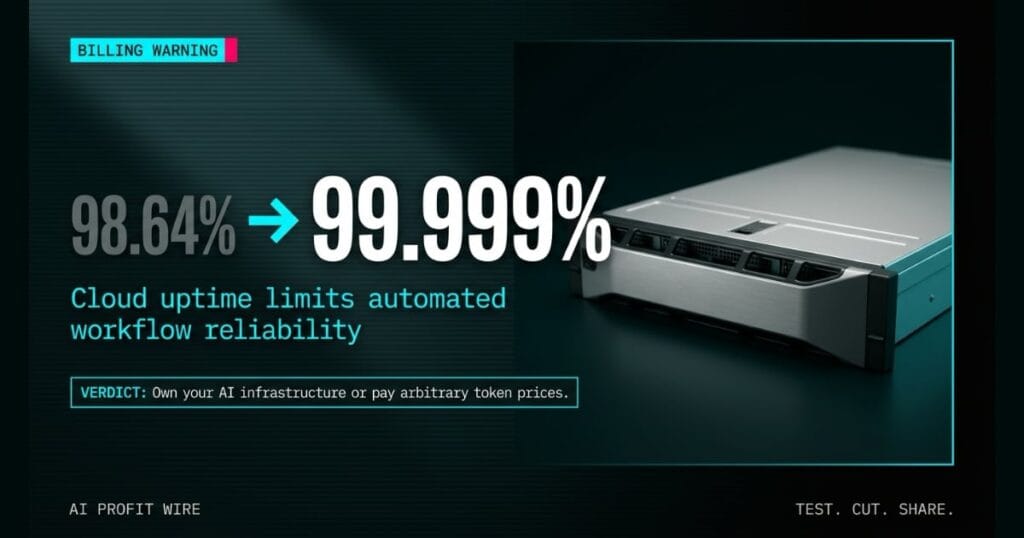
Self-hosting open-source AI models can lock in your operational costs and protect your business from unpredictable future token price increases.
What is self-hosted AI inference and what changed?
Self-hosted AI inference runs open-source large language models on infrastructure you control, which eliminates your reliance on arbitrary cloud token pricing.
Major AI providers subsidize token costs at a loss, which means prices will very likely increase once funds dry up and they must operate like a normal business.
Even Microsoft canceled its Claude Code licenses after finding the tool too expensive, despite developers preferring it over GitHub Copilot, which is the clearest signal yet that the subsidy era is ending.
You can avoid this billing trap by running production-ready tools like Ollama and vLLM, which lock in your operational compute costs instead of outsourcing spend decisions to a third-party provider.
Self-hosting open-source models is the only way to completely insulate your business from unpredictable token price hikes.
What is the evidence behind self-hosted AI inference?
The evidence points to rising dependencies and unstable cloud availability, which makes relying on external API endpoints a growing operational risk.
In 2026, Claude experienced an uptime of only 98.64%, whereas an industry-standard compute service maintains an uptime of 99.999%, which severely limits your reliability when outsourcing AI logic.
Agent logic is increasingly token-heavy due to tool calls and retrievals, and even a 10% token cost increase repeated 3 or 4 times forces a hard look at your financials.
You will not decommission an in-production chat support agent just because costs went up 10%, but compounding hikes make the math unavoidable.
The risk of arbitrary token price hikes and cloud outages makes self-hosted infrastructure a financial necessity for automated workflows.
How does self-hosted AI inference compare to the alternatives, and what background do small business owners need?
Self-hosting open-source models requires taking on the operational burden of infrastructure, which contrasts with the frictionless but expensive nature of frontier cloud models.
You can lease GPU infrastructure from providers like CoreWeave at approximately $4.76 per hour for H100s, with volume discounts for committed capacity.
Vast.ai offers the lowest headline prices, from around $0.17 per hour for older GPUs through a peer-to-peer marketplace, while RunPod and Lambda Labs cover the middle ground for production deployments.
Most organizations can achieve a strong balance between performance and resource consumption using 3B to 13B parameter range models at Q4 quantization, which run on a single consumer GPU.
For high concurrency needs, you can deploy vLLM as a production-grade server with continuous batching and PagedAttention, while SGLang handles structured JSON and tool calls for your automated workflows.
Infrastructure-as-a-service is a highly competitive and mature space, which provides stable alternatives to arbitrary token pricing.
How does self-hosted AI inference affect day-to-day operations for small businesses?
Day-to-day operations shift from simple API calls to active infrastructure management, which requires you to handle model deployment and resource utilization.
When you own the model endpoint, you control which model version is running and when it gets updated, which prevents unexpected breaking changes from external vendors.
Self-hosting also guarantees privacy because prompts and outputs never leave your environment, and tools like QLora allow you to customize small models to match state-of-the-art performance at a fraction of the size.
Small business owners can fold this approach into the AI signals they already track without rewiring the workflows around them, which keeps migration costs predictable.
Taking responsibility for your model infrastructure delivers total data privacy and absolute control over your operational updates.
A 12-truck moving fleet rolls 6 days a week on a third-party fuel-adjustment algorithm that quietly raised its per-mile rate 10% four separate times over the last billing cycle. The invoice hits and the owner watches the entire quarterly margin evaporate, because the routing logic was tied to a subsidized, loss-leader rate that nobody audited.
You cancel the vendor contract, lease your own fuel storage, and hire an internal dispatcher to calculate fixed rates based on actual usage. The per-mile cost stops fluctuating, but you now own the dispatcher’s training, the routing crashes, and every breaking change.
You can no longer point a finger at a vendor when the routing software crashes, and you eat the cost of every misrouted truck. That trade is necessary, because handing your margin to an arbitrary external meter is a guaranteed way to bleed out slowly.
What is the final verdict on self-hosted AI inference?
The final verdict is that self-hosting open-source LLMs is a mandatory operational shift for any business deeply integrated into AI automation.
Although you inherit the burden of infrastructure management and supply chain security, the alternative is exposing your core business logic to unpredictable price hikes and 98.64% uptime guarantees.
By deploying 3B to 13B parameter models at Q4 quantization on leased infrastructure, you secure stable compute costs and complete data privacy.
Own your AI infrastructure, or resign yourself to paying whatever arbitrary token prices your provider decides to charge next quarter.
Source: blog.n8n.io
