Simplifies AI tool management for SMBs but may disrupt workflows relying on deprecated experimental features.
What is Microsoft Copilot app merger and what changed?
Microsoft’s combining its separate consumer-facing Copilot app and the Microsoft 365 Copilot business app into 1 unified experience.
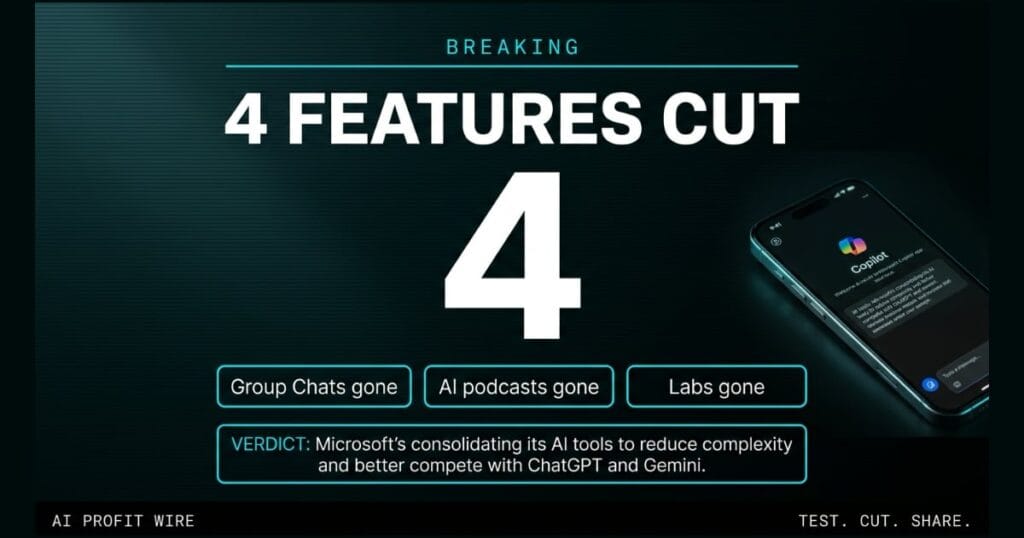
The company’s removing 4 specific features: Group Chats, AI-generated podcasts, Copilot Labs, and Deep Research. These changes take effect by August 18, 2026.
Paying professional users will receive a replacement for the Deep Research tool. Microsoft’s also removing the floating blob UI element named Mico, described internally as an AI-ified version of Clippy, to simplify the interface.
Microsoft’s consolidating its AI tools to reduce complexity and better compete with ChatGPT and Gemini.
What is the evidence behind Microsoft Copilot app merger?
TechCrunch reported that Microsoft EVP Jacob Andreou issued an internal memo regarding the app’s direction. The memo was initially surfaced by GeekWire and detailed in Microsoft’s support documentation.
Andreou stated the app needed to earn the right to exist in customers’ lives. This required ditching features that didn’t work to create a more cohesive experience. The Information first reported Andreou’s memo in July 2026.
The merger follows a broader pattern of consolidation seen across the AI app space. Claude merged Cowork into Chat, OpenAI merged its agentic feature Operator into ChatGPT, and Google added deep research and web browsing capabilities to its Gemini app.
Two years ago, Microsoft described AI as a generational shift in technology that it wanted to lead. Today’s consolidation is an admission that the prior split-app strategy failed to deliver on that ambition.
Internal leadership admitted the prior split strategy was too complicated for users.
How does Microsoft Copilot compare to the alternatives, and what background do small business owners need?
Microsoft’s merger is a direct response to the streamlined interfaces of ChatGPT, Claude, and Gemini.
Those competitors use a single entry point for most tasks, while Microsoft’s split between business and consumer apps created friction. The new unified app removes this barrier and acknowledges that personal and professional uses of AI often overlap.
Small business owners should note that files from the stand-alone Copilot app are migrating to OneDrive. This centralizes data but requires active storage management, and other features may temporarily disappear during the transition.
The merger shifts Copilot from a fragmented experiment to a streamlined productivity tool.
How does Microsoft Copilot affect day-to-day operations for small businesses?
The merger simplifies tool management by removing the need to switch between consumer and business versions of the app.
Business owners relying on Copilot Labs or AI podcasts for content will see those workflows break by August 18, 2026. You’ll need to find alternative tools for these specific tasks, and paying professional users gain access to a replacement for Deep Research called Researcher.
Files generated by the stand-alone Copilot app migrate to OneDrive, which centralizes storage but requires active management of your storage limits. You can compare related AI tooling shifts in our signals archive.
Simplified app access reduces onboarding time for new employees and lowers operational friction.
The sharp scent of peppermint disinfectant fills the lobby, but the air is cold from an overactive AC unit. The front desk staff is staring at a new patient scheduling system that requires a 20-hour certification course just to book a basic cleaning.
The tool’s supposed to save time, but the setup friction is so high that the staff spends more time in manuals than with patients. It’s an over-engineered solution that creates a bottleneck at the only point of entry for the business.
Microsoft’s previous split app strategy was that same over-engineered bottleneck. By August 18, 2026, they’re finally ripping out the 4 features that slowed down the user.
What is the final verdict on Microsoft Copilot app merger?
This is a necessary correction for a product that suffered from corporate over-engineering. The company is finally acknowledging that personal and professional AI use cases overlap, and that a single entry point beats a fragmented app portfolio.
The loss of experimental features is a small price for a tool that actually works across both personal and professional contexts. It removes the cognitive load of choosing which app to open, which matters more for productivity than any single feature addition.
Small business owners who built workflows around Copilot Labs or AI podcasts need to migrate before August 18, 2026. Everyone else gains a simpler tool that finally competes on usability with ChatGPT and Gemini.
The merger increases the tool’s utility by prioritizing a cohesive experience over a laundry list of unused features.
Source: TechCrunch AI
