Provides small businesses with a free, built-in tool to improve accessibility and communication with Deaf customers and employees.
What’s Google DeepMind SL2T and what changed?
Google DeepMind introduced SL2T, a massively multilingual sign-language-to-text translation model. It brings sign language AI out of the lab and into consumer products for the first time.
SL2T powers sign-to-text dictation in Gboard and Live Transcribe on Pixel 11, starting with American Sign Language to English. The feature is available at no additional cost, allowing Deaf users to sign to their phone anywhere they’d normally type.
More devices are coming soon, and additional languages will follow the initial rollout. You can sign to search the web, draft messages, or ask Gemini to execute tasks.
Google DeepMind SL2T changes mobile communication by turning sign language into streaming text for free.
What’s the evidence behind Google DeepMind SL2T?
The model is trained on over 100,000 hours of data across more than 50 sign languages. Roughly a quarter of the training data is in American Sign Language.
Training jointly on diverse languages, dialects, and proficiency levels causes the model to learn shared underlying structures. This approach outperforms single-language models in Google’s internal experiments.
SL2T achieves a zero-shot score of 70 BLEURT on the sd-test benchmark, which assesses ASL to English translation quality. This score is significantly higher than any previously reported score.
The evidence shows SL2T delivers high-quality translation by scaling diverse training data and bypassing intermediate annotations.
How does Google DeepMind SL2T compare to the alternatives, and what background do small business owners need?
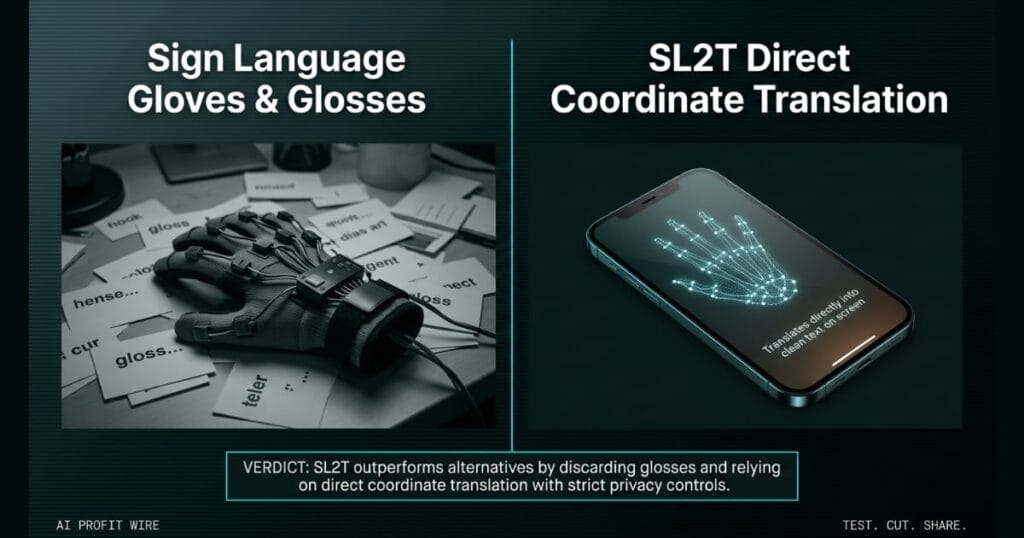
Previous attempts at sign language technology, like sign language gloves, were fundamentally limited because sign languages are independent natural languages with distinct grammars. They require true machine translation rather than a sequential process of sign-to-word transformations.
SL2T translates a sequence of pose landmark locations directly into text, bypassing intermediate annotations known as glosses. Glosses fail to capture rich, non-linear aspects of sign languages such as non-manual markers and spatial constructions.
To protect user privacy, an on-device model tracks the location of points on the signer, and only pose landmark locations are sent to the server for translation. The original video is discarded immediately, which offers a distinct privacy advantage over standard camera-based tools.
SL2T outperforms alternatives by discarding glosses and relying on direct coordinate translation with strict privacy controls.
How does Google DeepMind SL2T affect day-to-day operations for small businesses?
Small businesses gain a free, built-in tool to improve accessibility and communication with Deaf customers and employees. You avoid specialized software costs and reduce friction in daily interactions.
The model addresses practical issues like minimizing streaming latency and improving performance for one-handed signing. It also ensures fairness for the 10% of signers who are left-handed.
Integrating this into standard mobile keyboards expands your service capabilities. You can deploy this across your team today without purchasing additional hardware.
Small businesses can immediately deploy SL2T to cut communication barriers and software costs simultaneously.
A work order sits on the counter for a commercial client requesting a master key system replacement. The notes hide a critical detail: the client is Deaf, and your field locksmith struggles to text back and forth while holding a torque wrench.
The friction point is the delayed response, where typing complex security jargon with greasy hands kills the job’s momentum. You need a way for your locksmith to sign the technical specs and get instant text without buying expensive hardware.
Google’s new model handles this exact bottleneck by tracking simultaneous movements of hands, arms, torso, head, and face. It converts those pose landmark locations into text at no additional cost, letting your team communicate naturally on the job site.
What’s the final verdict on Google DeepMind SL2T?
SL2T provides immediate, cost-free operational value for small businesses. It translates sign language into text directly on mobile devices using massive data scaling.
The model achieves a 70 BLEURT score on the sd-test benchmark and prevents hallucination on non-signing inputs. It also ensures fairness for the 10% of signers who are left-handed.
You can deploy this feature today in Gboard and Live Transcribe to improve accessibility for Deaf customers and employees. It requires no new software purchases and protects user privacy by discarding raw video immediately.
Founders should deploy SL2T today to improve communication access at zero cost.
Source: Google DeepMind
