Prevents costly inventory miscalculations and overstocking by guiding businesses toward reliable AI implementations that protect revenue and optimize supply chain operations.
What are autonomous AI agents and what changed in demand forecasting?
Autonomous AI agents are large language models prompted to execute multi-step tasks, and they’re now failing at demand forecasting. The change is that teams are replacing statistical models with LLMs, only to discover the agents quietly perform worse than spreadsheets.
The core issue is that an LLM doesn’t have a feedback loop unless you manually build one. When November actuals come in 30 percent below the agent prediction, nothing in the system updates for the next run.
The agent reasons from the same context window every time and makes similar inferences from similar data. A context window is a hint, not a training signal, and you’ve no control over how the model weights that error data.
Autonomous agents fail at demand forecasting because they can’t self-correct their prediction errors.
What is the evidence behind autonomous agents failing at demand forecasting?
The evidence shows that autonomous agents hallucinate seasonal trends when given 18 months of weekly sales data. They generate plausible narratives instead of statistical confidence intervals, masking noise as fact.
With 18 months of data, you’ve only 2 observations of Q4, and no method can establish annual seasonality from 2 cycles. A forecasting library will tell you the data’s insufficient, but an agent will describe the pattern anyway.
The business case collapses because forecast error costs money asymmetrically and standard accuracy metrics hide it. Understocking a high-margin product costs far more than overstocking, and a stockout for a production line part costs multiples of its value.
Agents optimize symmetric error metrics like MAPE, which treats 100 units over and 100 units under as equally bad, destroying inventory margins.
How does the agent as orchestrator pattern compare to the alternatives, and what background do small business owners need?
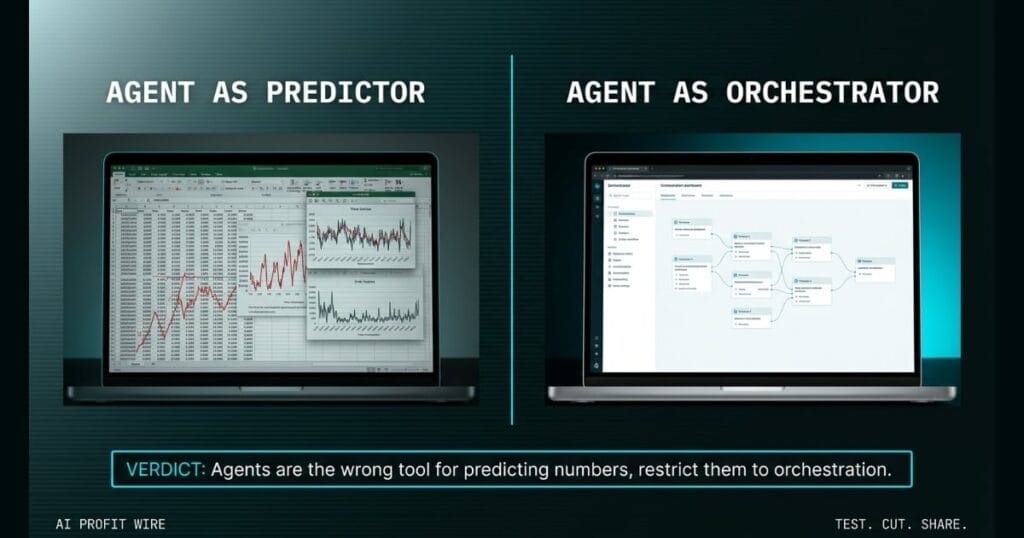
The working alternative is using the agent as an orchestrator wrapped around a dedicated statistical model. The numeric forecast comes from a backtested, versioned model, while the agent handles the surrounding context.
This division of labor means the statistical model handles numbers under uncertainty, and the agent handles data preparation and scenario runs. The agent can execute and compare a dozen scenarios in the time an analyst configures one.
Small business owners need to understand that serious forecasting systems optimize quantiles tied to a service level, deliberately biasing the forecast in whichever direction is cheaper to be wrong. You can’t prompt your way to a loss function.
Using AI as an orchestrator instead of a predictor is the only pattern that consistently holds up in supply chain operations.
How does AI agent demand forecasting affect day-to-day operations for small businesses?
Implementing these systems incorrectly leads to costly inventory miscalculations and overstocking for small businesses. You’ve got to beat a naive baseline first, like same period last year adjusted for trend, before trusting any system.
Many sophisticated systems fail to beat this baseline because nobody checks it. You must keep the override path active and log every time a human overrules the forecast.
That log becomes the most valuable dataset you can build, serving as the only honest record of whether the system’s trusted. This operational discipline prevents costly supply chain errors from compounding.
Small business owners must log every forecast override to capture the true cost of AI prediction failures.
The crackle of the two-way radio cuts through the dispatch office as a 3 axle rig sits idling at the loading dock. The automated routing agent promised a 30 percent efficiency gain, but it hallucinated a seasonal traffic pattern from 2 weeks of data and scheduled 12 deliveries into a bottleneck. The dispatcher stares at the screen, realizing the system treated a 100 minute early arrival and a 100 minute late arrival as the exact same penalty.
The agent reported complete success, and the generated routes look completely reasonable on the dashboard map. But it lacks a feedback loop to know that dock 4 only handles 2 pallets an hour, and now 4 drivers are burning diesel while waiting for a single forklift.
You can’t prompt your way out of a physical constraint. You need a routing algorithm that backtests against actual dock throughput, using the AI only to flag the exceptions and log why the dispatcher had to step in.
What is the final verdict on autonomous agents in demand forecasting?
The hard part is organizational, because forecasting and LLM engineering are different disciplines with opposing habits. The projects that skip the evaluation harness tend to be the ones being quietly rebuilt a year later.
Forecasting people are suspicious of anything that can’t be backtested, while agent people ship on prompt iteration. You must settle what better means while it’s still an argument about metrics.
If you build the agent and the model before defining the evaluation, both teams will optimize different things. The system everyone signed off on will quietly lose to a spreadsheet.
Autonomous agents are the wrong tool for predicting numbers from a time series, and small business owners must restrict them to orchestration roles.
Source: AutoGPT Blog
