Small businesses relying on Substack for newsletters may need to adjust their content strategies to maintain reader trust as AI usage becomes visible.
What is Substack AI detection and what changed?
Substack launched a new feature that scans content to estimate how much was written by AI versus a human, running directly in the Substack app on posts, comments, and replies.
The platform also introduced an optional AI author’s note, allowing writers to disclose their creation process before the Pangram algorithm flags the text.
Substack CEO Chris Best stated that software should do everything for the writer except the hard part, which is having an idea worth reading and sharing.
Substack exposed AI usage directly to the reader, shifting from assumption to measurable data.
What is the evidence behind Substack AI detection?
The feature uses Pangram detection software to analyze any text longer than 100 characters within the app, giving readers an estimate of human versus AI content composition.
The company told TechCrunch that the tool isn’t designed to prohibit or penalize AI-assisted writing, but rather to encourage writers to explain their process through a ‘how I make this’ statement.
Publishers can also run Pangram on their own drafts before publication, and report and remove scans on their own work if they believe the detection software made a mistake.
The evidence shows Substack is encouraging disclosure over prohibition, with tools for writers to audit and dispute their own scores.
How does Substack AI detection compare to the alternatives, and what background do small business owners need?
Substack joins several platforms leaning into AI labeling as generated photos, videos, and music become more prevalent across social media and streaming services.
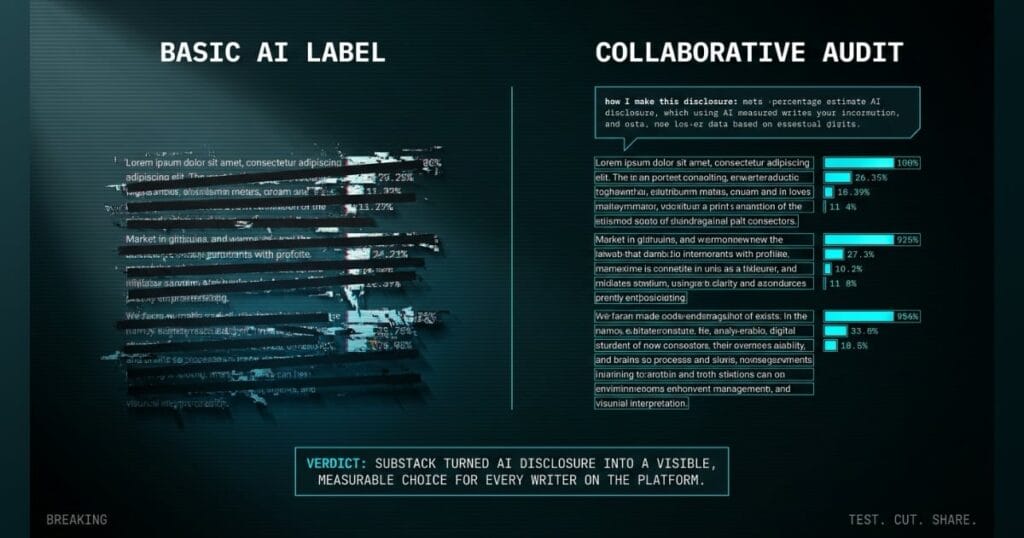
Unlike platforms that attach a blanket AI label, Substack allows publishers to run Pangram on their own drafts before publication, giving writers a preview of what readers will see.
Writers can also report and remove scans on their own work if they believe the detection software made a mistake, adding a dispute layer that basic filters lack.
Substack offers writers the ability to audit and dispute their own detection results, rather than accepting a one-way label.
How does Substack AI detection affect day-to-day operations for small businesses?
Small business owners using Substack for newsletters now have their AI usage visible to readers as a measurable estimate on any content above 100 characters.
Founders who rely on AI to draft posts can use the optional AI author’s note to disclose their process before the Pangram scan displays the results to their audience.
You can run the Pangram scan on your own drafts before publishing to see what your readers will see, and dispute any results you believe are mistakes. For more tools that optimize your content workflow, check out NeuronWriter’s AI content optimization capabilities.
Founders publishing on Substack need to decide whether to disclose their AI process voluntarily or let the Pangram estimate speak for them.
A boutique fitness studio sends a weekly newsletter to 2,000 subscribers with workout tips and class schedules. The owner uses AI to draft the initial outline, then edits each section by hand before sending. Under the new Pangram scan, that newsletter might show a 40 percent AI estimate because the structural skeleton still carries AI fingerprints, even after human editing.
The owner adds the optional AI author’s note explaining the process: AI outlines the structure, and the coaching team writes the final advice. Readers see the disclosure before the algorithm’s estimate, which preserves the trust built over 200 weekly editions.
The alternative is letting the scan display the raw percentage without context. Readers who see ’40 percent AI’ without explanation might question whether the workout tips came from a machine or a coach who’s actually in the gym.
What is the final verdict on Substack AI detection?
The launch makes AI usage a visible metric on Substack, with the 100-character threshold catching posts, comments, and replies alike.
Writers who proactively disclose their process through the AI author’s note give readers context before the Pangram estimate appears, while those who don’t leave the interpretation to the algorithm alone.
Substack turned AI disclosure into a visible, measurable choice for every writer on the platform.
Source: TechCrunch AI
