Small businesses can leverage proactive AI agents in Slack to drastically reduce software development time and costs, allowing non-technical teams to query codebases and automate routine engineering tasks.
What is Claude Tag and what changed?
Claude Tag is Anthropic’s multiplayer Slack integration, launched the week of July 14, 2026, that proactively handles engineering tasks inside team channels.
Unlike Claude Code, which requires manual kickoff, Claude Tag monitors bug reports in Slack, drafts PRs, and tags the engineer who last touched the affected codebase without manual prompts.
The tool ships with team memory, so preferences stated in natural language in a channel get applied to every future PR in that channel, and Anthropic views it as the evolution of Claude Code.
Claude Tag shifts AI from a reactive assistant to a proactive team member inside Slack.
What is the evidence behind Claude Tag?
Cat Wu and Thariq Shihipar from Anthropic’s Claude Code team confirmed in a fireside chat with Simon Willison on July 21, 2026, that Claude Tag lands 65% of internal product engineering PRs.
That 65% figure applies specifically to Anthropic’s Claude Code product engineering team, not all of Anthropic. The team also reduced their Claude Code system prompt by 80% for frontier models Fable and Opus 4.8 by replacing hard constraints with broader context.
The Claude Code team built trust in automated code review over a 6-plus-month process, with code owners manually reviewing critical changes to the system prompt while Claude handles outer-layer code review fully.
Anthropic’s own engineering data shows proactive agents can autonomously handle 65% of routine product engineering work.
How does Claude Tag compare to the alternatives, and what background do small business owners need?
Claude Tag extends Claude Code from an individual interactive tool into a proactive team layer that runs continuously inside Slack channels. Claude Code remains the recommended tool for complex, interactive tasks where engineers iterate closely with the agent, while Claude Tag handles the proactive, routine maintenance work that bogs down development cycles.
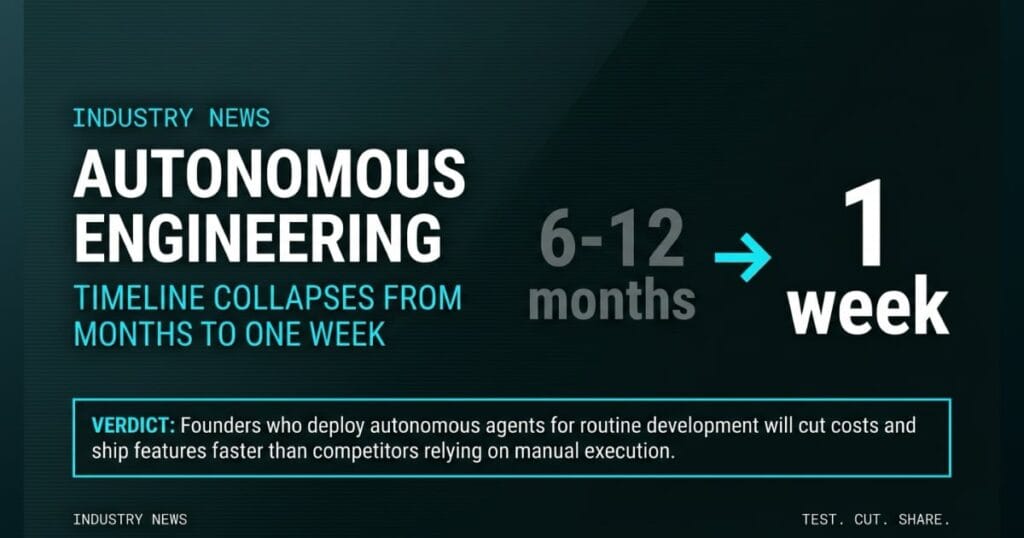
Cat Wu noted that the timeline between conceiving a feature and deploying it has collapsed from 6 to 12 months down to possibly 1 week, forcing engineers to develop business sense and product taste over raw execution skills. Anthropic’s internal data shows the team spent a 6-plus-month process building eval infrastructure before they trusted automated code review on outer-layer changes.
The 80% system prompt reduction parallels OpenAI’s own GPT-5.6 prompting guidance, which Simon Willison flagged in the same post: leaner prompts improved evaluation scores by roughly 10 to 15%, reduced total tokens by 41 to 66%, and cut cost by 33 to 67%. Both frontier labs are now converging on the same prompt-design shift, which founders should mirror in their own agent deployments.
Claude Tag and Claude Code split engineering work into proactive routine fixes and interactive complex work, with humans reserved for core architecture review.
How does Claude Tag affect day-to-day operations for small businesses?
Small business owners can deploy proactive AI agents in Slack to monitor bug reports, draft PRs, and answer non-engineering questions about the codebase.
Anthropic’s own marketing team uses Claude Tag to clone the codebase and ask plain-language questions about product features, removing the bottleneck of pulling engineers off high-value work to explain how something works.
Founders tracking autonomous agent signals from the AI Profit Wire can model the same split on a smaller team, with the agent handling routine fixes while humans own architecture review.
Founders who deploy proactive agents in their team channels recover engineering hours currently lost to manual bug triage and codebase questions.
A maintenance ticket hits the property management Slack at 11 PM: the HVAC unit in unit 4B failed, and the tenant is asking for a status update in the morning. Your on-call tech is across town on a burst pipe, and you are paying him time-and-a-half to triage tickets by hand.
You tell a Claude Tag-style agent to monitor the maintenance channel, draft a work order, and tag the tech who last serviced 4B. By the time you log in at 7 AM, the agent has filed the work order, pulled the service history, and flagged the warranty status on the failed compressor.
That is the 65% shift Anthropic reported internally, translated to a 12-unit property portfolio. The agent handles the routine intake work, and the human tech shows up with the right part and the full service history loaded on his phone.
What is the final verdict on Claude Tag?
Claude Tag proves that proactive, autonomous AI agents can handle 65% of routine engineering work inside Slack, with team memory and proactive monitoring built in.
Anthropic’s own data shows a 6-plus-month investment in eval infrastructure and code review automation was required to trust the system with outer-layer changes.
The system prompt reduction of 80% for frontier models confirms that modern AI models need context, not rigid rules, to operate autonomously at this level.
Founders who deploy proactive agents for routine engineering work will cut development time and free their humans for architecture and product taste.
Source: simonwillison.net
