This signals a major shift in how platforms protect digital assets, impacting small business owners who rely on content monetization and need to safeguard their intellectual property.
What’s Patreon’s AI Crawl Control and what changed?
Patreon shifted from passively asking AI bots not to scrape its platform to actively blocking them using Cloudflare’s technology.
The platform first put measures in place to deter AI crawlers in 2023, but scraping has become more sophisticated. Patreon is now using Cloudflare’s AI Crawl Control to update its enforcement, moving away from the standard robots.txt file which relies on bots to behave voluntarily. The shift also reflects new discovery surfaces like Patreon’s redesigned Home Feed and tweet-like Quips, which expose more content to crawlers than the paywalled back catalog did. Patreon’s paywall historically locked most creator content out of reach, but the new surfaces opened fresh attack vectors that the 2023 robots.txt could not cover.
Passive requests are dead, and hard infrastructure blocks are the new standard for protecting digital assets.
What’s the evidence behind Patreon’s AI Crawl Control?
The evidence comes from direct testing of the new blocking features, which completely eliminated unauthorized bot access.
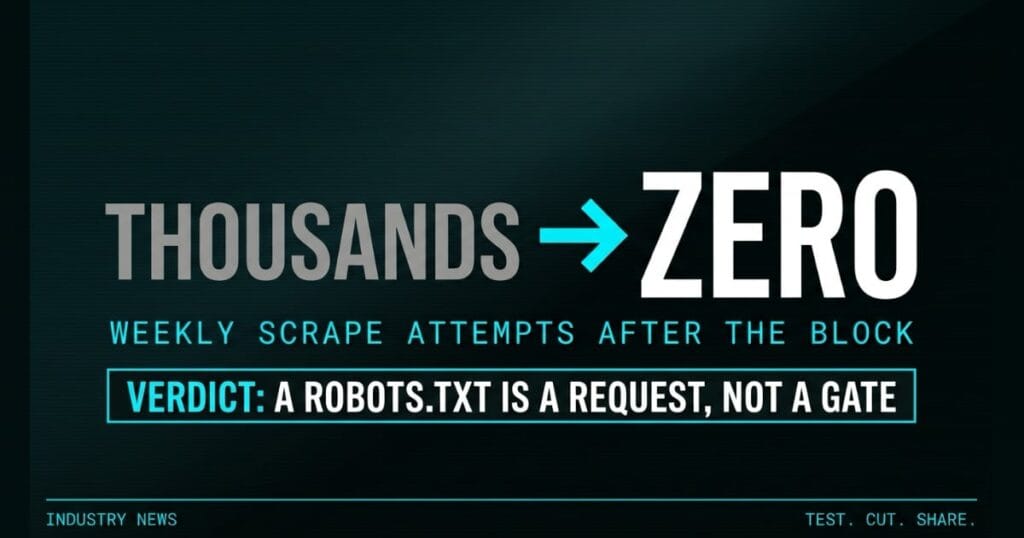
During testing, individual AI training crawlers’ weekly attempts to access Patreon went from thousands of attempts to zero. This proves that AI scrapers were actively ignoring Patreon’s previous robots.txt file and scraping the site anyway despite its requests. The company noted that consent shouldn’t depend on whether a scraper chooses to behave, which reframes bot compliance as a platform decision, not a bot decision. The drop from thousands to zero is the cleanest proof point a small business owner can cite when arguing for infrastructure-level enforcement over a polite text file.
Allowing bots to self-regulate resulted in thousands of weekly content thefts, while active blocking drove that number to zero.
How does Patreon’s AI Crawl Control compare to the alternatives, and what background do small business owners need?
Patreon’s approach distinguishes between bots that steal content and bots that drive traffic, unlike a blanket block which would hurt discovery.
The platform will still allow bots that index pages and organize information to send users back to Patreon. This selective blocking is necessary because new discovery tools like a redesigned Home Feed could expose more content to crawlers, and a blanket block would kill organic reach. Cloudflare now offers tools that allow website publishers to block AI bots, including a prototype dubbed Pay Per Crawl, and changed its default settings so that mixed-use crawlers are blocked on pages that host ads. Pay Per Crawl opens a third path between full block and full open: charge the bot for the right to scrape, which turns unauthorized training into a revenue line for publishers.
Selective blocking protects paid intellectual property while still allowing search indexing to drive audience growth.
The 6am alarm unlocks the print shop’s front entrance, and the morning shift finds the same competitor’s associate crouched in the corner photographing your custom stencil library with their phone. The “No Photography” sign has been on the door for 3 years, and they’ve ignored it every Tuesday morning. Patreon just proved that AI bots ignore polite requests and scrape everything in sight. Their weekly theft attempts fell from thousands to zero only because they deployed a hard infrastructure block through Cloudflare. Leaving your intellectual property on a public URL with a robots.txt file is exactly what got those stencil designs leaked to every discount print shop in town. You need a locked showroom, not a “please don’t photograph” sign on the door.
How does Patreon’s AI Crawl Control affect day-to-day operations for small businesses?
Small business owners who monetize content must recognize that relying on a robots.txt file is no longer a viable defense against AI training bots.
Your digital products and premium content are vulnerable to ingestion if you rely on passive requests. Implementing infrastructure-level blocks, like the tools Cloudflare provides, is necessary to prevent AI models from training on your work without permission. You can review more infrastructure enforcement updates in the signals archive to audit your own site’s vulnerability. The same logic applies to gated courses, member-only podcast feeds, and downloadable templates: if a bot can fetch the URL, it will fetch the URL, and a robots.txt file is a request, not a gate.
Founders must shift from requesting bot compliance to enforcing hard technical boundaries on their digital assets.
What’s the final verdict on Patreon’s AI Crawl Control?
Patreon’s implementation proves that active blocking is the only effective way to stop AI bots from scraping protected content.
The transition from a 2023 passive request to a hard block reduced weekly scraper attempts from thousands to zero. It sets a clear precedent that platforms and founders must use infrastructure tools to protect their digital assets from unauthorized training. Cloudflare’s Pay Per Crawl marketplace also gives small publishers a monetization path that did not exist 12 months ago, which makes the active-block decision strategically richer than simply locking bots out.
If you operate a digital business, you must implement active bot blocking or accept that your content will be stolen.
Source: TechCrunch AI
